
Superforecasting: The Art and Science of Prediction, by Philip Tetlock and Dan Gardner, came out on 29 September 2015. It told the world about superforecasters, a small minority of people who predict world events more accurately than others and keep doing so year after year. On 30 September 2025, Émile Servan-Schreiber marked the tenth anniversary with a confession: his company had come across something similar almost a decade before the book, and had not realised what it had.
How superforecasters were found
The book grew out of the Good Judgment Project, a team led by Tetlock that competed in a geopolitical forecasting tournament funded by IARPA, the US intelligence community’s research agency. Thousands of volunteers forecast questions such as elections, conflicts and economic indicators. The team noticed that the top performers in one year’s tournament tended to be at the top again the next year, and the year after.
That persistence was the discovery. If the best forecasters had simply been lucky, they would have fallen back towards the average. They did not, which suggested that forecasting is a stable skill rather than chance. As Servan-Schreiber put it, that was not the obvious proposition ten years ago that it is today.
Servan-Schreiber’s company, then called Lumenogic, played a small part in this. According to Hypermind’s history, Tetlock asked the company in 2012 to join the Good Judgment Project and contribute its prediction-market expertise. NewsFutures had been founded by Servan-Schreiber and Maurice Balick in 2000 and renamed Lumenogic in 2010. Its successor, the Hypermind prediction market, launched in May 2014 with the aim of building its own panel of top forecasters.
A 2006 market for LCD televisions
Over the anniversary weekend, Servan-Schreiber went through old slide decks from NewsFutures projects of the 2000s. One covered a 2006 corporate prediction market about LCD televisions. It asked how far consumer prices would fall and how falling prices would affect demand for 32-inch and 37-inch screens.
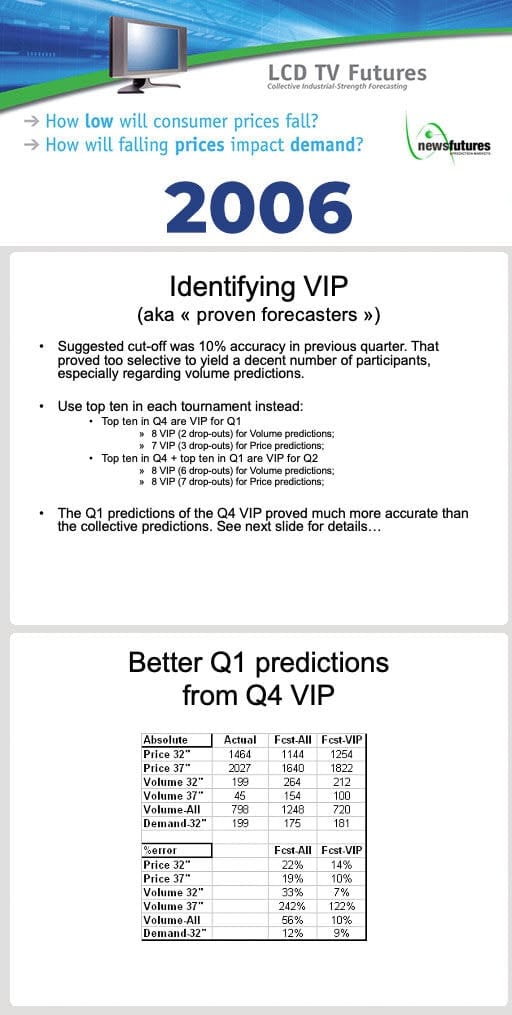
The slides describe a problem and a fix. The plan had been to single out participants who had been highly accurate in the previous quarter. That cut-off proved too strict to leave enough people, so the team instead took the top ten in each quarterly tournament and called them “VIPs”, or “proven forecasters”. The forecasts of the fourth quarter’s VIPs for the first quarter of the next year were then compared with the forecasts of the whole crowd.
The VIPs did markedly better. Their percentage error was 14% against the crowd’s 22% on the price of 32-inch sets, and 10% against 19% on 37-inch sets. On total volume it was 10% against 56%. The two groups were closest on demand for 32-inch sets, at 9% against 12%. One small corporate market proves nothing in general. But the pattern is the same one that later defined superforecasters: past accuracy predicts future accuracy, so it pays to listen most to the people who have already been right.
Servan-Schreiber compared himself to the Vikings who reached the Americas centuries before Columbus. They stumbled onto something new, did not recognise it and moved on. In his view the credit rightly goes to Tetlock’s team, who recognised what they had found and told the world. The real discoverers, he wrote, are those who live to tell.
From superforecasters to machines
A few days before the anniversary, Servan-Schreiber shared an essay in Newsweek by Marcus Weldon. It traces forecasting research from Tetlock’s perspective: his early study of expert predictions, the distinction between single-theory “hedgehogs” and eclectic “foxes”, the wisdom of crowds and the Good Judgment Project. It then turns to large language models. Weldon reports research findings that teams of forecasters outperform individuals, that interacting with an AI assistant improved human accuracy, and that crowds of language models can match average human crowds. He quotes Tetlock:
It is absolutely crucial to integrate LLMs into almost all lines of inquiry
Philip Tetlock, quoted by Marcus Weldon in Newsweek
Weldon’s essay ends by suggesting that human–AI cooperation may help people become “super- or even ultra-forecasters”. Servan-Schreiber’s answer was that this is why The Forecasting Machine combines an ensemble of language models, and that it is available now. The same logic runs from the 2006 market to the ensemble: find the sources that have been reliably right, combine them well and keep score.