
In the weeks after The Forecasting Machine opened to the public in September 2025, Émile Servan-Schreiber posted several of the questions he had put to it, along with the machine’s written rationale. Three of them were very different: a budget standoff in Washington, a proposed coin and the future of late-night television. A year later, two have known outcomes. Looking back at them shows how the machine reasons about an open question, including where that reasoning went wrong.
How long would the shutdown last?
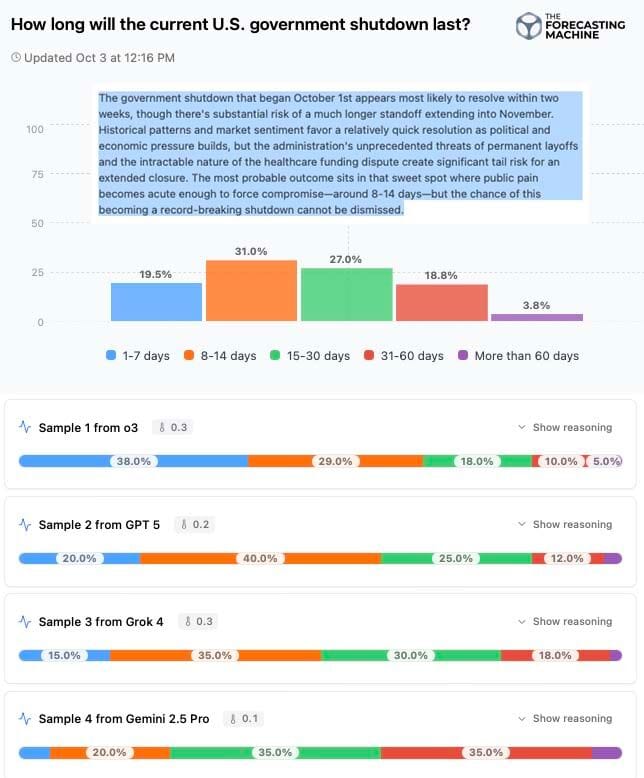
The US federal government shut down just after midnight on 1 October 2025, when Congress failed to pass funding. On 3 October, Servan-Schreiber shared the machine’s forecast of how long it would last:
- 1–7 days: 19.5%
- 8–14 days: 31.0%
- 15–30 days: 27.0%
- 31–60 days: 18.8%
- More than 60 days: 3.8%
The single most likely band was one to two weeks, in line with past shutdowns. But the rationale stressed that the total probability on longer outcomes was nearly half. It attributed this to an unprecedented standoff and to an administration willing to use tactics earlier presidents had avoided. It ended on a pointed line:
dysfunction has become so normalized that a month-long government shutdown registers as merely concerning rather than shocking
The Forecasting Machine’s rationale, 3 October 2025
The shutdown ended on 12 November 2025, when President Trump signed a funding bill after a 60–40 Senate vote and a 222–209 House vote. According to PBS NewsHour, it lasted 43 days, the longest on record, beating the 35-day shutdown of 2018–19.
The outcome fell in the 31–60-day band, to which the machine had given 18.8%. Its most likely band was wrong. Its warning that a long, record-setting standoff was a real possibility was right. One of the individual models in the ensemble, Gemini 2.5 Pro, had put roughly a third on the 31–60-day band, judging by the published chart. That shows the spread of views that aggregation smooths out.
Would the Treasury mint a Trump dollar coin?
On 4 October 2025, after reports of a draft design, Servan-Schreiber asked whether the US Treasury would mint a $1 coin featuring Donald Trump for the 250th anniversary of independence in 2026. The machine said yes 32.5%, no 67.5%.
Its rationale weighed a plausible legal route, the 2020 Circulating Collectible Coin Redesign Act, against an 1866 ban on depicting living persons. It argued that legal challenges could easily delay the coin past 2026.
That reasoning was wrong. According to the United States Mint, 250,000 Trump dollar coins were struck in Philadelphia on 4 July 2026 with a “July 4th” privy mark. The Mint cites authority under Public Law 116-330, the 2020 act the machine had named. Rolls and bags went on sale on 2 September 2026, with release into circulation planned for the autumn.
Giving roughly one in three to something that happens is not a disaster. Events at that level should happen about a third of the time. But in hindsight the rationale overrated the legal obstacle and underrated the administration’s room to act. That is the kind of error a growing track record should reveal and correct.
Which late-night host would be cancelled next?
On 21 September 2025, days after ABC suspended Jimmy Kimmel and two months after CBS announced the end of The Late Show with Stephen Colbert, Servan-Schreiber asked which host would be cancelled next. The machine’s answer spread the risk across five hosts: Jon Stewart 33.3%, Seth Meyers 29.2%, Jimmy Fallon 16.8%, Bill Maher 10.5% and John Oliver 10.3%.
Its reasoning was that political pressure had replaced ratings as the main threat. It argued that hosts on subscription channels such as HBO were safer than those on broadcast networks, and that Stewart’s direct provocation of the administration made him the likeliest target. Servan-Schreiber noted in the comments that he had misspelled Stewart’s first name and the machine had corrected it.
This one is still open. A Deadline report in August 2026 said none of the five had been cancelled, with Fallon and Meyers under contract through 2028. We will not score the question until it resolves.