
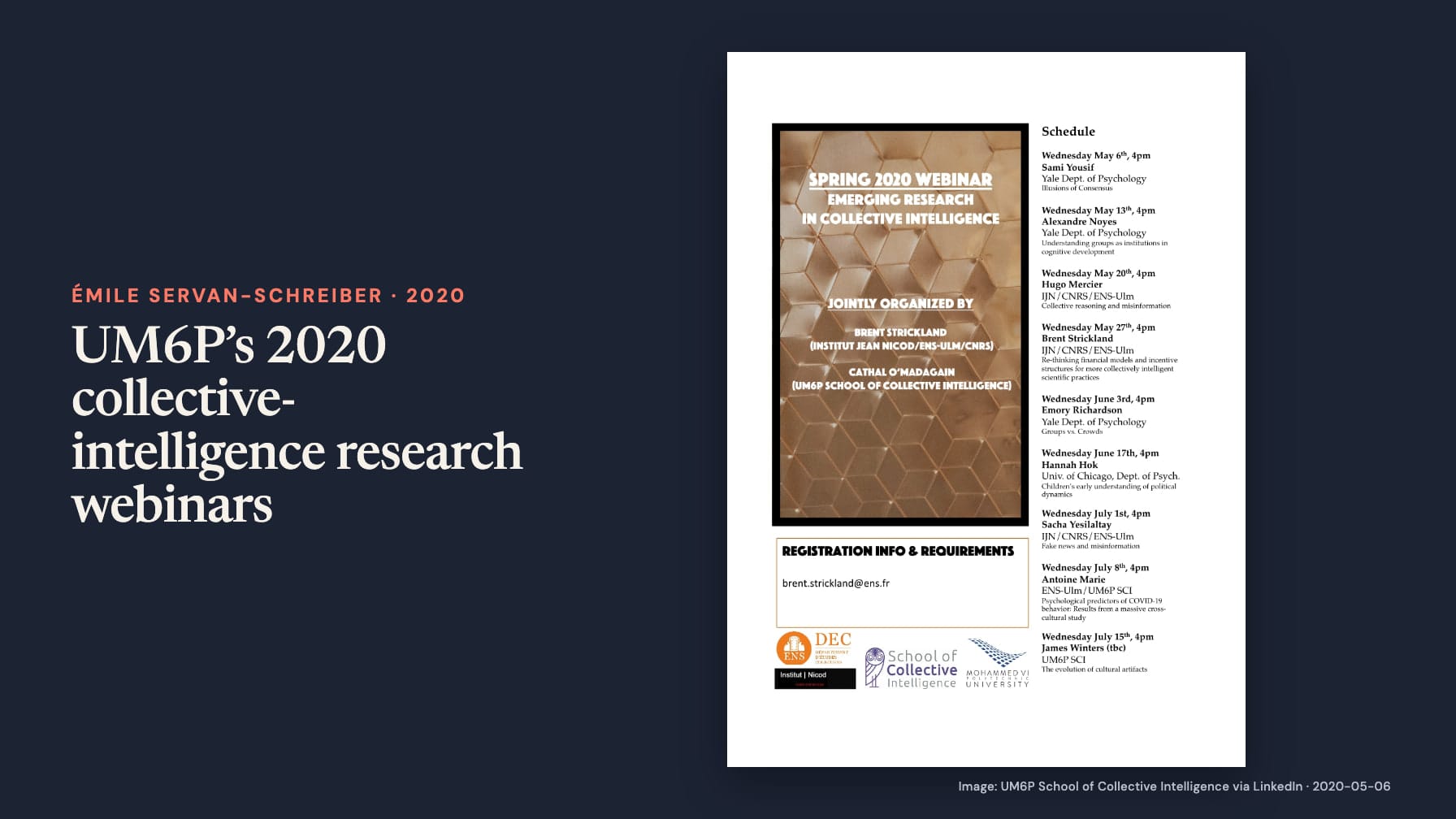
On 6 May 2020, Émile Servan-Schreiber reshared the UM6P School of Collective Intelligence’s announcement of its Emerging Research in Collective Intelligence webinar series. Its first advertised speaker was Sami Yousif of Yale, presenting “Illusions of Consensus” at 4 p.m. Paris time that day.
Brent Strickland of Institut Jean Nicod, ENS and CNRS and Cathal O’Madagain of UM6P jointly organised the series. The programme poster lists sessions extending into July, bringing questions about reasoning and groups together with misinformation and behaviour during COVID-19.
What makes agreement informative?
Yousif’s opening topic connects to his 2019 paper with Rosie Aboody and Frank Keil, published in Psychological Science. Across four experiments, the authors examined whether people distinguished agreement arising from independent primary sources from reports that all depended on one primary source. Participants were similarly confident in conclusions supported by those two forms of apparent consensus.
That result concerns how people evaluate evidence. It does not measure a prediction market’s accuracy. Its relevance to forecasters is the distinction between several independent observations and several repetitions of one observation. Counting sources without tracing their origins can make agreement seem more informative than it is.
The wider advertised programme
- 13 May: Alexandre Noyes, Yale, on understanding groups as institutions in cognitive development.
- 20 May: Hugo Mercier, IJN/CNRS/ENS-Ulm, on collective reasoning and misinformation.
- 27 May: Brent Strickland on financial models and incentives for more collectively intelligent scientific practice.
- 3 June: Emory Richardson, Yale, on groups versus crowds; 17 June: Hannah Kim of the University of Chicago on children’s understanding of political dynamics.
- 1 July: Sacha Yesilaltay, IJN/CNRS/ENS-Ulm, on fake news and misinformation.
- 8 July: Antoine Marie, ENS-Ulm/UM6P SCI, on psychological predictors of COVID-19 behaviour; 15 July: James Winters, UM6P SCI, on the evolution of cultural artefacts, marked to be confirmed.
The list gives advertised dates, subjects and affiliations from Institut Jean Nicod’s programme. ENS’s individual event listing gives Mercier’s talk the more specific title “Not born Yesterday: Why humans are less gullible than we think”. Its listing for Winters’s 15 July session explicitly marks it cancelled. The schedule should therefore be read as an announcement, rather than a claim that every session took place.
The series offers an earlier view of the educational setting described in our account of forecasting at UM6P and IE University. Its distinctive contribution is to put evidence independence, incentives and social reasoning in the same conversation. For forecasting, those are questions about how to build a useful collective before assessing its results.