
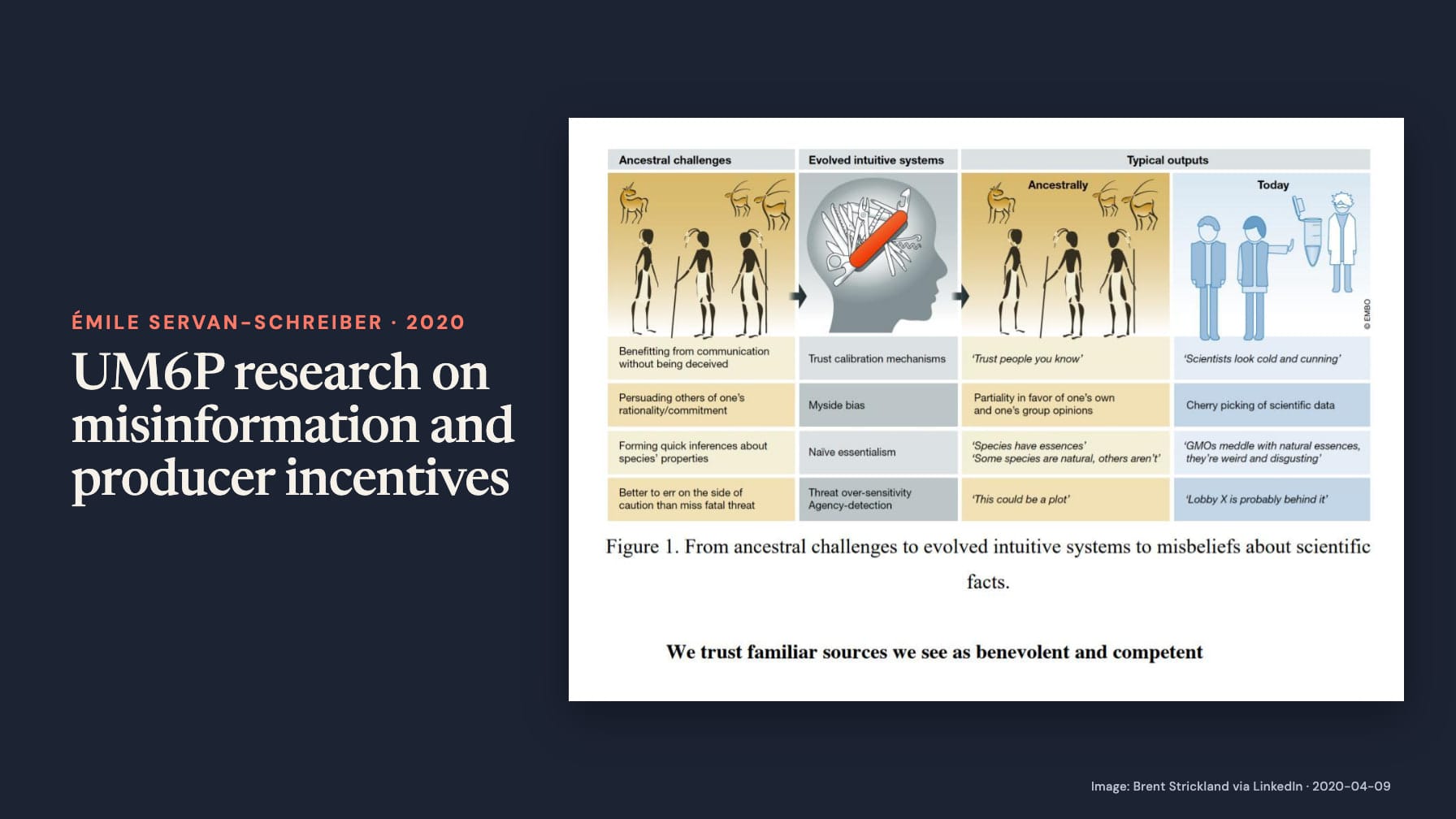
On 9 April 2020, amid the early COVID-19 crisis, Émile Servan-Schreiber reshared Brent Strickland’s announcement of a paper on scientific misinformation. Strickland asked why misleading scientific claims were circulating and drew attention to both psychological mechanisms and the incentives of information producers. Servan-Schreiber’s accompanying comment connected modern gullibility to evolutionary roots.
The paper was The cognitive foundations of misinformation on science: What we know and what scientists can do about it, by Antoine Marie, Sacha Altay and Brent Strickland, published in EMBO Reports in April 2020. The publication record lists UM6P School of Collective Intelligence affiliations for Marie and Strickland. The publication lists Altay under that name; Strickland’s announcement calls him Sacha Yesilaltay.
Understanding the information people accept
The paper is a commentary drawing on earlier research, rather than a new experiment measuring the spread of COVID-19 claims. It considers how intuitive reasoning, trust, attachment to existing beliefs and selective retelling can distort scientific information. Its account connects cognitive processes useful in earlier environments to misunderstandings in modern science communication.
The authors also discuss how scientists might reduce misunderstanding through clearer framing and engagement with audiences. These are proposed responses grounded in the research they review. Their emphasis is on how a scientific explanation travels between people and what may change as it is retold.
Why the producers matter too
Strickland’s announcement emphasised a further lesson: explanations focused only on consumers’ biases can miss the economics of production. He argued that complicated truths may attract fewer clicks than simpler or exaggerated accounts, giving universities, news outlets and websites incentives to package research in misleading ways. He therefore suggested paying more attention to producer incentives, rather than concentrating entirely on correcting the audience.
His argument shifts attention from the audience alone to the incentives shaping what gets published. The forecasting relevance is the question it raises for anyone assembling evidence: what pressures shaped the information before it reached the forecaster?
Strickland described the paper as the school’s first peer-reviewed publication. That priority claim belongs to his announcement. The journal’s discussion of incentives in collective forecasting addresses a related design problem: participants respond to what a system rewards. This research announcement extends that attention upstream, to the information on which collective judgement depends.