
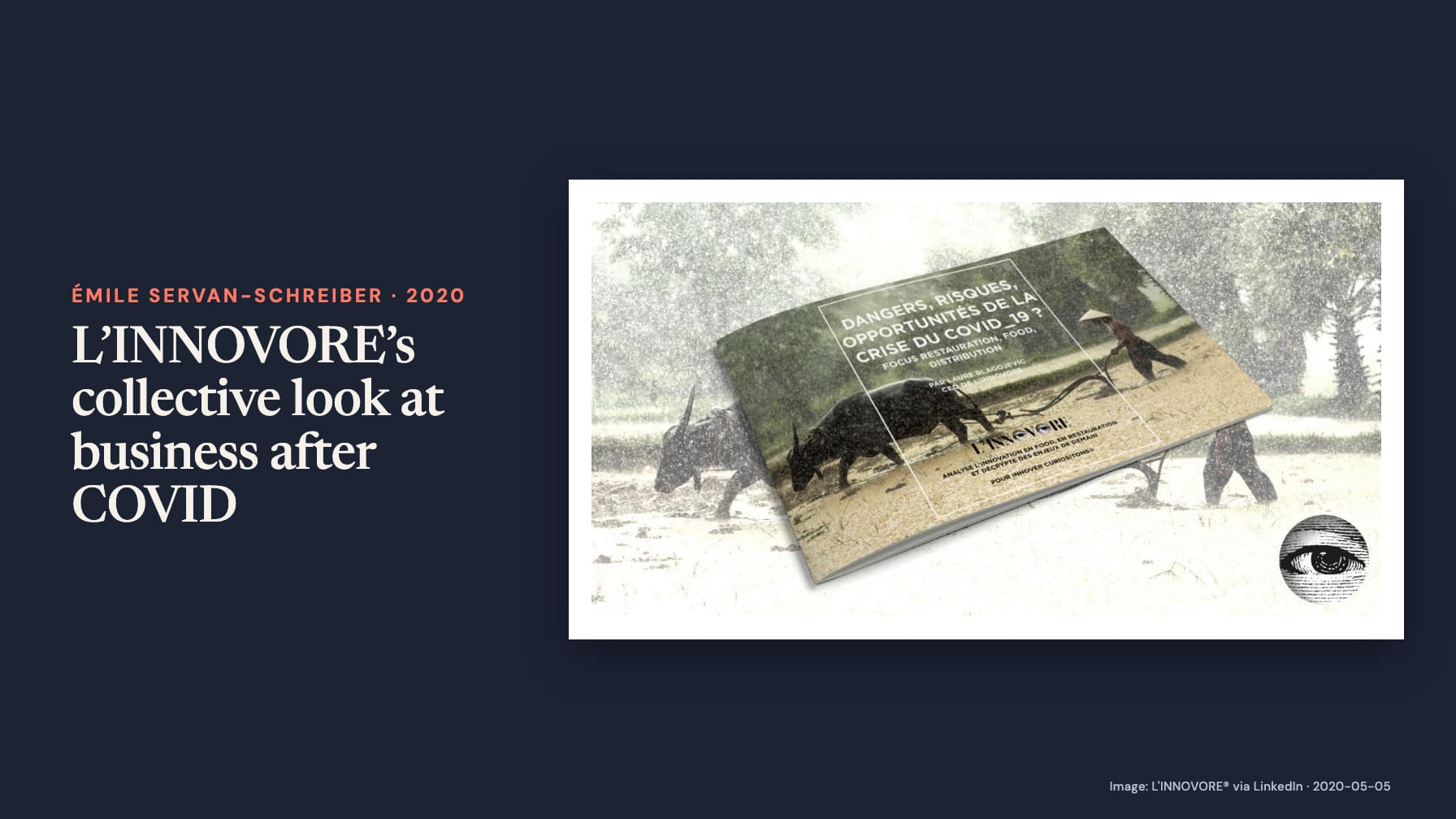
On 5 May 2020, Émile Servan-Schreiber reshared L’INNOVORE’s announcement of a white paper about the dangers, risks and opportunities created by COVID-19 in restaurants, food and distribution. The publisher thanked him among a long list of contributors, alongside figures including Thierry Marx, Serge Papin and Christophe Felder.
The announcement’s premise was that intelligence is augmented when several people contribute. The question driving the publication was what would follow the crisis. Its attached cover identified Laure Blagojevic, L’INNOVORE’s CEO, as the author. Servan-Schreiber’s accompanying comment endorsed the publication, without summarising his own contribution.
What the publication set out to examine
Restauration Collective reported the white paper on 6 May, describing a collaborative exercise spanning the food-service chain. Its account identified concerns including healthier and more local food, transparency, delivery and changes to restaurant operations. These were professionals’ views about an uncertain future, rather than a table of forecast probabilities.
In an interview published by TastyCloud on 24 June 2020, Blagojevic explained that businesses had been asking L’INNOVORE about life after the crisis. The company analysed the impacts and decided to share the work. She described COVID as accelerating digital and omnichannel commerce, some return to more local supply, and greater attention to health in food. Blagojevic presented these as expectations about how the sector might change, linking business decisions to consumers’ priorities.
Different roles in a sector-wide discussion
Servan-Schreiber’s contributor credit establishes his involvement, but the full paper and his specific contribution remain unavailable. Bringing together chefs, business leaders and other specialists gave the project several points of entry into the same crisis: production, distribution, restaurant operations and customers’ changing expectations.
The publication belongs to the broader practice of bringing several perspectives into foresight. Our article on the forecasting toolbox explains how quantified crowd forecasts can complement such work. Here, the documented contribution is to a collective sector analysis, addressing how businesses could prepare for changes in the way people buy and consume food.