
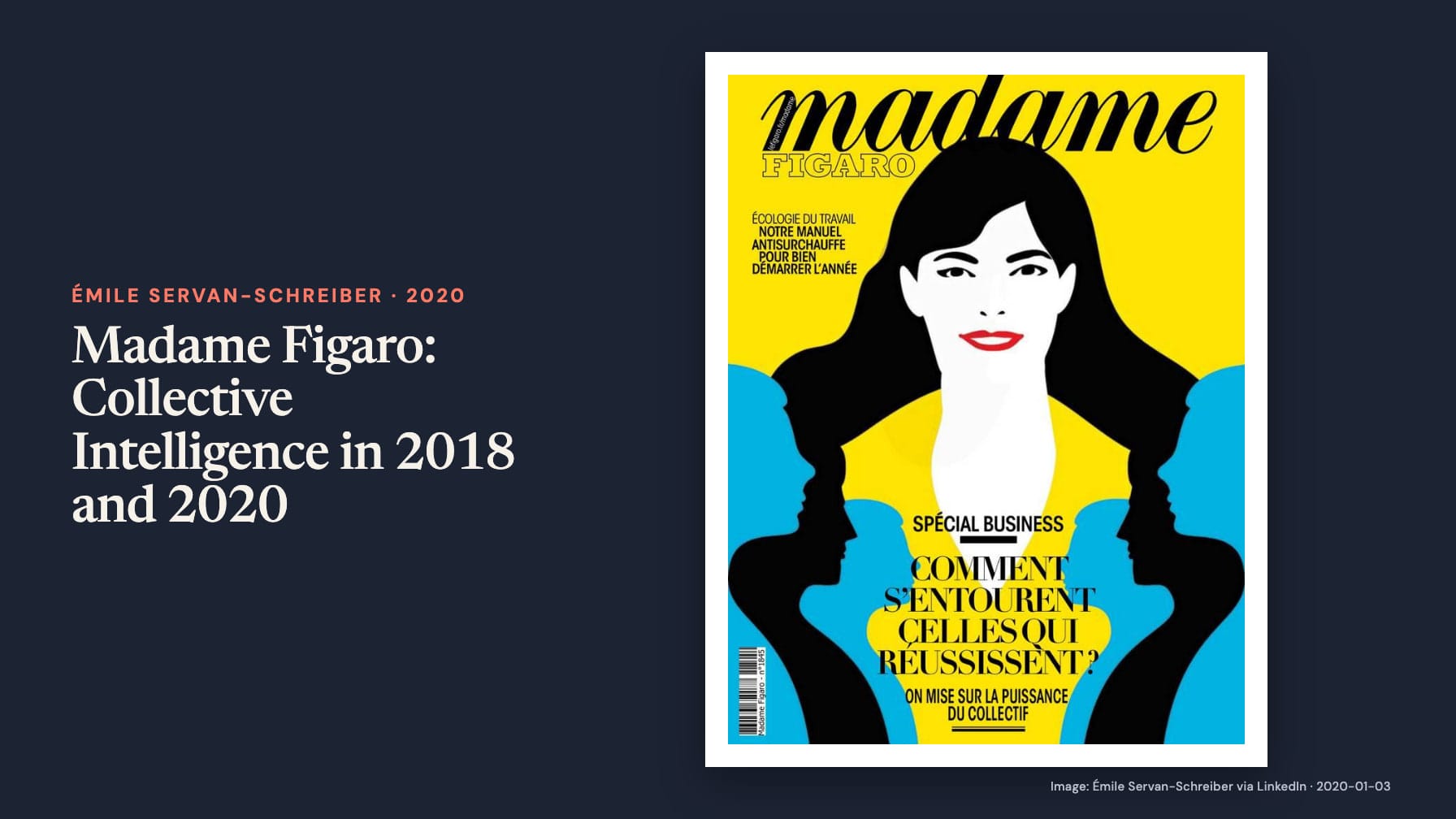
On 3 January 2020, Émile Servan-Schreiber recommended a Madame Figaro issue on the power of the collective. Its cover framed a business question: how successful women surround themselves with others. That recommendation followed a different contribution to the magazine, an editorial he had announced on 14 December 2018. The two posts document separate publications, not a single issue.
The 2018 editorial: organising human intelligence
The photographed editorial, on page 23, moved from artificial intelligence in everyday devices and growing interest in neuroscience to a third form of intelligence: the collective. Servan-Schreiber argued that phones, email, social networks, video calls and automatic translation connected people more closely, creating an opportunity to organise human thinking better.
The prospect was optimistic, but conditional. He distinguished the number of people from their organisation, invoking the yellow-vest movement as his example of a multitude whose lack of organisation could produce violence. That political interpretation was his argument in the editorial, not a scientific finding about the movement.
The editorial’s practical conclusion emphasised listening, goodwill and respect for differences. Its concern was that the century’s intelligence should include better organised human collaboration alongside artificial intelligence.
What the group-intelligence research supports
The editorial also linked a group’s performance to its proportion of women and its members’ emotional understanding. The relevant 2010 Science paper by Anita Williams Woolley and colleagues studied 699 people in groups of two to five. It reported a collective-intelligence factor associated with average social sensitivity, more equal conversational turn-taking and the proportion of women in a group.
Those are correlations in the studied groups, rather than a claim that all women or all female-majority teams are more intelligent. MIT’s account of the research explicitly notes that social sensitivity can be valuable whether a participant is male or female. The distinction matters when a short editorial brings research to a general readership.
The later recommendation
The January 2020 cover returned to collective working as a business theme. Servan-Schreiber’s recommendation establishes that he endorsed reading the issue; it does not establish that he wrote for it. The cover’s question about how successful women surround themselves with others gives collaboration a practical workplace setting, while the 2018 editorial makes the broader case for organising connected minds.
Together, the posts show collective intelligence reaching a readership beyond forecasting specialists. The journal’s account of Supercollective Intelligence supplies the wider book context. These two magazine moments preserve a narrower point: connecting people creates potential, while the quality of their interactions determines what a group can do with it.