
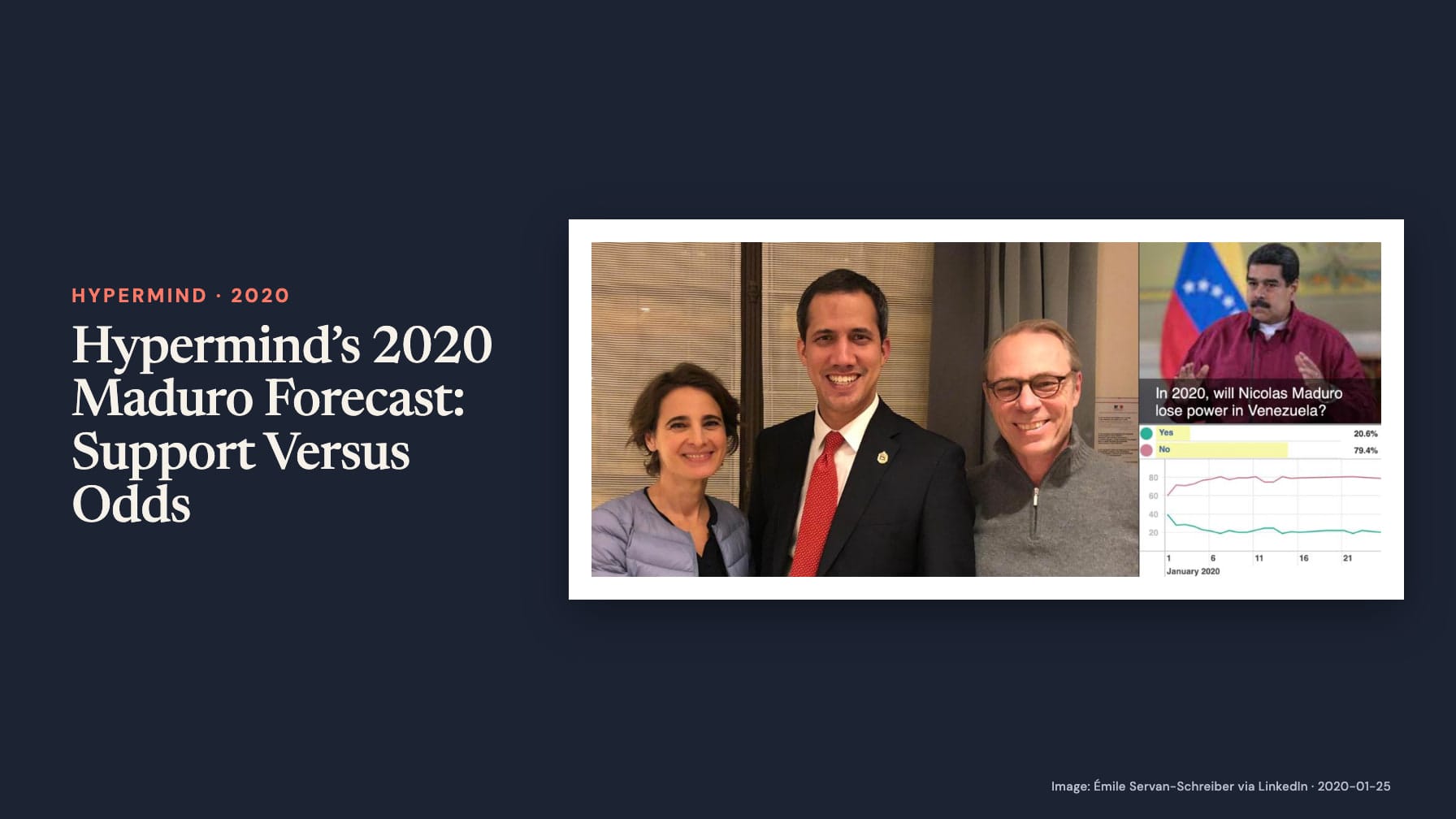
On 25 January 2020, Émile Servan-Schreiber declared his enthusiastic support for Juan Guaidó and reported that Hypermind gave him only a 20% chance of ousting Nicolás Maduro that year. The post placed a political preference beside a much more cautious estimate. Servan-Schreiber praised Guaidó’s courage and said he and his wife, Laurence Debray, supported him fully.
The chart asked a broader question
The attached graphic is more precise than the post’s paraphrase. It asked whether Nicolás Maduro would lose power in Venezuela in 2020 and showed yes at 20.6%, no at 79.4%. Those exact figures belong to the image accompanying the January 25 update. The written 20% is preserved as Servan-Schreiber’s rounded description, rather than silently replaced.
The post connects the chance to Guaidó ousting Maduro. The card asks about Maduro losing power, without specifying Guaidó as the cause. An exit through another route is a different possibility from the particular political change Servan-Schreiber supported. The contract’s full loss-of-power definition and settlement notice are unavailable.
The picture includes a January price history alongside the yes and no values. The displayed snapshot gives readers a precise assessment to compare with the speaker’s preference. Its calendar-year horizon is equally important: the estimate concerns Maduro’s position during 2020, rather than whether his government might end at any later date.
Recognition was different from control
The dispute over political authority makes the wording especially important. The US State Department’s 2020 human-rights report described Maduro as refusing to cede control over the instruments of state power, preventing Guaidó from exercising authority inside Venezuela. That report supplies evidence about effective control during the year, while its recognition of Guaidó reflects the US government’s stated position.
A State Department statement on 5 January 2021 continued to recognise Guaidó and the last democratically elected National Assembly, and criticised the legislative elections held on 6 December 2020 under Maduro’s regime. Together with the annual report, it supports the historical conclusion that Maduro had not been displaced by Guaidó during the forecast year. Recognition and effective control remained different questions.
A preference need not become a probability
The personal commitment and the market assessment remain visibly separate. Supporting a political outcome is a statement about what someone wants; a 20.6% probability is an estimate of how likely an event is. Servan-Schreiber publicly reported a low market probability for a change he favoured, while describing his own support for Guaidó in much stronger terms.
This is a different contract from The Forecasting Machine’s later Maduro-removal forecast. The 2020 card should retain its own platform, horizon and question wording. One realised non-removal outcome cannot establish calibration; the useful lesson is the discipline of keeping advocacy, event definition and probabilistic judgement distinct.