
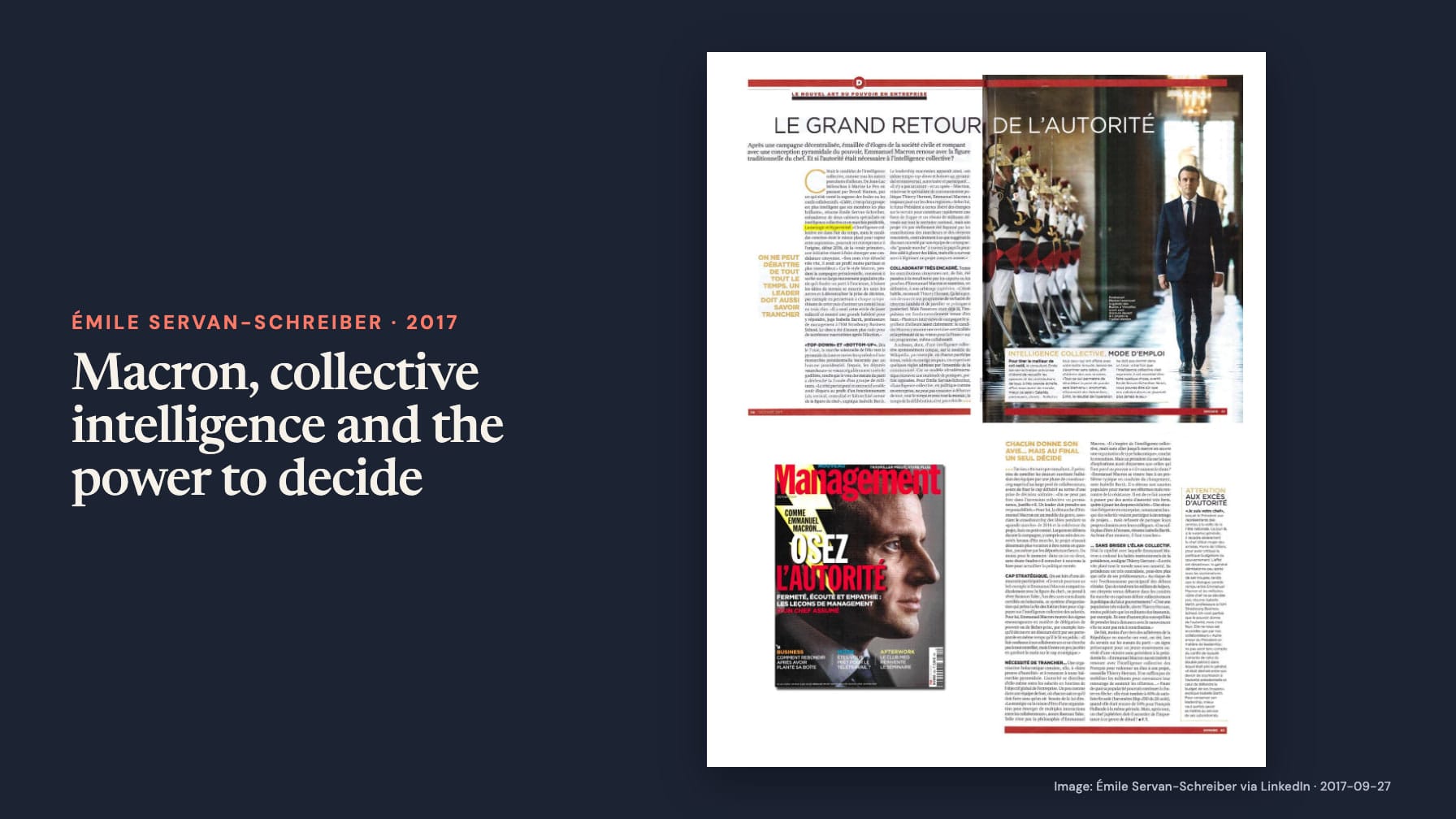
On 27 September 2017, Émile Servan-Schreiber drew attention to an article in the October issue of Management that revisited his spring essay about Emmanuel Macron and collective intelligence. The two documents belong to different moments: the essay appeared before the presidential vote; the magazine clipping examined the president’s approach after taking office. Reading them together reveals a tension between gathering diverse contributions and retaining authority to decide.
An argument made before the election
Servan-Schreiber published his original essay on 21 April 2017. It was an explicitly favourable interpretation of Macron’s candidacy. He argued that a movement drawing people from both the left and the right could combine perspectives and reduce ideological blind spots. He also interpreted weaker partisan discipline as room for independent thought.
The essay names four conditions for collective intelligence: diversity of opinion, independence of mind, decentralised information sources and an effective means of synthesising contributions. Servan-Schreiber assigned Macron the role of synthesiser and presented the campaign’s large-scale collection of citizens’ opinions as the decentralised component. These were his claims about the campaign, not results from a controlled comparison of political movements.
The distinction matters because research about diversity has narrower conditions than a political endorsement. Lu Hong and Scott Page’s 2004 paper models circumstances in which diversity in problem-solving approaches can outweigh differences in individual ability. It does not establish that political centrism inherently produces better judgment or that any campaign combining left and right satisfies the model’s conditions.
Participation and the final decision
The attached Management pages examine Macron’s apparent return to a more vertical exercise of power. Alongside Servan-Schreiber, the article quotes management academic Isabelle Barth and political communication specialist Thierry Herrant. Their assessments are commentary on leadership, rather than a measured evaluation of presidential decisions.
In its practical advice box, the clipping attributes to Servan-Schreiber recommendations to solicit contributions widely, use voting to identify ideas that stand out, explain how a final decision will be made, and seek candid contributions through safeguards such as anonymity. He also argues that leaders must eventually decide. The article’s question is therefore not just whether participation occurred, but how contributions influenced the synthesis and the ultimate choice.
Macron’s election itself is independently verifiable. The Constitutional Council’s proclamation of 10 May 2017 declared him elected following the second round on 6–7 May. That outcome does not validate Servan-Schreiber’s explanation for his success. Neither the essay nor the September update supplies a numerical election probability.
Our history of Hypermind’s 2017 election market covers the separate forecasting record. This story concerns the design of collective judgment: who can contribute, whether dissent survives, and how a decision-maker uses the resulting information. The pre-election essay and later clipping show why those questions remain distinct from simply counting an election victory.