
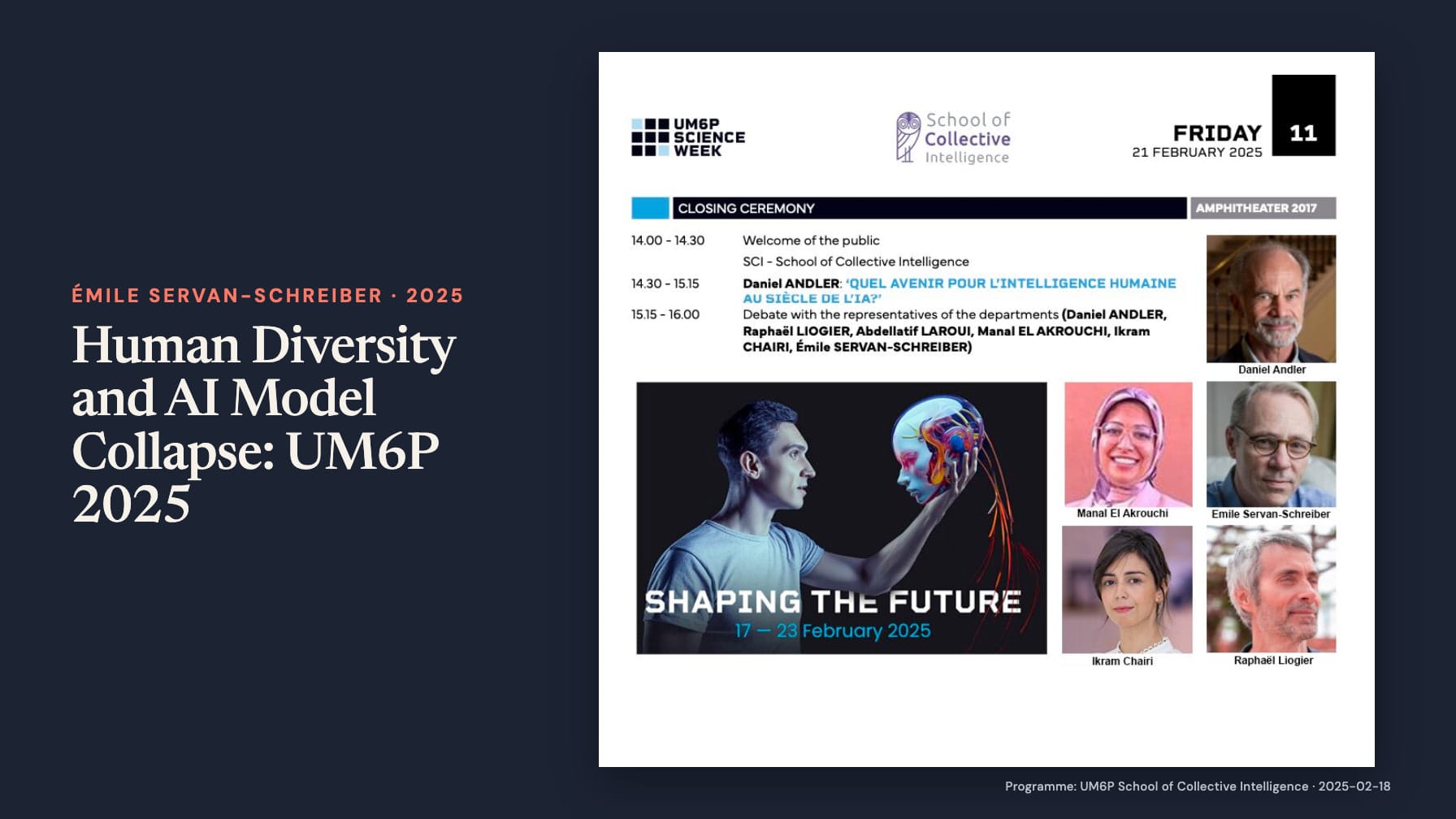
On 18 February 2025, Émile Servan-Schreiber announced a debate he was organizing for UM6P’s School of Collective Intelligence about the future of human intelligence in the AI century. The programme image attached to the invitation placed Daniel Andler’s talk and the subsequent discussion on Friday 21 February. On 22 February, the day after the scheduled debate, Servan-Schreiber published his own response: perhaps the harder question was whether AI had a future without human intelligence.
His answer was a qualified no. He described large language models as a concentration of human collective intelligence, drawing their capabilities from knowledge and opinions people have published. In his view, keeping AI grounded in a changing world would require continued contact with the varied observations of humans.
What recursive training can lose
The essay connected that argument to model collapse. In a 2024 Nature paper, Ilia Shumailov and colleagues studied what happens when successive generations of generative models train on outputs from earlier generations. They found that indiscriminate use of generated content could progressively erase parts of the original data distribution, especially its less common cases.
The experiments and analysis covered language models and other generative-model families. This makes the risk more specific than a claim that machines inevitably become less intelligent: repeatedly learning from generated approximations can reduce the variety represented in training data. Losing unusual cases can matter even when the most common patterns remain recognizable.
Other primary research establishes an important qualification. In a 2024 preprint, Matthias Gerstgrasser and colleagues compared replacing original data with synthetic generations against accumulating synthetic data alongside the original real data. Their experiments found that the accumulation approach avoided collapse in the settings they tested. Synthetic data is therefore not automatically destructive; the training procedure and retention of real data matter.
From diversity to forecasting
Servan-Schreiber drew a broader lesson: humans’ divergent perspectives are a resource for AI, rather than merely a limitation to overcome. He invoked the diversity theorem from collective intelligence to support that interpretation. The essay does not establish a universal theorem that every AI system must depend equally on human expertise and human disagreement.
For forecasting, the practical question is whether an ensemble is drawing on distinct information or repeating similar approximations. Our discussion of correlated errors in crowd and language-model forecasts explores that distinction. The February essay adds a question about the source of the information itself: how will a system continue to encounter observations that its earlier models did not already capture?