
Émile Servan-Schreiber brought his argument about diversity and collective intelligence to JUMP’s 2019 forums in two cities. He appeared at the Brussels forum on 26 March, then announced on 24 May that he would participate again in Paris to discuss diversity’s role in collective intelligence. JUMP’s official Paris brochure dates that forum to 18 June 2019. JUMP’s speaker biography confirms his participation in both forums. A comment reshared on 19 June preserves one of the claims attributed to his talk.
Digital transformation and workplace equality
Both forums addressed how digital transformation could become an opportunity for gender equality. The Brussels announcement named Servan-Schreiber among the speakers and placed the event under Proximus’ chairmanship. JUMP’s official newsletter independently lists the 26 March date and identifies him as a Brussels speaker. The Paris brochure describes a day of conferences, practical workshops and tools for workplace inclusion, under Orange’s presidency.
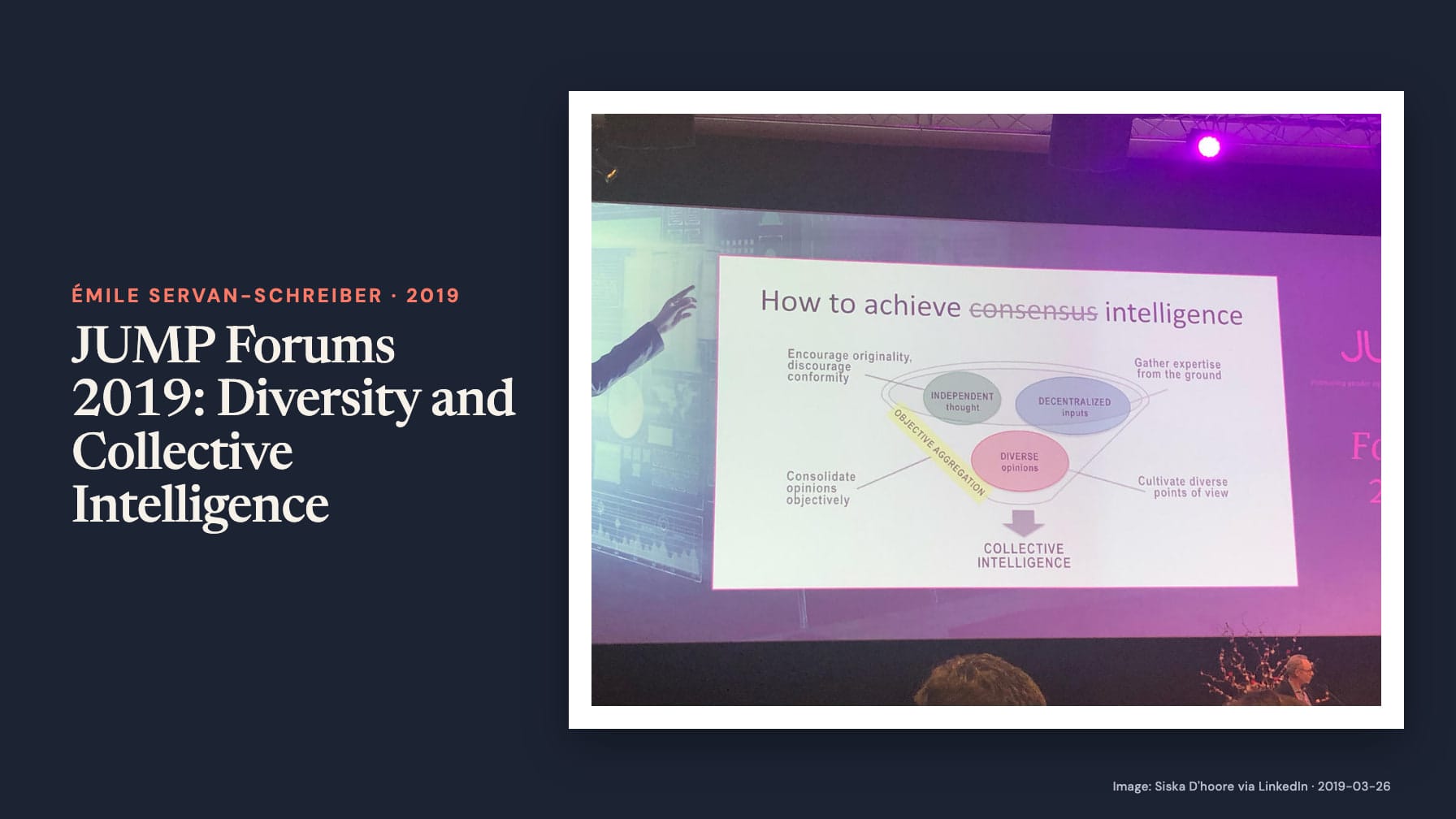
At Brussels, Servan-Schreiber reshared Siska D’hoore’s account of his recipe for collective intelligence. The attached photograph shows a diagram bringing independent thought, decentralised inputs and diverse opinions into objective aggregation. A slide deck hosted by JUMP gives the fuller presentation, How Diversity Drives Collective Intelligence. It connects group performance, social sensitivity and participation with the problem of conformity.
What the gender claim does and does not establish
In the 19 June reshare, Isabella Lenarduzzi attributed to Servan-Schreiber the view that a group should contain at least 50% women to have higher collective intelligence. She also reported his argument linking a group’s emotional abilities with its intellectual performance. The numerical threshold is therefore a speaker claim reported by an attendee, not a probability forecast or a universal scientific rule.
Woolley and colleagues’ 2010 Science study associated small-group performance with social sensitivity, speaking-turn distribution and the proportion of women. Its abstract supplies no universal 50% threshold. The talk’s recommendation goes beyond that reported correlation.
The organisation of different perspectives
For forecasting, the most useful thread in the JUMP material is how different perspectives remain available to a group. Diverse membership cannot help if contributions are silenced or immediately copied from a dominant voice. A combination method then needs to produce an answer that can be tested, rather than simply celebrate disagreement.
That question connects these appearances with Servan-Schreiber’s discussion of expertise and diversity. At JUMP, the workplace-equality setting brought membership and participation into the same conversation. A forecasting process needs both: contributors with different information and a method that lets their judgements influence the combined estimate. The resulting estimates can then be assessed against outcomes.