
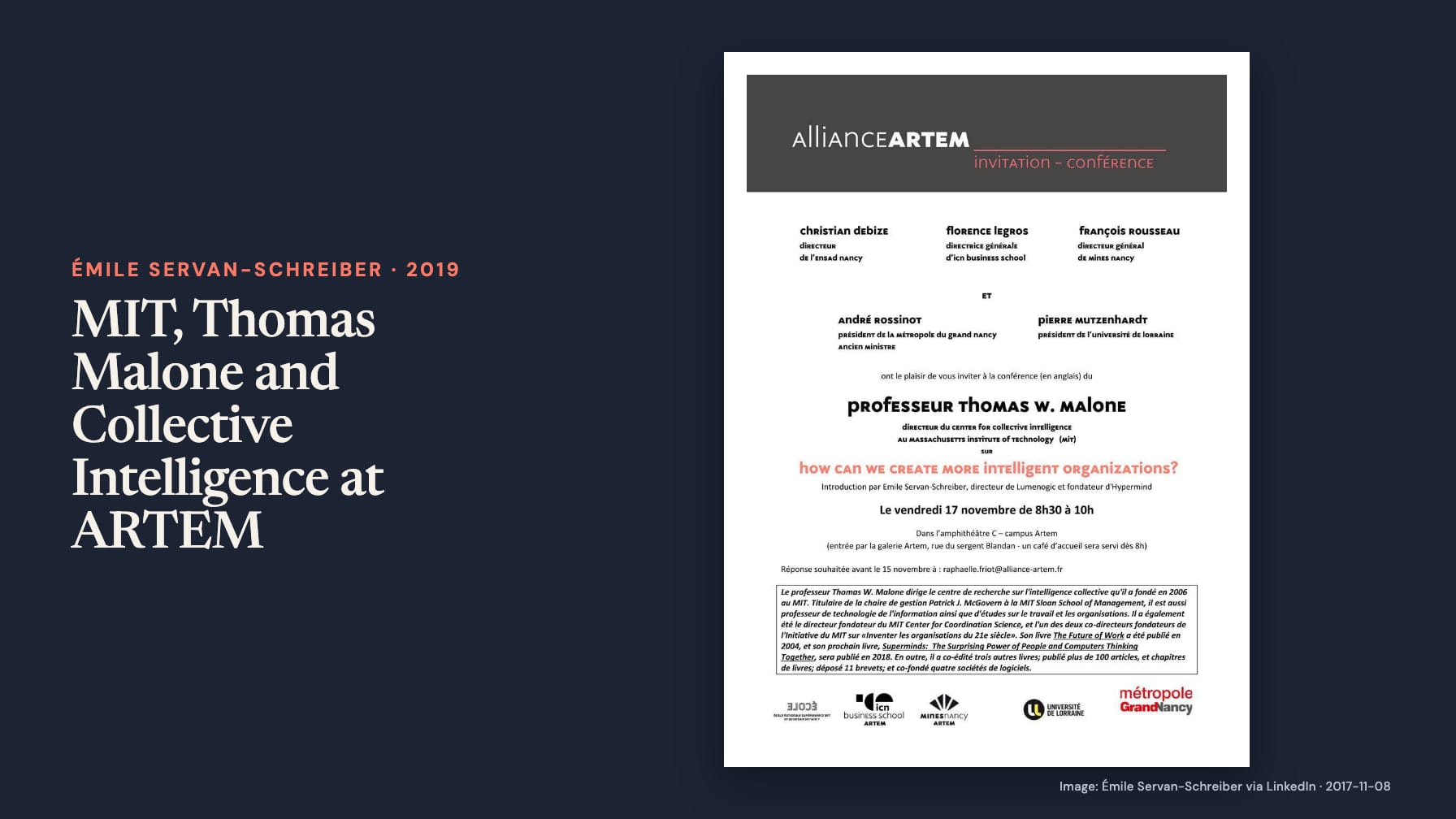
On 17 November 2017, Thomas Malone, founding director of the MIT Center for Collective Intelligence, gave a keynote at Nancy’s Alliance ARTEM. Émile Servan-Schreiber introduced him. Four days later, Servan-Schreiber published his introduction and described the visit as coinciding with the soft launch of a School of Collective Intelligence he was helping create at the campus.
An educational idea built around disciplines
ARTEM brought together Nancy’s engineering school, business school and school of art and design. In his account, Servan-Schreiber saw that combination as a promising setting for a field that asks how people and computers can work together intelligently. He said he had recognised the opportunity after visiting Nancy at André Rossinot’s invitation to discuss collective intelligence and digital humanism.
On 20 September 2016, Servan-Schreiber had announced a Nancy talk on what collective intelligence could accomplish, scheduled for the digital-humanism gathering on 29 September. His later account connects that visit with the ARTEM idea: combining disciplines could support teaching and research on how groups solve problems together.
The November 2017 invitation gives the keynote’s question: how can we create more intelligent organisations? It names Servan-Schreiber as director of Lumenogic and founder of Hypermind. His subsequent article credits MIT’s centre with helping establish collective intelligence as a scientific discipline and points to research measuring group intelligence.
Human minds remain part of the future
Servan-Schreiber’s introduction placed Malone’s work against fears about artificial intelligence, jobs and surveillance. His argument was that humans still have value in a technological future, and that research should examine how their contributions can be organised alongside machines. He presented the planned ARTEM school as a way to pursue that work across disciplines.
He described the proposed school as a project at its beginning. Its appeal lay in the relationship among engineering, management and art: different disciplines could examine both the tools that connect people and the ways those people organise their work. That educational ambition is the focus of his first-person account.
A thread extending to Superminds
His interest in people and computers working together also appeared in a brief November 2012 update about a conversation with MIT’s collective-intelligence director. The update supplies the theme without identifying a recording. That theme links his educational proposal to the question of how different human contributions can be organised alongside computing tools.
On 4 September 2019, Servan-Schreiber reshared Malone’s reference to a C-SPAN interview about Superminds. MIT’s official biography dates the book to May 2018 and lists an August 2019 C-SPAN appearance. This follow-up returns to the human–computer collaboration theme, also discussed in our article on human and model crowds. The educational ambition was to translate a research question into a multidisciplinary programme; its later institutional outcome remains unverified.