
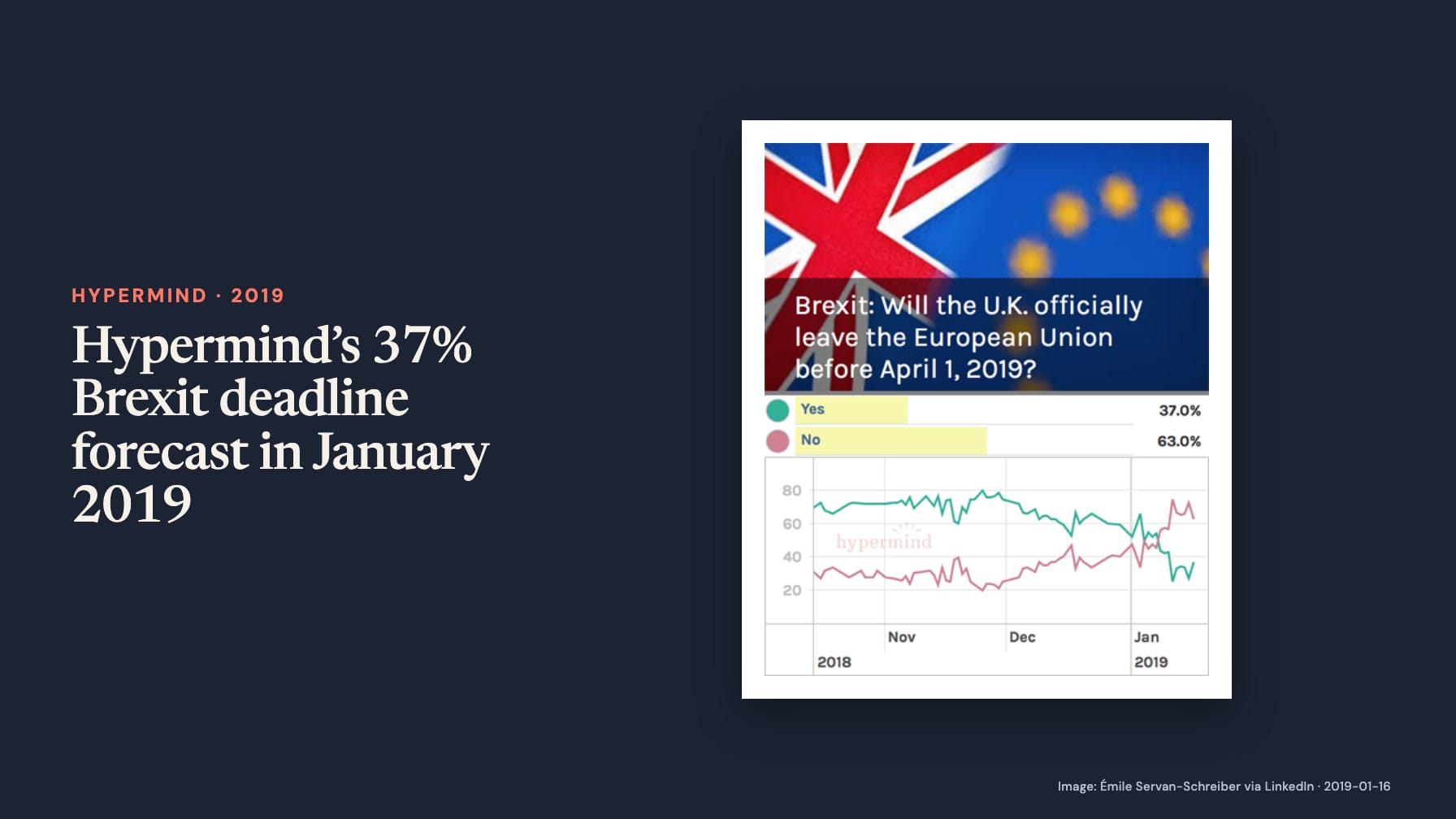
On the morning of 16 January 2019, Émile Servan-Schreiber reported a 37% probability of Brexit happening “on deadline”, according to the Hypermind prediction market. The image shared with the post supplies the question that the short announcement left implicit: would the United Kingdom officially leave the European Union before 1 April 2019?
The chart displays 37.0% for Yes and 63.0% for No. These are historical figures attached to that January post. They concern withdrawal by a specified date, rather than eventual withdrawal or approval of a particular agreement. The wording matters: a prediction about timing can be evaluated only against its own deadline.
The parliamentary context
The announcement came the day after the House of Commons rejected the government’s withdrawal agreement. Parliament’s contemporary account records the 15 January vote as 432 against and 202 in favour. The vote forms the immediate context for the dated market estimate. It left a separate question about whether the remaining political and legal process would produce withdrawal before the April deadline.
This was a different question from the referendum forecast discussed in our 2016 Brexit and Trump market retrospective. A referendum outcome establishes a political decision; a withdrawal deadline asks whether subsequent legal and political steps will be completed in time. The January market made that second uncertainty explicit.
The later outcome
The Council of the European Union’s withdrawal timeline records that the agreement entered into force when the UK left on 31 January 2020. Withdrawal therefore occurred after the date printed on the Hypermind chart. The outcome was No under the question’s ordinary wording; the market’s detailed settlement rules are unavailable.
The event that occurred was the more probable option in this snapshot. That observation is narrower than proving that 37% was the right probability. As the journal’s guide to forecast scoring and calibration explains, calibration concerns patterns across forecasts. This case preserves something useful for such evaluation: a dated probability, a legible deadline and an independently documented outcome.