
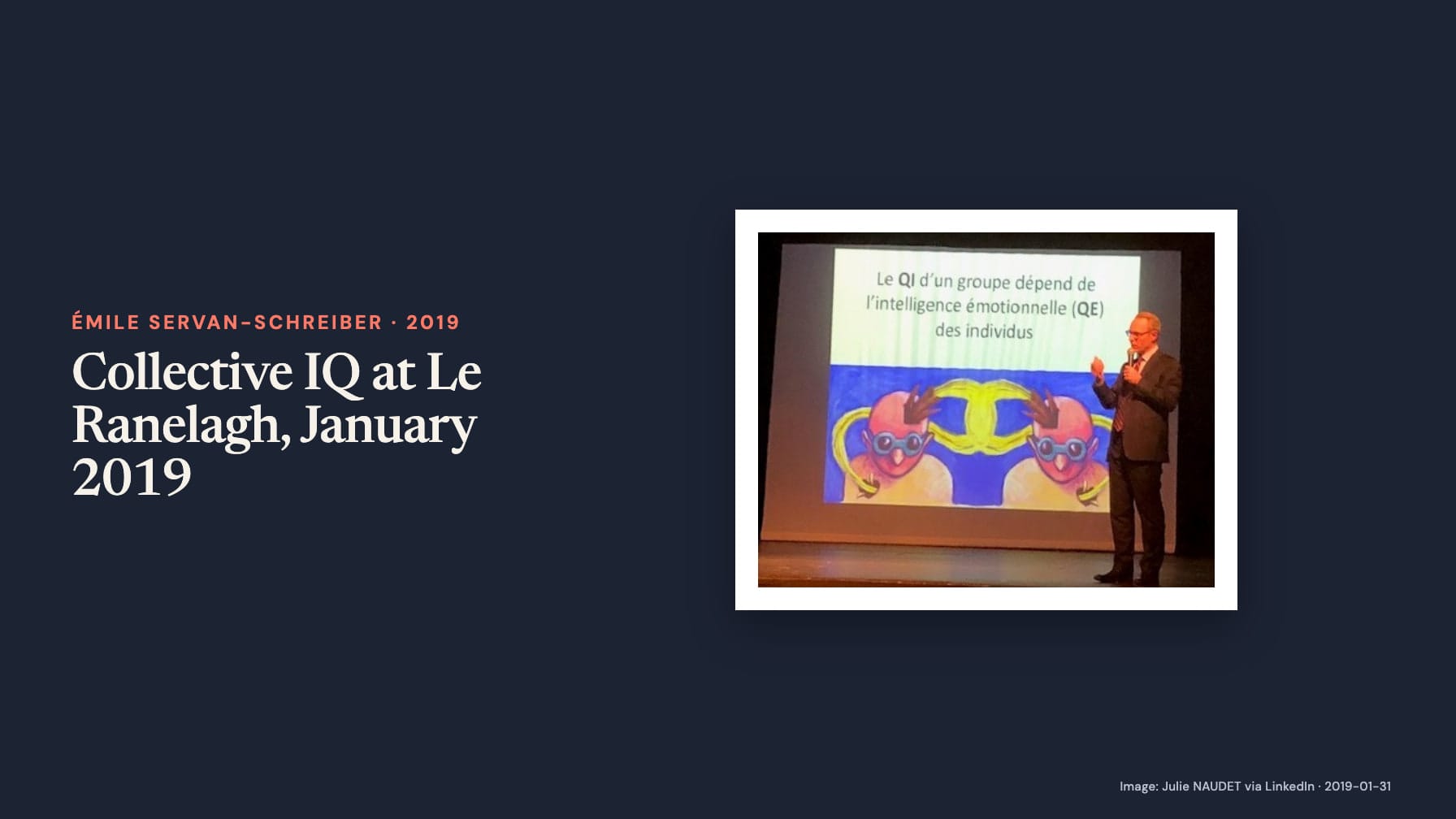
On 22 January 2019, Émile Servan-Schreiber invited readers to Le Ranelagh in Paris the following Monday for what he called his first major public conference on supercollective intelligence. A recap reshared on 31 January confirms that the conference had taken place and records an attendee’s interest in making groups perform better.
A public evening on collective IQ
The original event poster, attached to a December announcement, supplies details missing from the brief posts. It advertises a conference on collective IQ for Monday 28 January 2019, from 19:30 to 22:00, at Théâtre Le Ranelagh, 5 rue des Vignes in Paris’s 16th arrondissement. It names David Christoffel as leading the conference and discussion, alongside Servan-Schreiber as the speaker.
The poster carries the names of IPECOM Paris and the Association pour l’Épanouissement des Enfants à Haut Potentiel Intellectuel. It identifies Servan-Schreiber as a cognitive-psychology researcher and the author of Supercollectif. Fayard’s official listing dates that book to 24 October 2018, placing the event a few months after its publication.
From an invitation to a reported discussion
In the January invitation, the emphasis was on collective intelligence in the plural: what a group can do when its members’ abilities are brought together. Julie Naudet’s later recap described both new inspiration and confirmation of ways to improve collectives. The attached photograph shows a speaker beside a slide linking group IQ to individuals’ emotional intelligence. The slide brought interpersonal qualities into a talk about group performance.
The scientific context calls for more precise language. Woolley and colleagues’ 2010 study reported a collective intelligence factor across small-group tasks and associations with social sensitivity, equality of conversational turn-taking and the proportion of women in the group. Those findings support studying interaction, but do not establish that a group’s intelligence is determined by a single emotional-intelligence measure.
The public-conference record therefore documents an effort to make research about groups accessible beyond specialist audiences. The journal’s later Institut Diderot conference account continues that educational thread. For forecasting, the relevant question is how a group organises different contributions. The public format brought that question to people interested in education, psychology and the practical use of intelligence, beyond a specialist forecasting audience.