
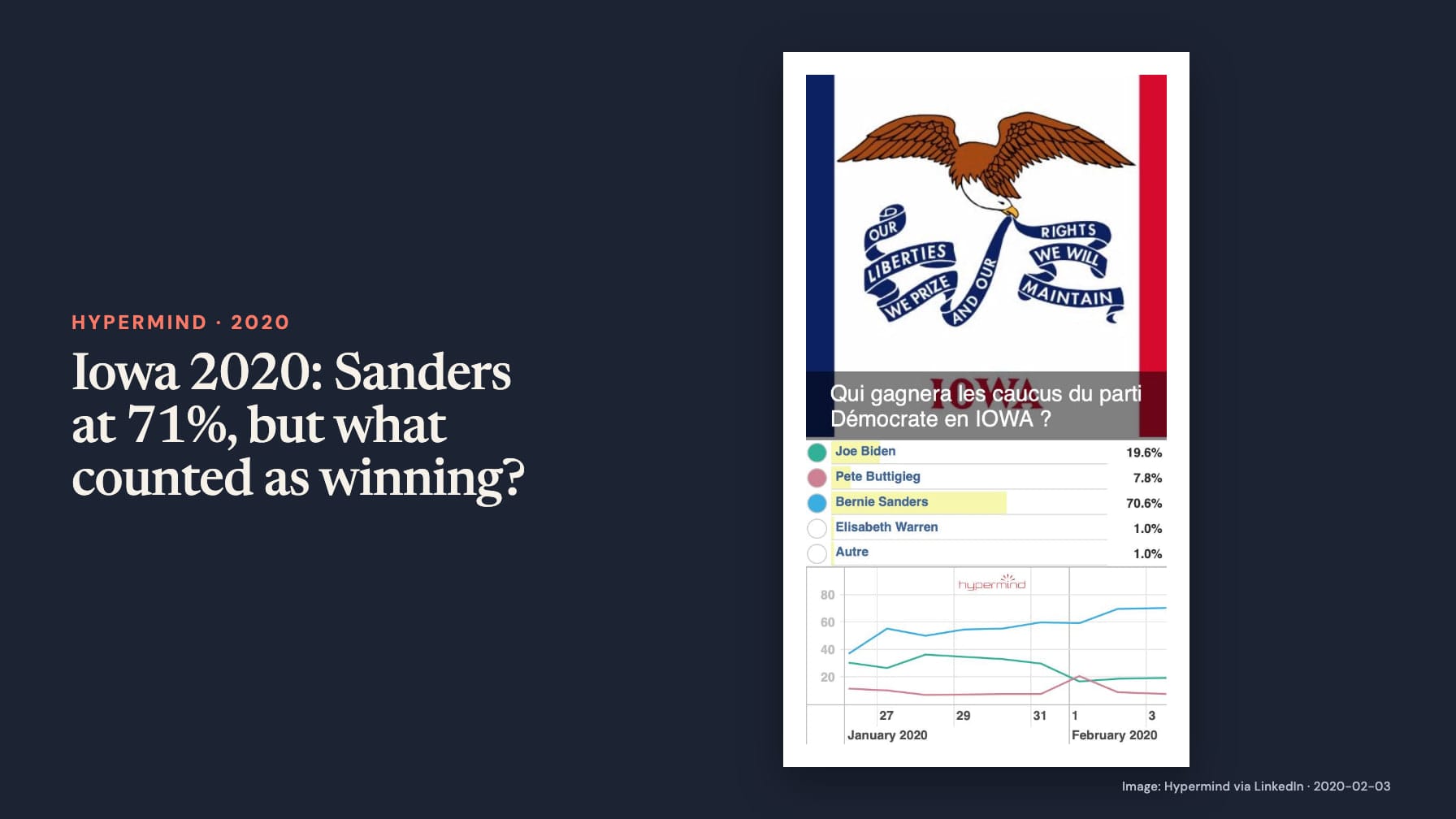
On 3 February 2020, before that day’s Iowa Democratic caucuses, Émile Servan-Schreiber reshared a Hypermind announcement giving Bernie Sanders a 71% probability of winning. The attached screenshot shows Sanders at 70.6%, with Joe Biden at 19.6%, Pete Buttigieg at 7.8%, Elizabeth Warren at 1.0% and other candidates at 1.0%.
The announcement’s 71% is a rounded description of the attachment’s 70.6%. Both made Sanders the clear favourite on the 3 February update. The announcement invited readers to follow a live dashboard, so it also described a forecast that could change as new information arrived.
The unresolved meaning of winning
The French chart asks who will win the Democratic Party caucuses in Iowa. Winning could mean leading the raw vote count, leading in state delegate equivalents or meeting another specified criterion. State delegate equivalents express precinct delegate allocations on a common statewide scale; they are not simply a count of people supporting a candidate.
The distinction was consequential. In its April 2019 announcement of the delegate-selection plan, the Iowa Democratic Party said it would publish first-alignment votes, final-alignment votes and state delegate equivalents. Several measures of the same caucus were therefore available before the market’s forecast was made.
The result and the dispute
On 6 February, Sanders’s campaign declared victory on the basis of the popular vote in the first and second alignments and disputed the delegate-equivalent calculations. That statement preserves the campaign’s argument, rather than an uncontested declaration of the market’s winner.
After the recount, the Associated Press reported on 27 February that Buttigieg had 562.954 state delegate equivalents and Sanders 562.021. AP declined to call a winner because it retained concerns about the reported results’ accuracy. The Iowa Democratic Party certified the caucus results on 29 February.