
On the morning after the 2020 US presidential election, while several decisive states were still counting ballots, Émile Servan-Schreiber posted that Joe Biden remained the slight favorite on Hypermind. In a reply, he made the probability more explicit: Biden had been favored at roughly two chances in three. Hypermind, he wrote, did not offer certainty; it measured uncertainty.
The distinction mattered. Biden ultimately won, but Hypermind's market had preserved a substantial chance of another Trump victory throughout the campaign. The same series also contained two narrower forecasts worth reviewing: the selection of Kamala Harris as Biden's running mate, and whether the loser would accept defeat before 26 November.
A forecast assembled over months
By March 2020, Hypermind was publishing a live dashboard that treated the election as a set of related uncertainties rather than a single horse race. It tracked the presidency alongside questions about the economy and the condition of the country after four years of Donald Trump. The probabilities changed as the pandemic, nominations, conventions, debates and voting altered the evidence.
On 12 August, after Biden selected Kamala Harris, Servan-Schreiber wrote that Hypermind's champion forecasters had anticipated the choice. He added that the selection had barely moved the general-election market: the prospect of a Black woman on the ticket had already been priced in, and Trump still held a 41% chance of winning.
Thirty percent was not a dismissal
Eight days before Election Day, Hypermind put Biden near 70% and Trump near 30%. Its comparison chart showed that Trump had held roughly the same probability at the equivalent point in 2016, shortly before beating Hillary Clinton. The image made a useful warning visible: an outcome with three chances in ten is an underdog, not an impossibility.
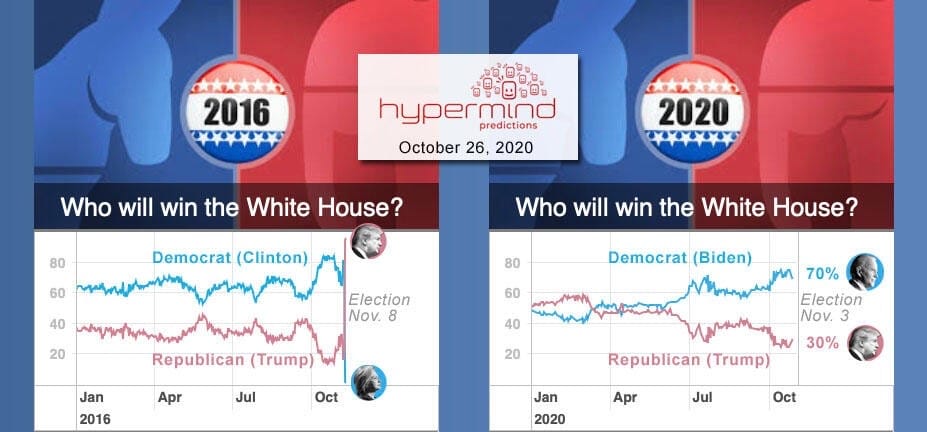
When counting continued on 4 November, the market still leaned Biden but did not treat the result as settled. That position was directionally correct. The Federal Election Commission's official results record 306 electoral votes for Biden and 232 for Trump. Biden received 81,283,501 popular votes, against 74,223,975 for Trump.
The lower-probability forecast that happened
On 19 October, Hypermind assigned a 32% chance that the loser would not accept defeat before 26 November—Thanksgiving Day in the United States. This was a separate, explicitly timed question. It was also the minority outcome: the market still put about two chances in three on acceptance before the deadline.
That minority outcome occurred. The General Services Administration issued its ascertainment letter on 23 November, allowing the formal transition to proceed, but Trump did not accept defeat before 26 November. Reuters reported his statement promising an orderly transition only on 7 January 2021, after Congress certified the result.
The result illustrates why a forecast archive should retain the whole distribution. Saying that the 32% outcome happened does not prove the forecast was wrong; events assigned 32% should happen sometimes. Nor does the correct Biden favorite prove the probability was perfect. Evaluation requires many resolved questions, consistent definitions and a proper scoring rule.
What this record does show
- Updating: probabilities changed across the campaign rather than freezing around an early narrative.
- Related questions: the dashboard separated the winner, running-mate choice and post-election conduct instead of collapsing them into one prediction.
- Uncertainty: Trump remained a plausible outcome even when Biden led, and non-acceptance remained plausible even when acceptance was favored.
- Resolution: dated screenshots and explicit deadlines make later review possible.
The 2020 sequence is therefore more informative than a claim that Hypermind “called” the election. The market put Biden ahead, kept the underdog alive, and attached a material probability to a contested aftermath. Its value lies in those calibrated degrees of belief, preserved before the outcomes were known.