
On 3 September 2020, two months before the US presidential election, Émile Servan-Schreiber posted a question from Hypermind’s Long Fork Project: “Can Trump make America happy again?” His answer, drawn from the crowd’s forecasts at the time, was “probably not”.
The Long Fork Project asked Hypermind’s champion forecasters, a group selected for their past accuracy, to predict how the United States would fare in 2022 and 2024 under two scenarios: Donald Trump re-elected, or Trump not re-elected. The gap between the two answers was meant to show where the choice of president would make a difference, and how much.
A conditional forecast
Most forecasts ask what will happen. A conditional forecast asks what will happen if something else happens first. Long Fork asked each question twice, once for each election result. Only one branch can ever be checked: once the election is decided, the other scenario never happens, so its forecasts can never be scored.
The dashboard tracked five measures, each split by election outcome:
- Covid-19 deaths in the United States from 1 January 2021, for the periods to 2022 and to 2024.
- The country’s rank in the World Happiness Report against 155 other countries, for 2020–2022 and 2022–2024.
- The S&P 500 stock index on 31 December 2022 and 31 August 2024.
- US real GDP in 2022 and 2024.
- The employment rate among prime-age adults, for 2021–2022 and 2021–2024.
Forecasts were updated daily until election day, 3 November 2020, and the best forecasters were to share a $20,000 prize. To make manipulation harder, only vetted champion forecasters were counted. The dashboard explained that each forecast was an average of the most recent predictions, typically the latest 40%, weighted by each forecaster’s past accuracy. The method was derived from research in IARPA’s ACE forecasting programme.
Why try it
In a 14 September 2020 blog post, Hypermind pointed out that Barack Obama in 2010 and Trump in 2019 had both used the phrase “Elections have consequences!” Its aim was to forecast some of those consequences before voters made their choice. Hypermind expected partisan bias to be considerably reduced, because the prize rewarded accurate forecasts of what would actually happen rather than wishful thinking.
It also acknowledged the difficulty. Hypermind described crowds as having a well-documented ability to forecast events weeks or months ahead; several years ahead is much harder. Hypermind said such a long-term conditional challenge had never been tried before. If it worked, it could help evaluate public policy against crowd-forecast outcomes, as the economist Robin Hanson proposed in his 2006 chapter “Decision Markets for Policy Advice”. Hypermind added that “we’ll know in a few years”.
The happiness question, checked
The chart in the September 2020 post shows the crowd’s estimate of the US happiness rank, where 1 is the happiest country. The United States had ranked 18th for 2017–2019. As of 3 September 2020, the crowd expected:
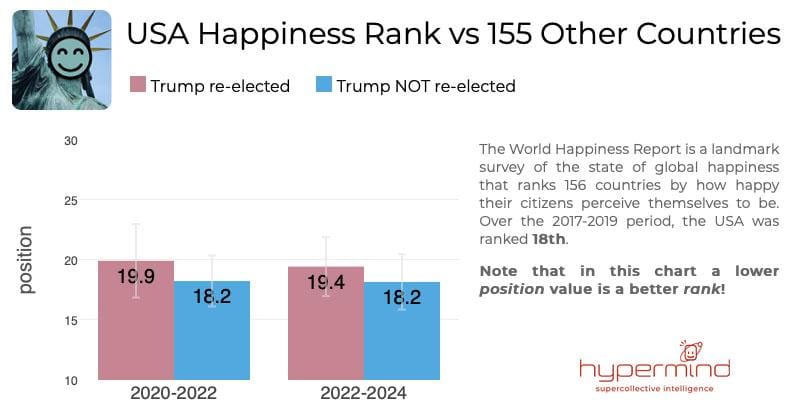
- If Trump was re-elected: a rank of about 19.9 for 2020–2022 and 19.4 for 2022–2024.
- If Trump was not re-elected: about 18.2 for both periods.
So the crowd expected a small difference, about one or two places, in favour of a Trump defeat. The error bars on the chart overlap, so the forecast was far from certain.
Joe Biden won the election, so only the “not re-elected” branch can be checked. The World Happiness Report for 2020–2022 data placed the United States 15th, about three places better than the forecast of 18.2. The report for 2022–2024 placed it 24th, about six places worse than forecast and, according to CBS News, the lowest US position since the report began in 2012.
One question checked against one outcome is not enough to judge the method. The crowd’s estimate was off by about three places in one period and about six in the other, in opposite directions. We have not found the final forecasts as of election day, or the forecasts for the other four measures, so we cannot score the full project.