
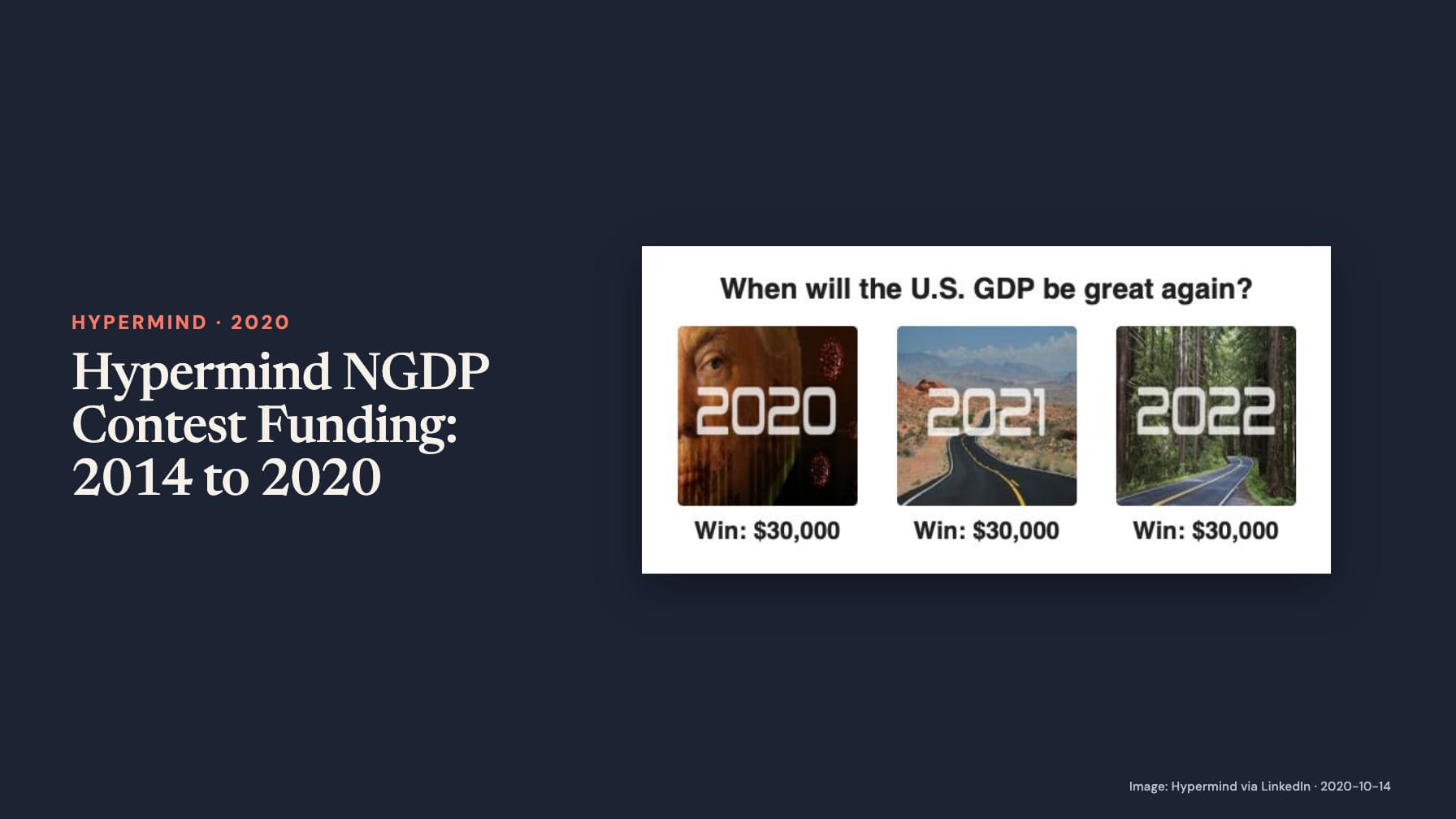
On 14 October 2020, Émile Servan-Schreiber shared a Hypermind invitation to forecast US nominal GDP “in this viral election year and beyond”. It advertised a share of a $90,000 prize, sponsored by the Mercatus Center at George Mason University. The attached graphic divided that total into three $30,000 amounts, labelled 2020, 2021 and 2022.
The funding question had arisen much earlier. On 16 December 2014, he announced a $10,000 nominal-GDP contest, describing it as designed by economist Scott Sumner and funded by Gabe Newell, Valve’s co-founder. The two announcements advertised sponsor-funded rewards at different stages of the experiment.
Why someone has to pay for the signal
A forecasting contest needs people willing to spend time assessing an uncertain outcome. In these announcements, sponsors supplied the rewards. Participants were invited to compete on their knowledge, with the contest seeking the information contained in their combined judgments.
Sumner’s own writing corroborates Newell’s role. In a June 2017 post, he thanked Newell for a $10,000 contribution to Hypermind and said Newell had made a similar contribution to the previous effort. Sumner explicitly described the goal as increasing trading volume. That is the rationale for subsidy: an interesting economic question alone may not attract enough activity to produce a useful signal.
Mercatus’s June 2018 account of an intervening contest describes trading without participants investing real money, with the most successful traders receiving Amazon gift certificates. It also describes winners using different approaches: economic models, long-term views and judgments about other participants’ errors. These payment details describe the intervening round, while the 2020 invitation advertises the later prize budget.
A prize budget is not an accuracy result
The 2017 Hypermind–Mercatus market is covered separately in this journal. The additional 2014 and 2020 announcements show the continuing effort to finance participation around the same economic variable. Nominal GDP measures output in current prices, so the question brings real activity and price changes together.
The 2020 invitation expanded the advertised reward to three annual $30,000 amounts. The practical funding problem stayed recognisable: ask people to devote attention to a difficult economic question and provide a reason to keep participating. Assessing the resulting signal is a separate task, requiring dated estimates compared with the GDP measure specified by the contract.