
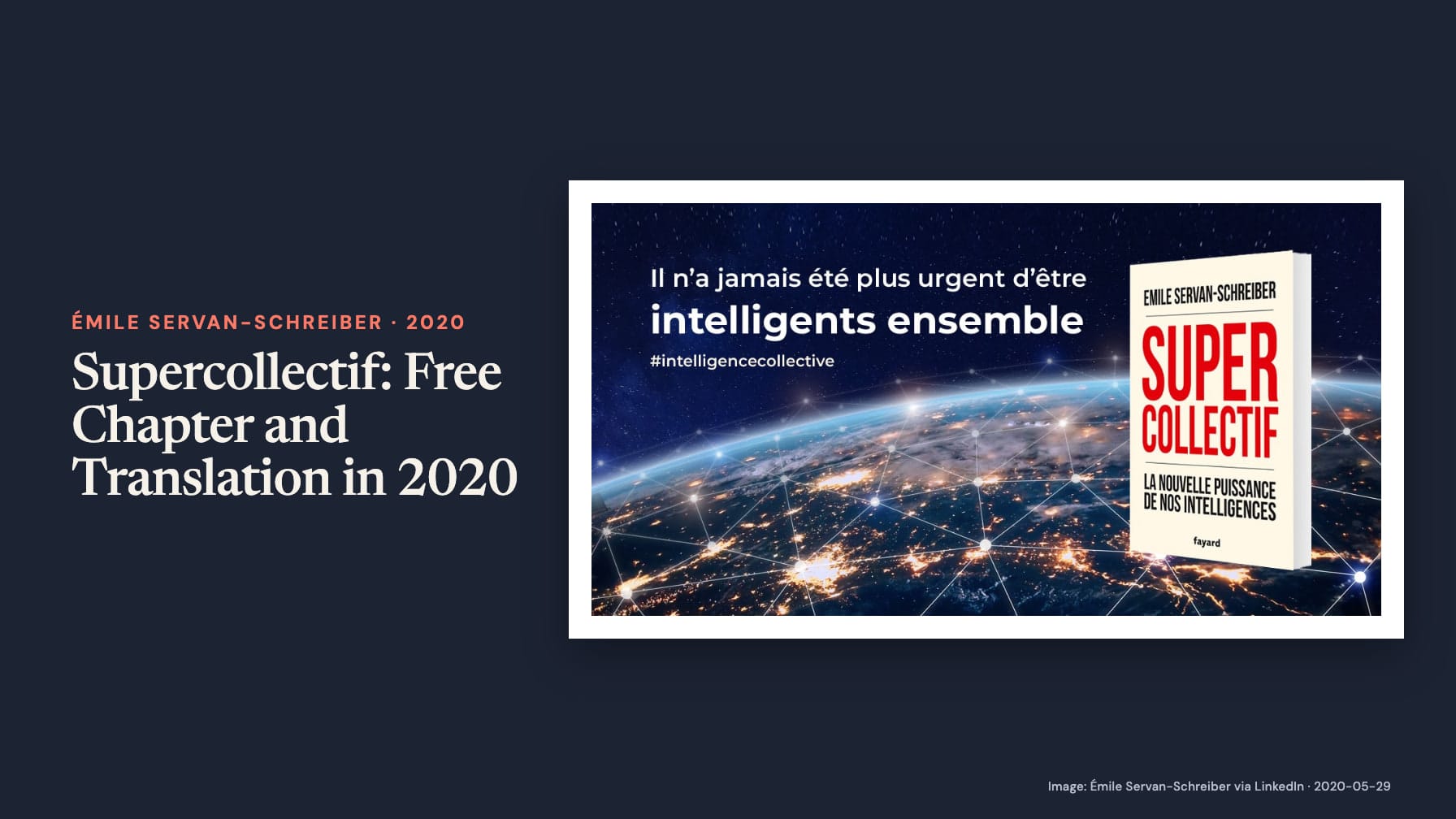
On 29 May 2020, Émile Servan-Schreiber shared a summary of Supercollectif and a link to download its first chapter free of charge. The offer was a way into a book that Fayard had published on 24 October 2018, rather than the announcement of a new edition. Earlier in 2020, a separate post had marked progress towards making the work available in English.
A translation completed, with review still ahead
On 28 January, Servan-Schreiber reshared Camille Larmanou’s announcement that he had finished translating the book into English. Larmanou thanked the author for entrusting him with the work and said the process had deepened his understanding of collective-intelligence research, from Francis Galton to MIT and UM6P’s School of Collective Intelligence.
He also made the stage of the work clear: considerable reviewing remained. Servan-Schreiber’s accompanying message indicated that something was coming soon. The announcement concerned a translation draft awaiting review. The later English-edition story covers its eventual printed release.
An invitation to read during the pandemic
The May summary explained why Servan-Schreiber wanted to make the argument easier to encounter. He wrote that the shock of COVID-19 had increased interest in collective intelligence and argued that improving the world required people to become more intelligent together. That was his interpretation of the moment, not a measured change in public attitudes.
In Servan-Schreiber’s summary, the free chapter introduced the book’s central challenge: digital connections create possibilities for combining many minds, but their value depends on organisation. The summary went on to identify diversity, decentralised sources, independence of thought and objective synthesis as conditions for useful collective judgement. It connected those ideas to prediction markets and their application in organisations and democracy.
Hypermind’s publications page also lists a link to the first chapter. This gives readers a way to examine the opening argument before choosing whether to read the whole book. The French publisher’s catalogue identifies the original title as Supercollectif. La nouvelle puissance de nos intelligences.
For forecasting, these milestones concern the spread of methods rather than a forecast outcome. A translation broadens who can engage with the argument; a free chapter lowers the barrier to examining it. These were two different routes to wider access, keeping a completed translation draft distinct from publication and a book’s proposals distinct from demonstrated results.