
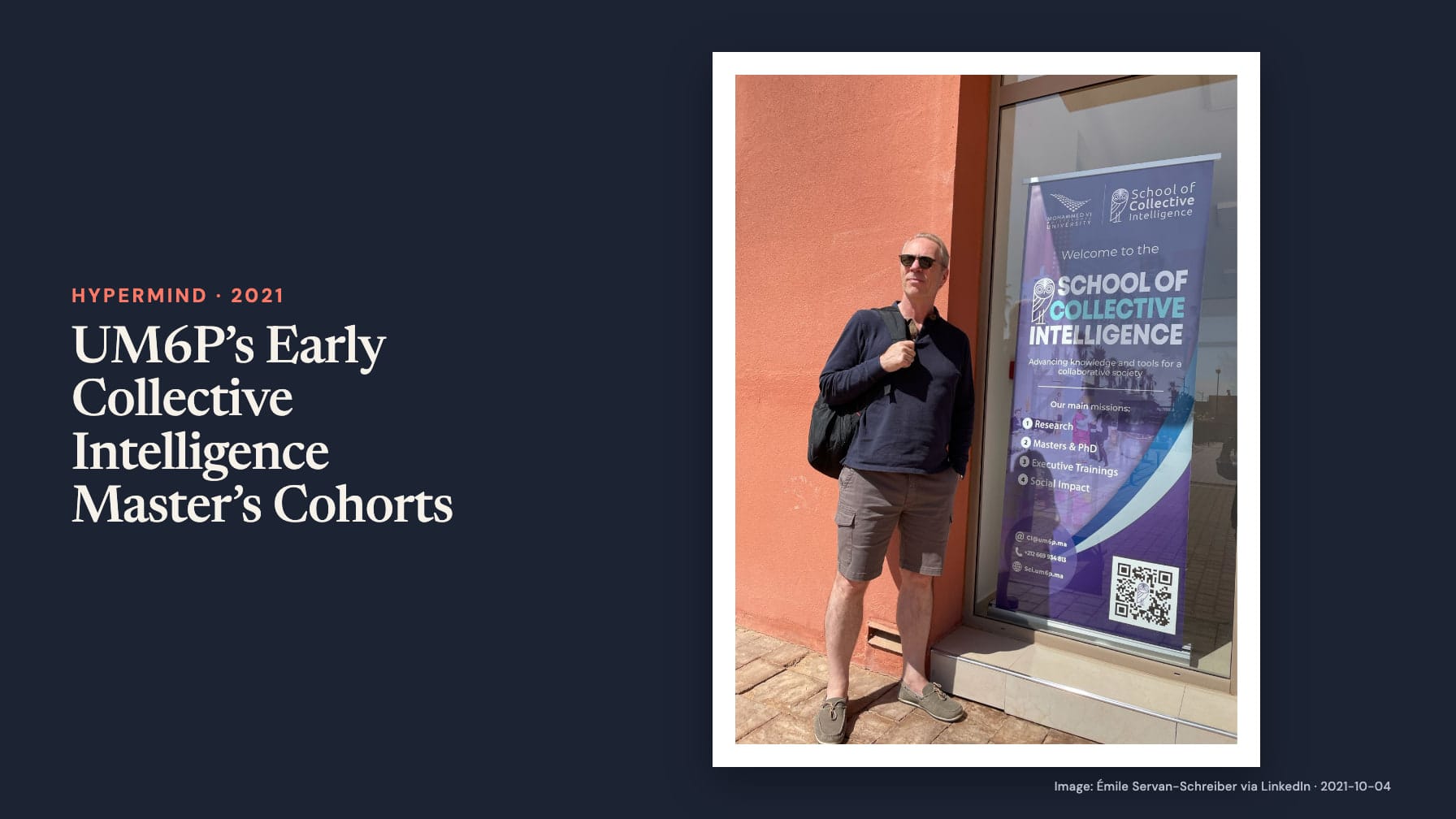
On 4 October 2021, Émile Servan-Schreiber announced another semester teaching crowd wisdom and prediction markets to master’s students at the UM6P School of Collective Intelligence. His enthusiasm for the students and international faculty followed a series of posts that began with recruitment in April 2020. It shows collective intelligence becoming a subject to teach, test and apply, alongside a forecasting practice.
Recruiting across disciplines
On 29 April 2020, he invited students from any discipline to apply. The announcement he shared from Bisan Abdulkader Germani placed cognitive science, data science, philosophy and entrepreneurship within the same programme. It proposed training in behavioural experiments, statistical methods and technologies designed to strengthen collective intelligence in organisations.
A May invitation pointed prospective applicants to a livestream with Lex Paulson, Bisan Abdulkader and Cathal O’Madagain. June recruitment posts directed them to a brochure and a faculty session with Servan-Schreiber, Mark Klein and Hugo Mercier. His 3 July account then shared the school’s report of that presentation, identifying Klein with MIT and Mercier with the École Normale Supérieure.
Those announcements were about how to educate people who could organise useful groups. Their stated scope reached beyond forecasting into management, collaboration and organisational change. The academic task was to connect practical methods to experiments that could establish whether they worked.
From remote classes to meeting the students
On 30 September 2020, Servan-Schreiber wrote about the school’s setting in Benguérir, Morocco, and said his master’s course would start on 19 October. His Christmas Day post described a semester taught through Microsoft Teams, followed by an opportunity to meet the students in person that week. The transition from remote teaching to an in-person meeting was part of his account of the first semester.
Recruitment resumed in April 2021 for a two-year master’s. The school’s announcement emphasised cognitive and data sciences, participatory methods and organisational design, with experimental and statistical techniques used to test different approaches. In October, Servan-Schreiber identified the focus of his own next semester as crowd wisdom and prediction markets.
Forecasting as something students can evaluate
A later official UM6P brochure independently lists Servan-Schreiber in cognitive science and crowd-based forecasting. Its curriculum combines statistics, computer science, cognitive science and experimental methods, followed by applied or research experience. That 2023 document corroborates the programme’s continuing educational design; it is not a transcript of the first cohort’s courses.
The connection to forecasting was concrete: students were being taught how many judgments can be combined, and how the result might be tested. Our account of proven forecasters supplies a related practical question: how should past performance affect the influence of an individual within a crowd?