
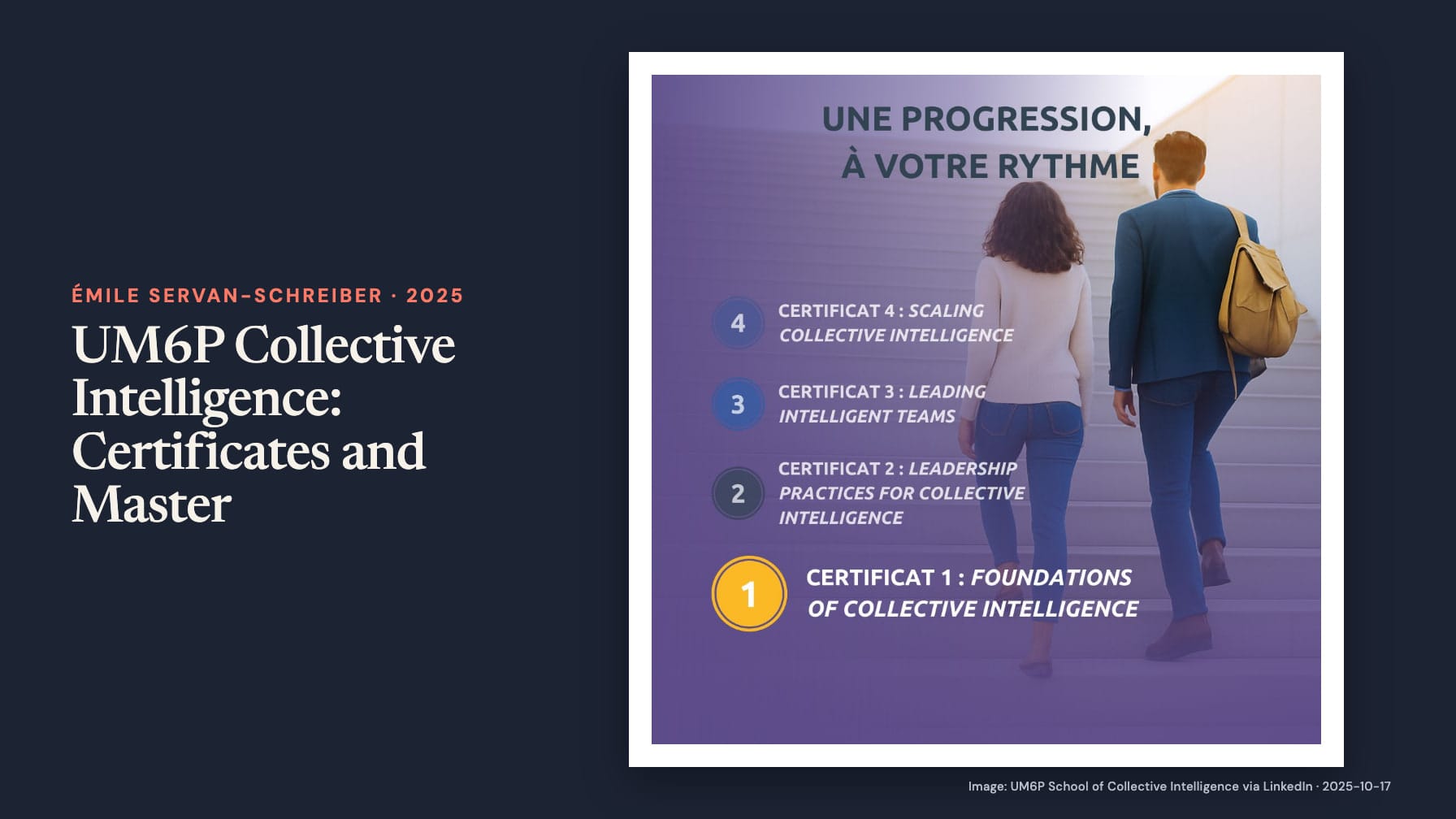
On 17 October 2025, Émile Servan-Schreiber shared an announcement from the UM6P School of Collective Intelligence about a new certificate pathway. Its first cohort was scheduled to begin in January 2026, starting with the foundations of collective intelligence. Participants were invited to advance one certificate at a time, according to their interests and capacity.
From an executive intake to modular study
An earlier announcement, shared on 16 May 2024, extended the application deadline for the school’s Executive Master to 19 May at 11 p.m. The announcement attributed the extension to a large number of applications. The later certificate pathway offered another structure for professional study: participants could commit to a particular stage before deciding whether to continue toward the full degree.
The October 2025 graphic laid out four stages: foundations, leadership practices, leading intelligent teams, and scaling collective intelligence. The school’s official certification page explains their relationship to a degree: completing four certificates and defending a thesis leads to an Executive Master’s in Collective Intelligence. A single certificate is therefore one stage of the pathway.
Forecasting within a broader toolkit
The official page describes certificates lasting six to ten training days each, aimed at managers, consultants, facilitators, executives and other professionals. Its stated skills include collaborative problem-solving, dialogue and storytelling, alongside digital tools such as prediction markets, deliberation platforms and AI-assisted team creativity.
An official Executive Master brochure uploaded in December 2025 adds detail on the forecasting component. Its prediction module concerns anticipating risks and examining strategic decisions through crowd wisdom, markets and contests. Other modules address cognition, creativity, dialogue and adaptive leadership. The brochure lists Servan-Schreiber’s teaching area as strategy and prediction.
For readers interested in how forecasting is taught, this pathway places prediction within a broader set of skills for working with groups. A manager may need to identify who holds useful information, invite contributions, organise discussion and select a method for combining judgements. The four-certificate structure lets participants approach those connected tasks in stages, with the thesis providing a further requirement for the Executive Master.