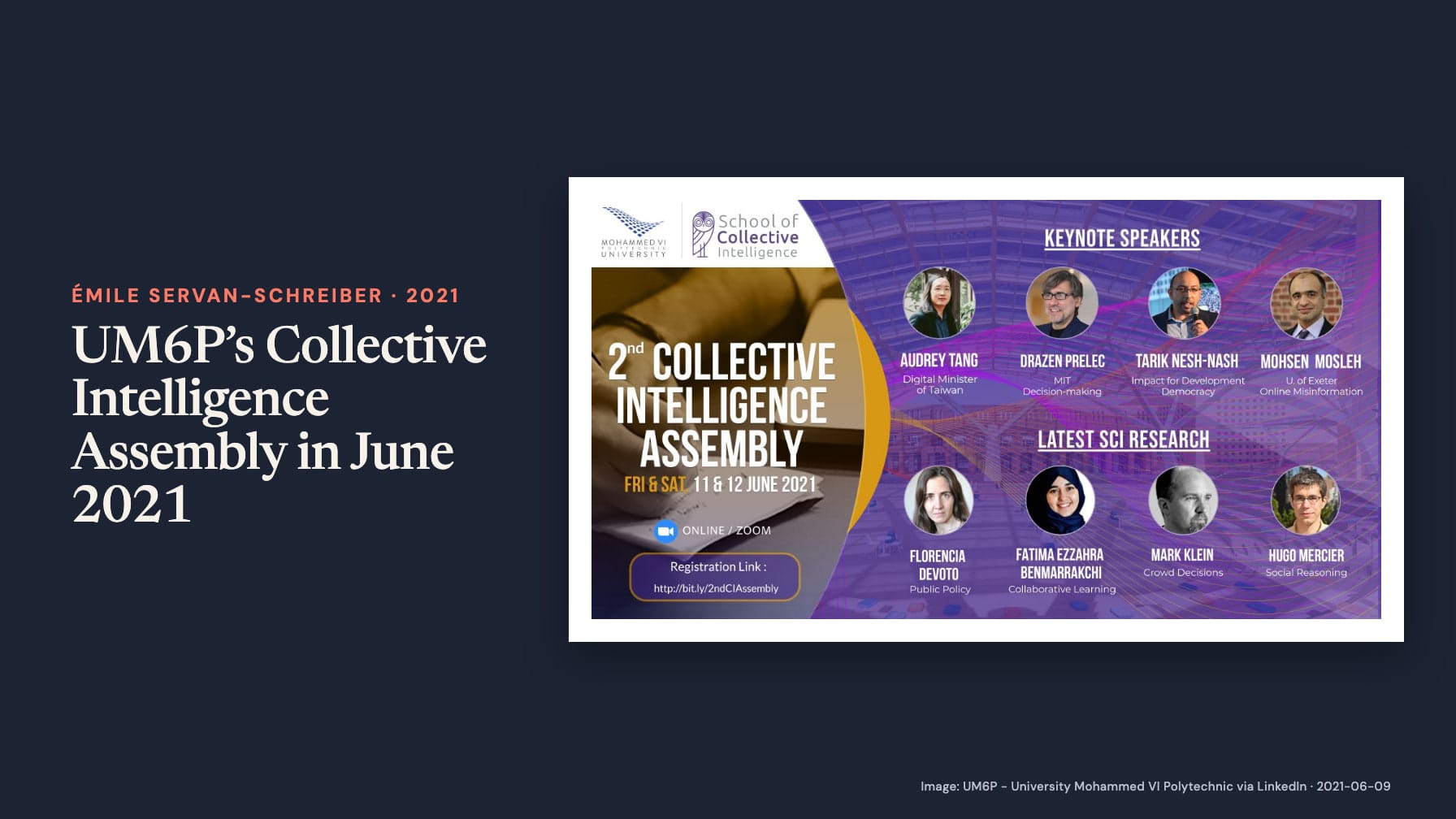
On 9 June 2021, Émile Servan-Schreiber shared Mohammed VI Polytechnic University’s invitation to its second Collective Intelligence Assembly. The university announced a free virtual event for Friday 11 and Saturday 12 June, combining recent research with an applied question: how could young people be encouraged to participate in Moroccan elections?
A programme spanning science and democracy
The university’s announcement named Audrey Tang, then Taiwan’s digital minister; MIT’s Dražen Prelec, associated with crowd decisions; and Tarik Nesh-Nash of Impact for Development. Its attached programme also listed Mohsen Mosleh of the University of Exeter on online misinformation. Together, the advertised topics connected methods for combining judgement with democratic participation and the information environment in which people make decisions.
The poster set out a second group of sessions on the school’s latest research: Florencia Devoto on public policy, Fatima Ezzahra Benmarrakchi on collaborative learning, Mark Klein on crowd decisions and Hugo Mercier on social reasoning. It specified an online Zoom format. The programme gave public policy, learning and social reasoning a place alongside methods for combining decisions.
Putting participation on the agenda
The invitation said organisers would coordinate a civic hackathon on inspiring youth participation in Moroccan elections. A hackathon in this setting was a proposed collaborative exercise around a public problem. Its purpose connected the research programme to a concrete civic challenge: creating ways for younger citizens to take part in public life.
For readers interested in forecasting, Prelec’s presence supplies a connection to research on eliciting and combining people’s judgements. Our article on minority rewards and prediction markets explores one such mechanism. The assembly’s programme instead placed crowd decisions beside other forms of collaboration, including learning and public-policy work.
The school’s institutional description identifies research, education and social impact as parts of its remit. The assembly brought those aims into one programme: share recent work, hear outside researchers and organise participation around a public problem. The invitation documents the planned programme; delivered sessions and hackathon results are unconfirmed.