
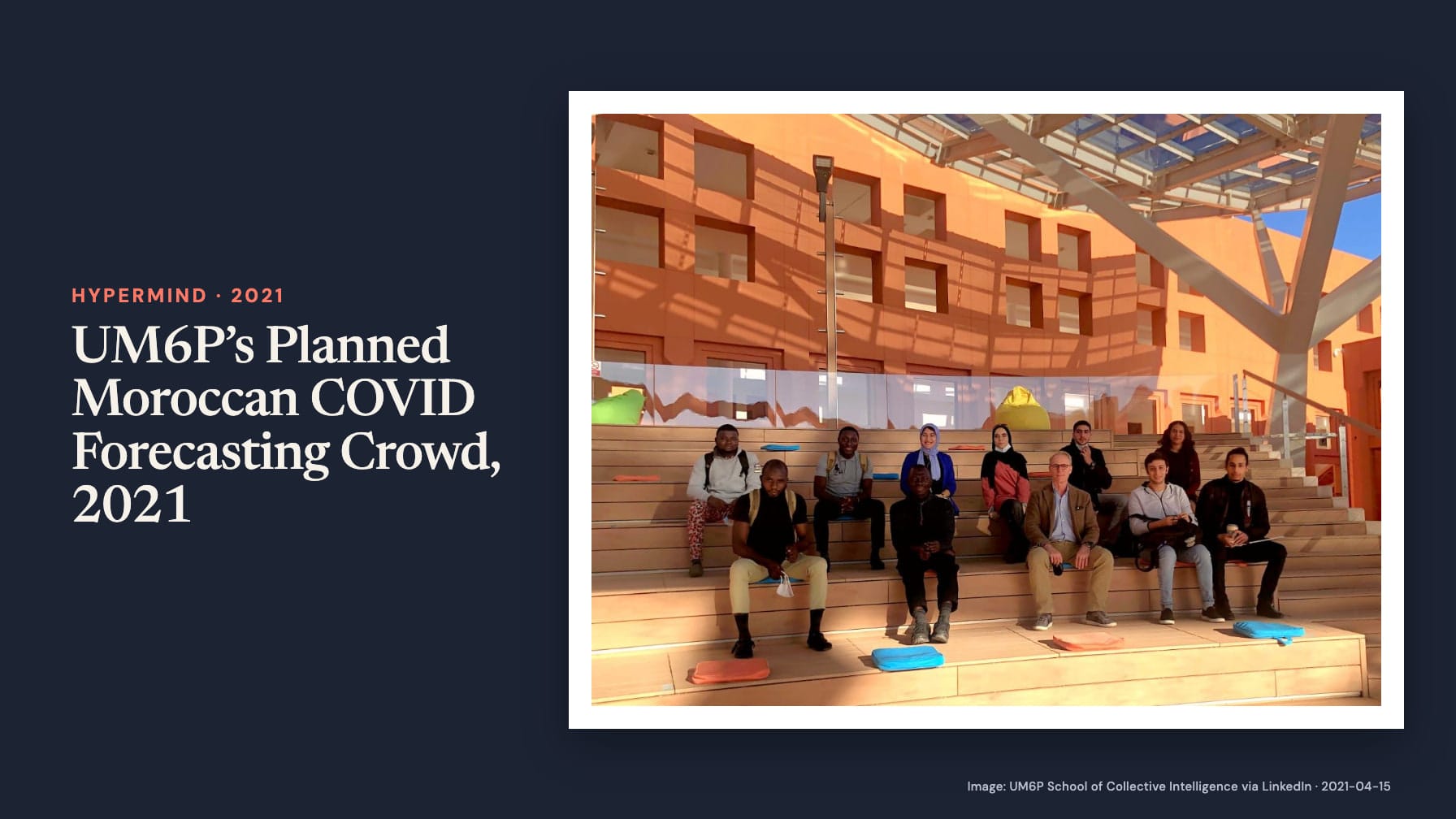
On 15 April 2021, Émile Servan-Schreiber reshared a researcher profile from the UM6P School of Collective Intelligence. Alongside his teaching, the profile announced a project intended to train a crowd of forecasters on the university campus to predict the evolution of the COVID-19 outbreak in Morocco. The start was planned for spring 2021.
The statement was prospective. Servan-Schreiber described a project he would lead, rather than reporting a trained cohort or completed forecasting contest. He said it was supported by a grant from the UM6P Social Innovation Lab and looked forward to working with researchers from SCI, CNRS and ENS. The grant and proposed research collaboration were details of his announcement.
Teaching the methods being used in practice
The school’s profile identified his master’s-level class as Collective Intelligence Methods in Computer Science. His accompanying research description focused on prediction markets and the wisdom of crowds: improving their operation, applying them to business and helping governments make better decisions. He linked that teaching to his practice as a founding director of Hypermind, conducting crowd-prediction projects with organisations and expert communities.
The Morocco proposal connected a training programme to a concrete public-health uncertainty. It aimed to build local forecasting capacity by teaching people to make collective predictions. Training matters because participants need to understand the target, express uncertainty consistently and revise estimates when new information arrives. Those are practical requirements for turning a group’s knowledge into useful forecasts.
Related research is context, not a project result
A separate peer-reviewed study, published in November 2021, examined infectious-disease forecasting with Johns Hopkins and Hypermind. It followed 562 participants over 15 months. The researchers used questions with specified outcomes and compared aggregated probabilities with the eventual results. That offers a relevant model for evaluating a forecasting programme, rather than evidence about the Moroccan project’s delivery.
The journal’s review of that disease-forecasting study covers its findings. The UM6P proposal concerns a different step: preparing people to contribute to a local forecasting resource. Its delivery and outcomes remain unverified. A future evaluation would need to distinguish participation in training, accuracy of individual estimates and the performance of their combined forecast.