
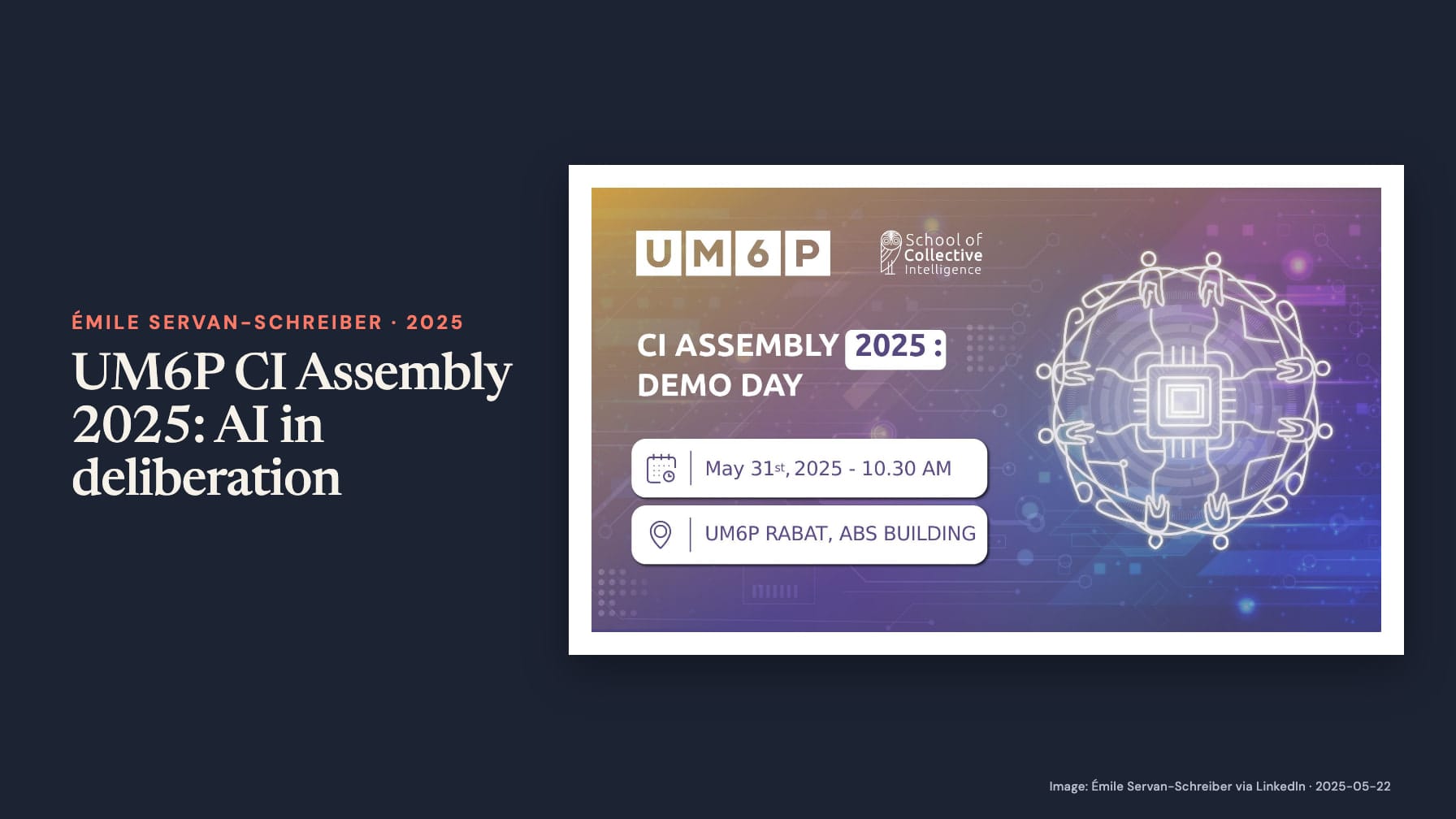
On 22 May 2025, Émile Servan-Schreiber reshared an invitation to the School of Collective Intelligence’s CI Assembly Demo Day at Mohammed VI Polytechnic University in Rabat. The subject was AI in deliberation: how technology might support fairer collective decisions and what that would mean for democracy.
The invitation announced 31 May and conversations with contributors from Stanford and Yale and with the school’s alumni. The accompanying poster specified 10:30 a.m. at UM6P Rabat’s ABS building. It framed fairness as a question to explore, rather than a result already achieved.
A workshop that separated values from feasibility
A later first-person report from the participating Optimum Pareto Foundation places the wider assembly on 30–31 May. It describes presentations of deliberation tools followed by workshops in which students could choose a tool to test. The foundation reports that 14 students used its Swarmcheck App to map arguments about integrating AI into school education in 2026.
The exercise split that proposition into two questions: whether integration would be desirable and whether it would be possible. Students added arguments and sources, tried comprehension assessments and voting, and navigated the resulting map. According to the foundation, participants valued having to address reasons on an anonymous map rather than the person presenting them.
Deliberation and forecasting ask different questions
That separation is relevant to forecasting. A group may favour a policy while doubting that it can be delivered by a deadline. Keeping those judgements apart makes the discussion easier to interpret. An argument map can expose the reasoning behind a choice; a probability forecast would additionally require a defined outcome and a way to check what happened.
These reports describe a demonstration of deliberation tools, without a comparative measure of fairness. The foundation’s account is valuable for its concrete description of the exercise: students could inspect reasons, add sources and distinguish support for a policy from belief in its feasibility.
The assembly complements the educational work described in Servan-Schreiber’s forecasting seminars. Its documented example concerns the organisation of a discussion: separating what people want from what they believe can happen, and making the supporting arguments visible.