
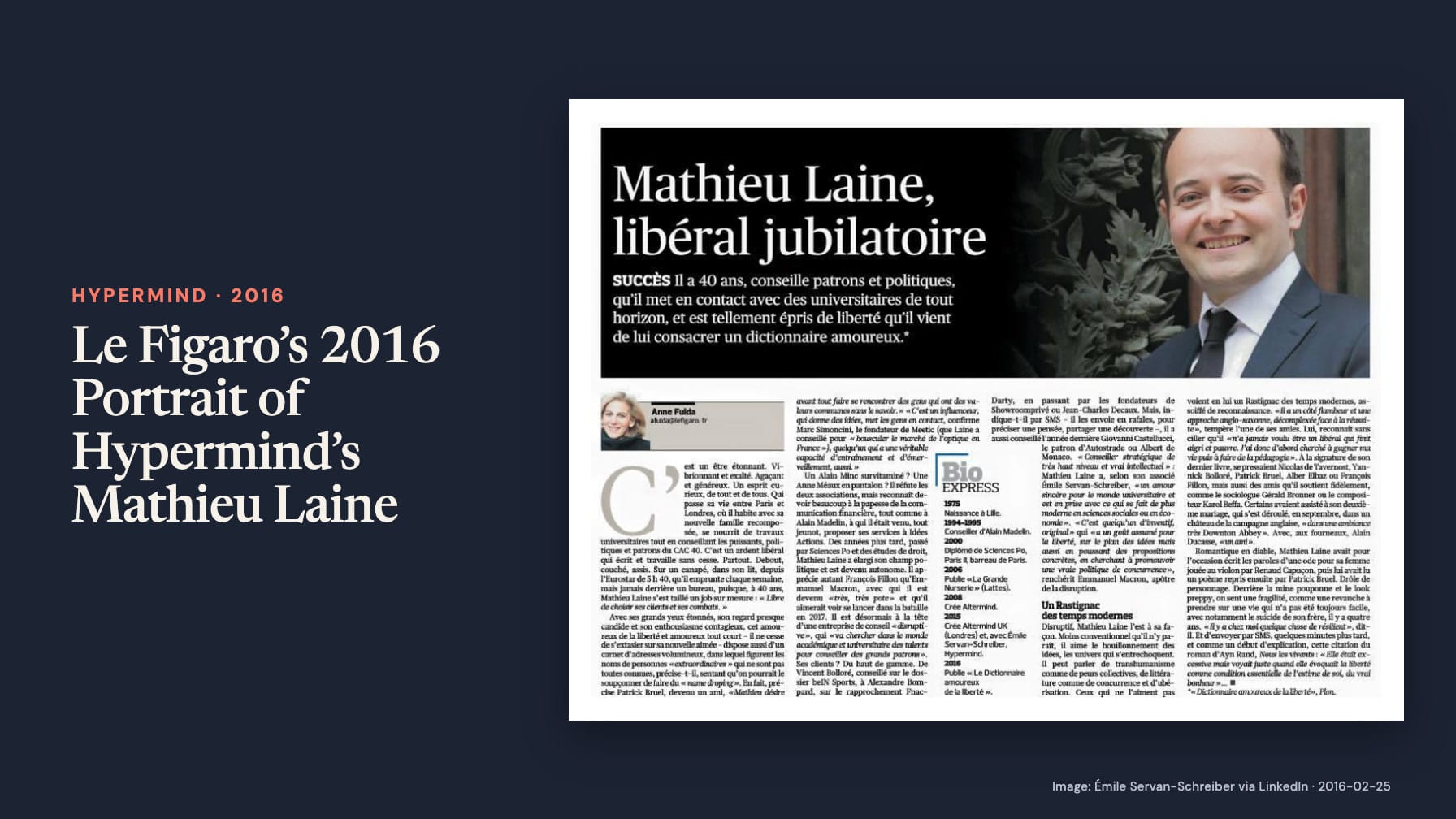
On 25 February 2016, Émile Servan-Schreiber shared Anne Fulda’s Le Figaro portrait of Mathieu Laine, describing him as his associate and Hypermind co-founder. The profile places that company connection within a broader account of Laine’s work bringing business leaders, politicians and university thinkers together.
Fulda’s portrait presents Laine as an adviser connecting business leaders and politicians with university thinkers. Its biographical column records the creation of Altermind in 2008 and, in 2015, the creation of Hypermind with Servan-Schreiber. The article also places Laine’s Dictionnaire amoureux de la liberté in 2016. These are contemporary details of the portrait, rather than a description of his current positions.
The Hypermind venture in its own period
A separate primary document supports the company connection. SRP Groupe’s registration document, registered on 8 September 2015, describes Laine as having co-founded the London prediction-market company Hypermind that year with Servan-Schreiber, in a joint venture with the American company Lumenogic. This distinguishes the venture described in the portrait from the longer history of the forecasting technology.
That history is followed in the journal’s account of Lumenogic’s later change to the Hypermind name. The 2015 filing documents a particular corporate arrangement; it does not make every earlier forecasting project part of the same founding event.
The founders had already explained their market to Le Point in its 4 June 2015 issue. In that interview, Servan-Schreiber described virtual trading and rewards for successful participants. Laine explained how prices expressed the participants’ collective assessment of future events, and how forecasting differed from measuring present opinion. Those explanations put a practical forecasting mechanism alongside the portrait’s account of connecting people and ideas.
The portrait connects two ways of bringing knowledge into decisions: introducing leaders to people with different expertise, and combining participants’ judgements through a prediction market. The contemporary filing explains the particular venture behind the Hypermind name. Together, those sources place Laine’s role in a dated company history, while the founders’ interview explains the forecasting mechanism they wanted readers to understand.