
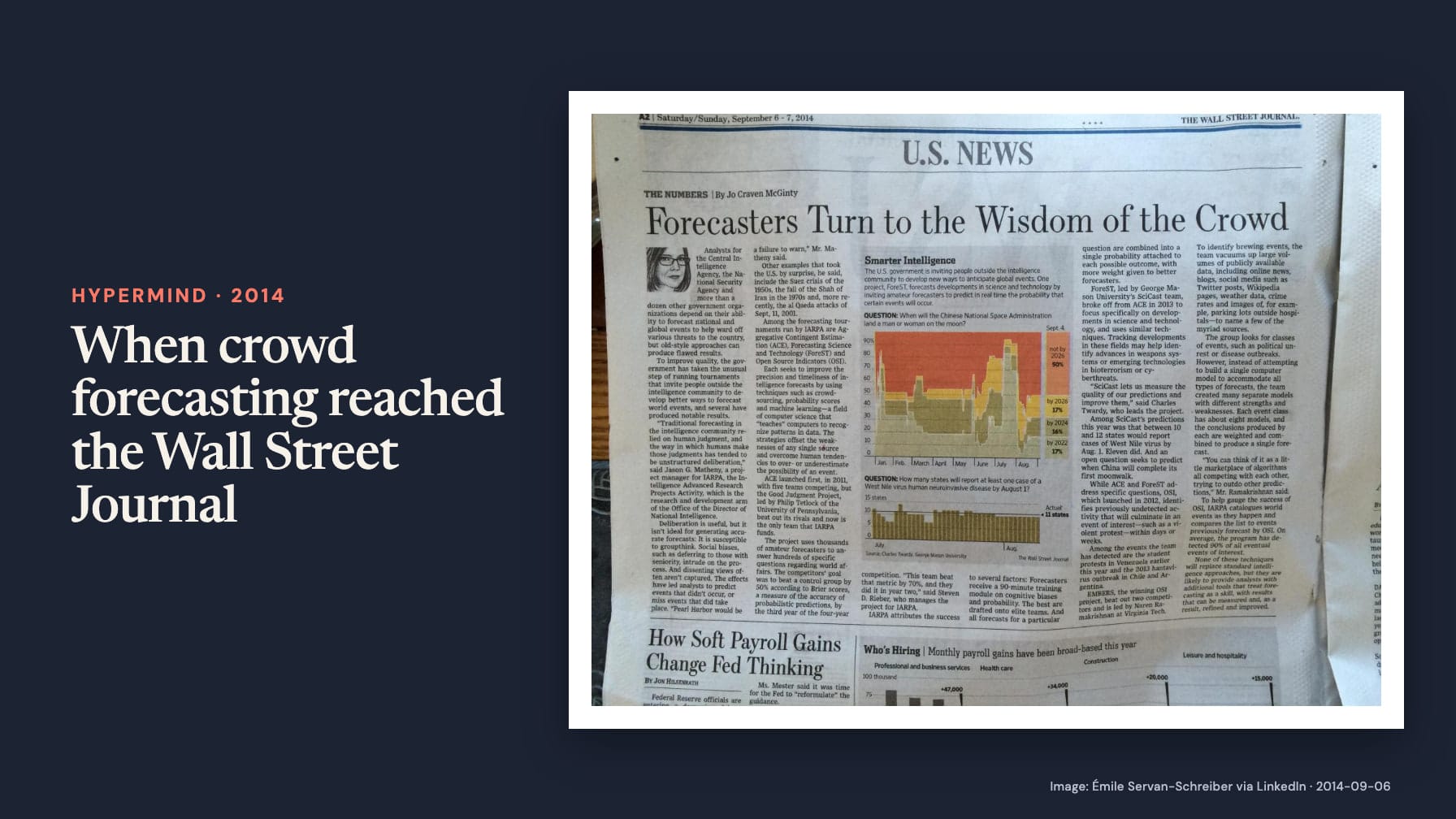
On 6 September 2014, Émile Servan-Schreiber shared a photograph of a Wall Street Journal page headlined Forecasters Turn to the Wisdom of the Crowd. His accompanying sentence pointed readers toward Hypermind.com. The clipping records a moment when organised crowd forecasting was reaching a general newspaper audience through the US intelligence community’s research tournaments.
The photographed page is dated 6–7 September 2014 and credits Jo Craven McGinty. Its online edition, updated on 5 September, used a different headline: U.S. Intelligence Community Explores More Rigorous Ways to Forecast Events. The article discusses IARPA’s Aggregative Contingent Estimation programme, Forecasting Science and Technology programme, and Open Source Indicators programme. Hypermind is Servan-Schreiber’s recommendation alongside that coverage; it is not named in the photographed article.
From discussion to testable forecasts
McGinty’s account contrasts informal deliberation with systems that capture predictions and evaluate them against events. It describes the Good Judgment Project, led by Philip Tetlock, and reports training in probability and cognitive biases, selection of stronger forecasters into teams, and aggregation that gives more weight to better forecasters. It also distinguishes those human forecasting methods from the open-data models used for early warnings. Those are different ways to improve anticipation, rather than a single prediction-market mechanism.
IARPA’s official ACE description confirms the programme’s focus on eliciting probability judgments, weighting and combining them, and testing accuracy against real events. Its later historical account identifies Good Judgment as the winning team and records the public release of programme data in 2017. These sources support the research context without transferring its results to Hypermind.
A contemporary SRI account dated 26 August 2014 explains SciCast’s science and technology forecasting work under ForeST. It describes a point-based prediction market where participants could answer questions and propose new ones with supporting material. The research was intended to test whether those collective judgments generated accurate forecasts.
Servan-Schreiber’s comment directed readers from research coverage to a forecasting platform they could explore. The newspaper feature described several approaches to anticipation, with different sources of information and ways to combine them. Our history of prediction markets in newsrooms follows a related editorial opportunity: readers can contribute estimates, while published forecasts remain accountable to clearly specified questions and subsequent outcomes. The important distinction is between reporting on a research programme and endorsing a particular platform. Here, the Hypermind recommendation came from Servan-Schreiber.