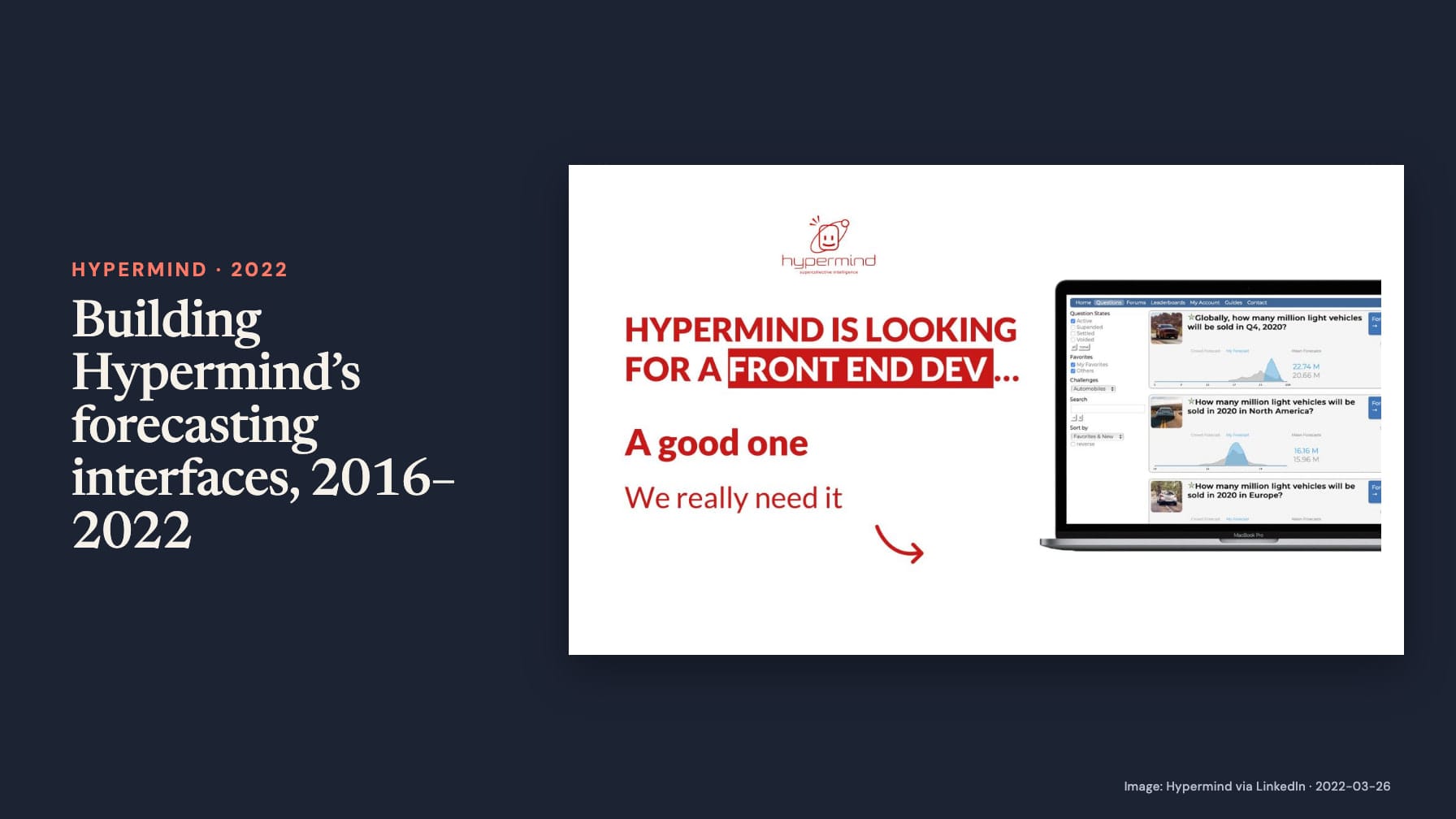
On 26 March 2022, Émile Servan-Schreiber shared English and French versions of a Hypermind front-end developer vacancy. His accompanying message asked whether someone could help make the company’s collective-intelligence applications beautiful as well as smart. The two posts describe one recruitment campaign, not two separate product launches.
Together with vacancies from 2016 and 2020, the announcement describes the work involved in building interfaces for crowd forecasting. People need ways to submit judgements and consult the collective estimate; the vacancies show the company seeking skills to maintain and develop those points of contact.
Public and corporate applications
The earliest post, dated 11 February 2016, sought a developer to maintain and extend the Hypermind prediction-market platform and other collective-intelligence platforms for public and corporate use. It named jQuery as an example of a relevant interface framework. The position could be full-time, part-time or contract work and was explicitly open to someone working anywhere in the world.
The recruitment address used the Lumenogic name. Hypermind’s official company history identifies Lumenogic as the company that launched the Hypermind market in 2014. The journal’s account of the later branding change provides the wider business context. The job post itself establishes that the public market sat alongside corporate applications.
Mobile interfaces and remote collaboration
On 12 September 2020, Servan-Schreiber sought a developer for collective-intelligence interfaces, particularly mobile ones. The listed requirements included HTML5, CSS3, JavaScript, JSON and RESTful APIs. Java, IntelliJ and web-wrapping tools such as Apache Cordova and Ionic were optional skills. A vacancy naming a tool is evidence of a hiring requirement, not proof that it became part of the production platform.
The post accepted several routes to demonstrating ability: formal training, development experience or personally built mobile applications whose code could be reviewed. It also required technical English, autonomy and fully remote work. Those details describe a distributed team’s working needs rather than a particular software architecture.
The 2022 interface brief
The March 2022 announcement placed the role under CTO Maurice Balick. It combined HTML, JavaScript and CSS development with use of back-office services through AJAX, graphical work with colleagues and dynamic interface modules. Fluent English and collaboration across continents were prominent requirements.
The sequence connects three recurring needs: public and corporate applications, mobile interfaces and collaboration across a remote team. By 2022, the brief combined programming with graphical design and communication with colleagues. Its focus on making applications easier to use complements the statistical work behind collective forecasting. The vacancies document intended responsibilities, without establishing which hires or redesigned features followed.