
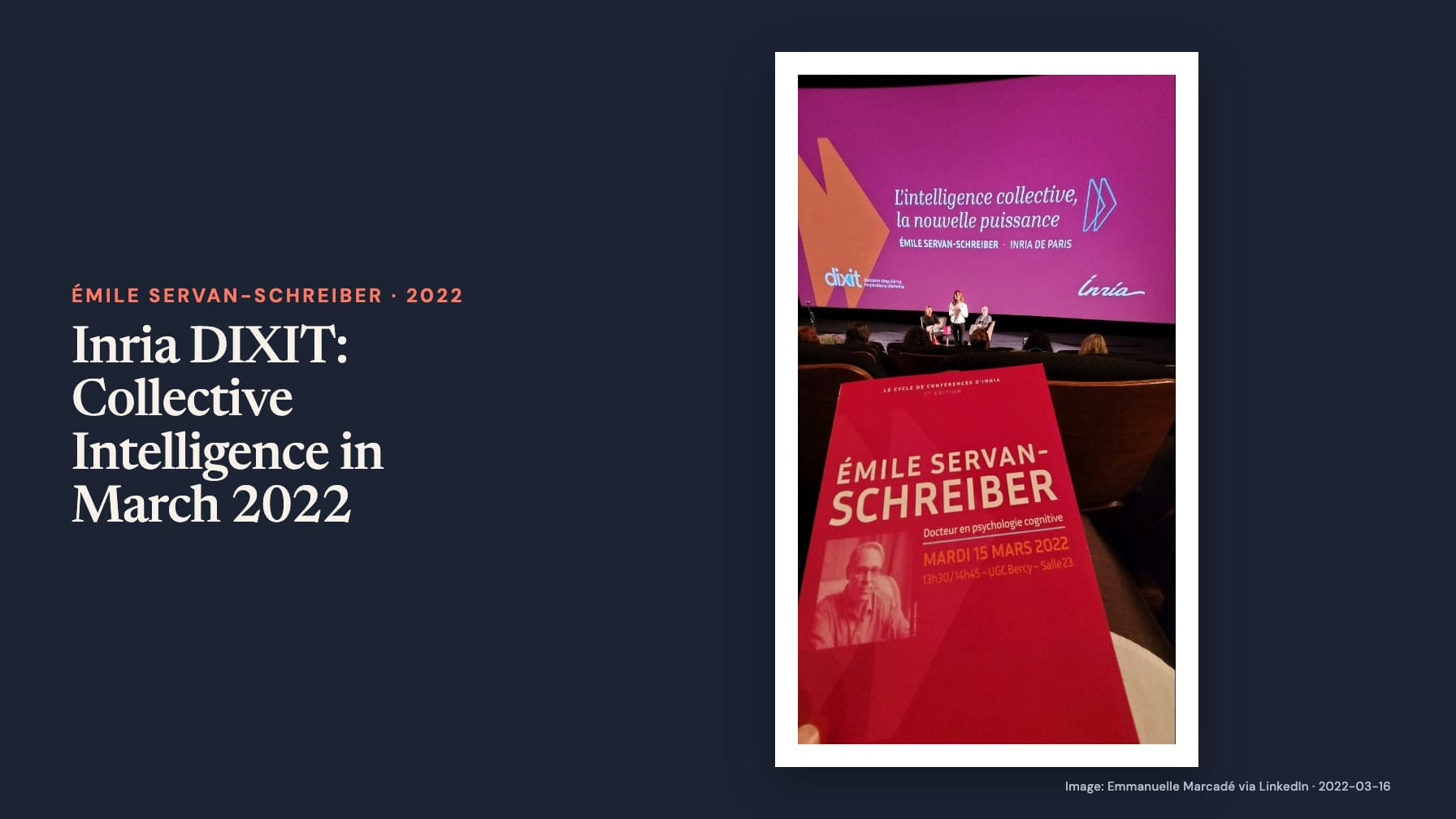
On 15 March 2022, Émile Servan-Schreiber spoke about collective intelligence at the opening event of Inria’s DIXIT conference series. The programme artwork gives the title L’intelligence collective, la nouvelle puissance. In our translation: Collective intelligence, the new power. Attendee accounts reshared the next day describe a discussion spanning psychology, sociology and digital research.
A staff conference about rebuilding connections
In the advance announcement, Laurent Stencel described DIXIT as an initiative for Inria personnel after two difficult years. The theme was renewal: a chance to step back, regain perspective and meet again. He named Inria’s communications teams, TERRE DE SIENNE and HRCLS in the organisation of the series, and said its content would become accessible in podcast form.
The printed programme specified UGC Bercy, Salle 23, from 13:30 to 14:45 on Tuesday 15 March. Photographs show DIXIT and Inria branding inside a cinema auditorium. Holding the discussion outside an ordinary work meeting matched the announced aim of stepping back and reconnecting, with collective intelligence as the first subject of the new series.
What attendees took from the discussion
Emmanuelle Marcadé’s account highlighted three ideas. First, the web creates a scale of connected group that Servan-Schreiber calls supercollective. Second, a group’s ability to use its members’ knowledge depends on the quality of their interactions as well as their individual reasoning. Third, conformity can suppress the differences that make a collective useful. Her recap emphasised the organisation of exchange alongside the technical ability to connect people.
Woolley and colleagues’ 2010 Science study linked small-group performance with social sensitivity and more equal speaking turns. It offers research context, without evaluating DIXIT.
Organising a useful collective
Stencel’s follow-up thanked Servan-Schreiber and Laurence Garcia and anticipated a podcast at the end of March; its public release has not been verified. His response stressed the value of bringing individual differences into an organisation’s shared work. Marcadé’s account approached the same concern through conformity: participants need room to argue for a view of their own.
The forecasting connection is practical. Independent perspectives must survive the group process before they can inform a shared estimate. That concern also runs through Servan-Schreiber’s later Institut Diderot discussion. DIXIT brought those conditions into a discussion for staff about how to work together after a difficult period.