
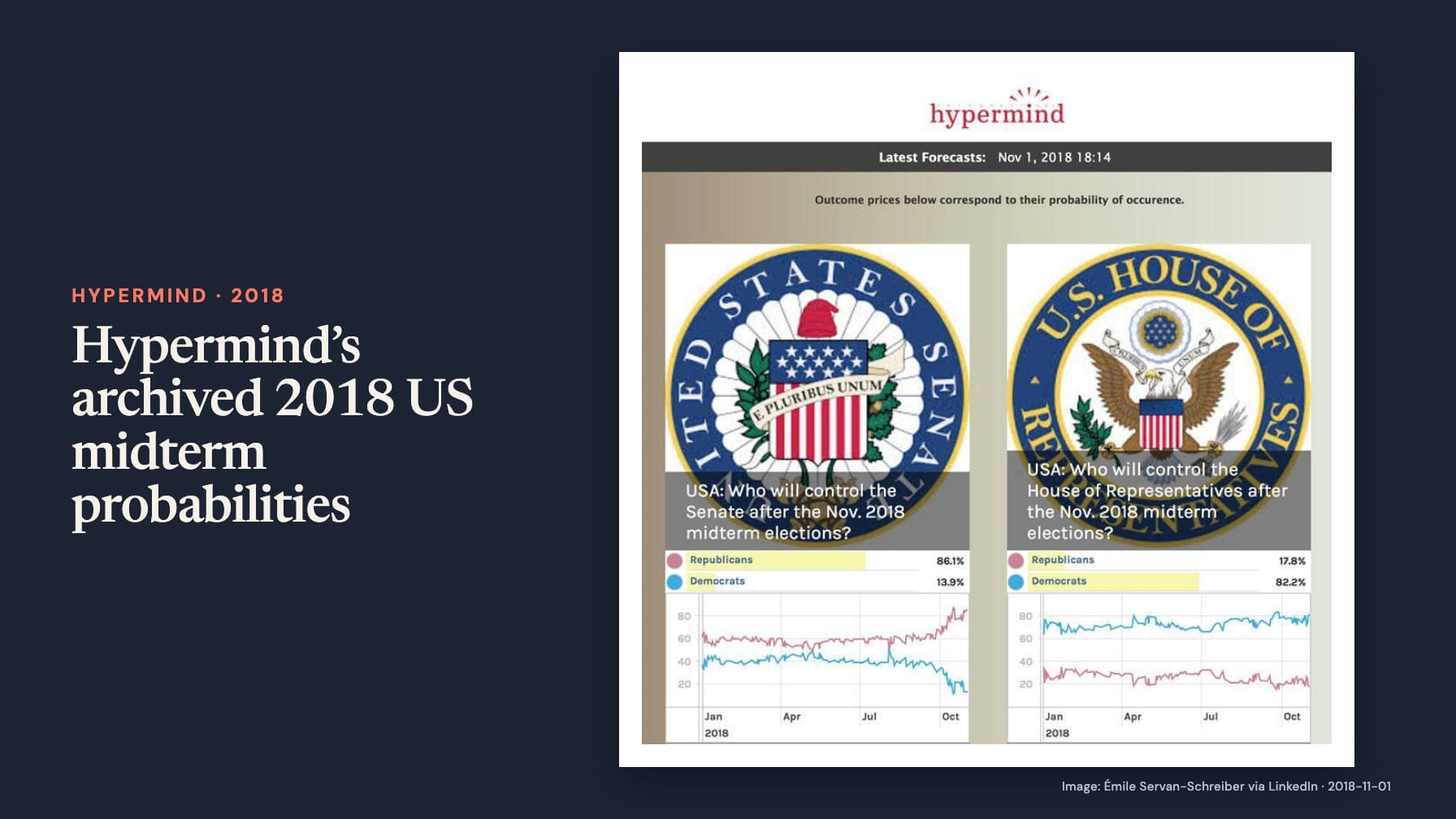
On 1 November 2018, five days before the US midterm elections, Émile Servan-Schreiber posted Hypermind’s forecasts for control of the two chambers of Congress. The attached dashboard favoured a split outcome: Republicans keeping the Senate and Democrats taking the House of Representatives. The elections produced that division.
The probabilities preserved in the dashboard
The dashboard is labelled 1 November 2018 at 18:14, with no time zone specified. It was attached to Servan-Schreiber’s LinkedIn update that day. Keeping that date with the numbers matters: the forecast was an assessment before voting, and the public dashboard could continue changing afterwards.
- Senate control after the November 2018 midterm elections: Republicans 86.1%, Democrats 13.9%.
- House control after the November 2018 midterm elections: Republicans 17.8%, Democrats 82.2%.
These figures are probabilities of controlling a chamber, rather than expected percentages of seats or votes. The two panels should also be read separately. They assign strong probabilities to different parties in the two chambers; they do not display a separate joint probability for a split Congress.
What happened after the election
The Federal Election Commission’s official compilation reports the resulting composition of the 116th Congress: 53 Republican senators, 45 Democrats and two independents; in the House, 235 Democrats, 199 Republicans and one vacancy. Those totals establish Republican Senate control and Democratic House control.
The compilation includes the Mississippi Senate runoff later in November and explains that the North Carolina ninth congressional district’s House result was not certified, requiring a new election. The vacancy did not put Democratic House control in doubt.
Two correct favourites, rather than proof of calibration
Both winning outcomes were clear favourites in the preserved forecast. The snapshot still allowed a minority probability for the alternatives. That is the point of recording percentages: readers can distinguish a confident judgement from a bare prediction of a winner.
Servan-Schreiber invited readers to follow real-time updates. These are the probabilities he published on 1 November, rather than asserted closing prices. The journal’s explanation of calibration and forecast accuracy shows why two successful favourites do not establish a general performance record. That requires many resolved questions, their dated probabilities and consistent scoring. The 2018 case contributes two dated observations to that kind of record.