
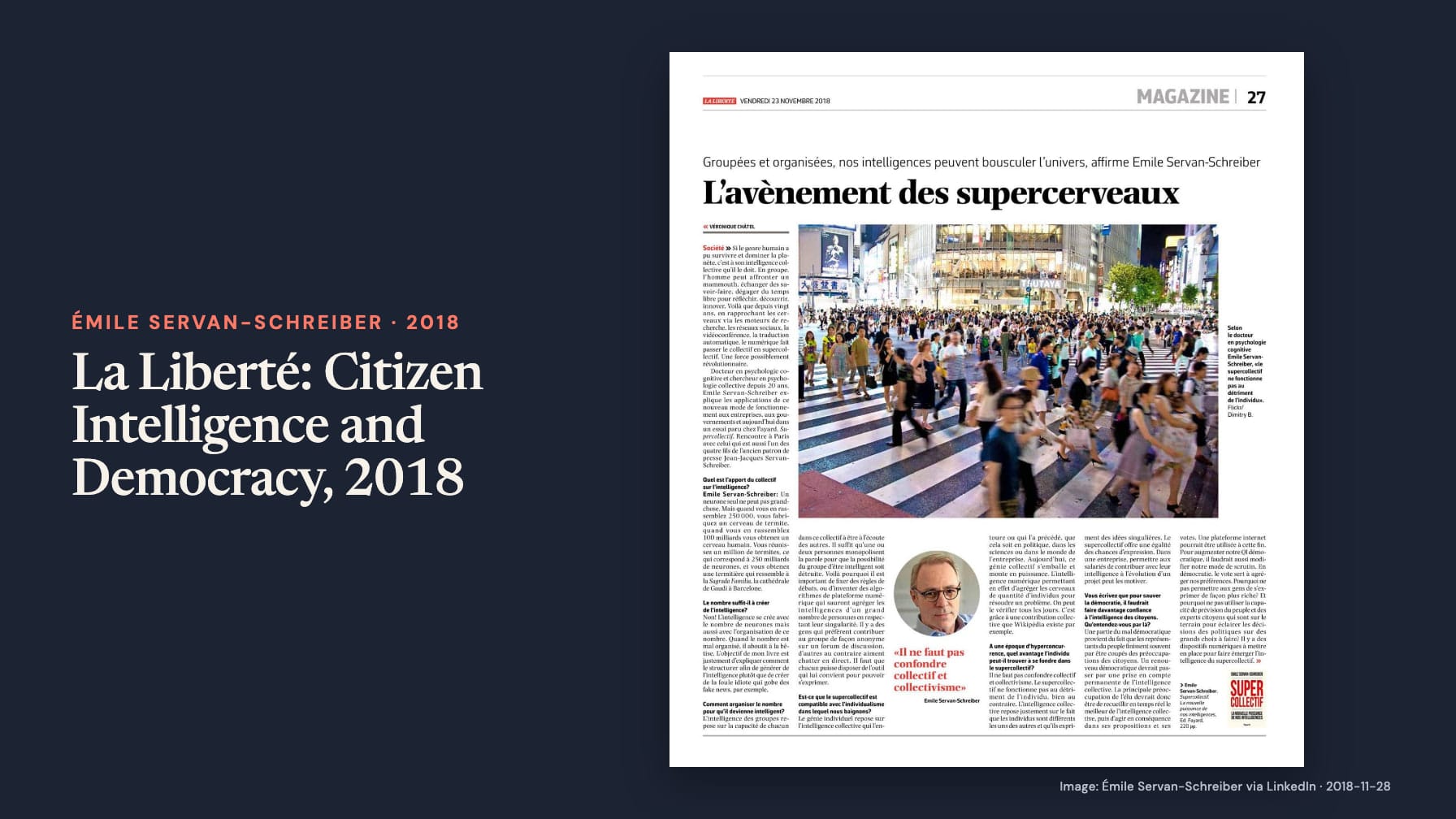
On 28 November 2018, Émile Servan-Schreiber shared an excerpt from an interview in the Swiss newspaper La Liberté. His proposal was that elected representatives should continually collect citizens’ collective judgement and act on it. The attached magazine page dates the interview to 23 November, credits Véronique Châtel and places it alongside his recently published book Supercollectif.
The problem of representatives losing contact
Servan-Schreiber argued that part of democracy’s difficulty comes from representatives becoming disconnected from citizens’ concerns. His remedy was ongoing participation: officials should gather the best available collective judgement in real time, then incorporate it into their proposals and votes. This was a political proposal, not a report of a system already adopted by a government.
The fuller interview goes beyond the excerpt. He suggested using an internet platform to collect contributions and argued for revisiting voting methods so that citizens could express preferences more richly. He also proposed drawing on the forecasting capacity of citizens and people with relevant experience to illuminate the consequences of major policy choices.
Those are related but distinct functions. Expressing a preference tells an official what people want. Forecasting asks what is likely to happen under a defined course of action. A democratic decision may need both, but a probability does not settle the question of which outcome a community ought to pursue.
Organisation protects individual contributions
Throughout the interview, Servan-Schreiber insisted that numbers alone do not make a group intelligent. He emphasised listening, rules for discussion and aggregation methods that can combine contributions while respecting individual differences. His concise distinction was:
Il ne faut pas confondre collectif et collectivisme
Émile Servan-Schreiber, La Liberté, 23 November 2018
In our translation: We must not confuse the collective with collectivism. In his account, the point of collective organisation was to allow distinct individuals to contribute, rather than erase their differences.
The proposal connects to themes explored in our article on citizen forecasting and democratic policy. Its forecasting relevance is the attempt to connect public participation with consequences that can be examined and eventually checked. In Servan-Schreiber’s argument, ongoing citizen contributions would help representatives retain contact with the people affected by their decisions, while forecasts would supply another kind of input: expectations about the consequences of possible policies.