
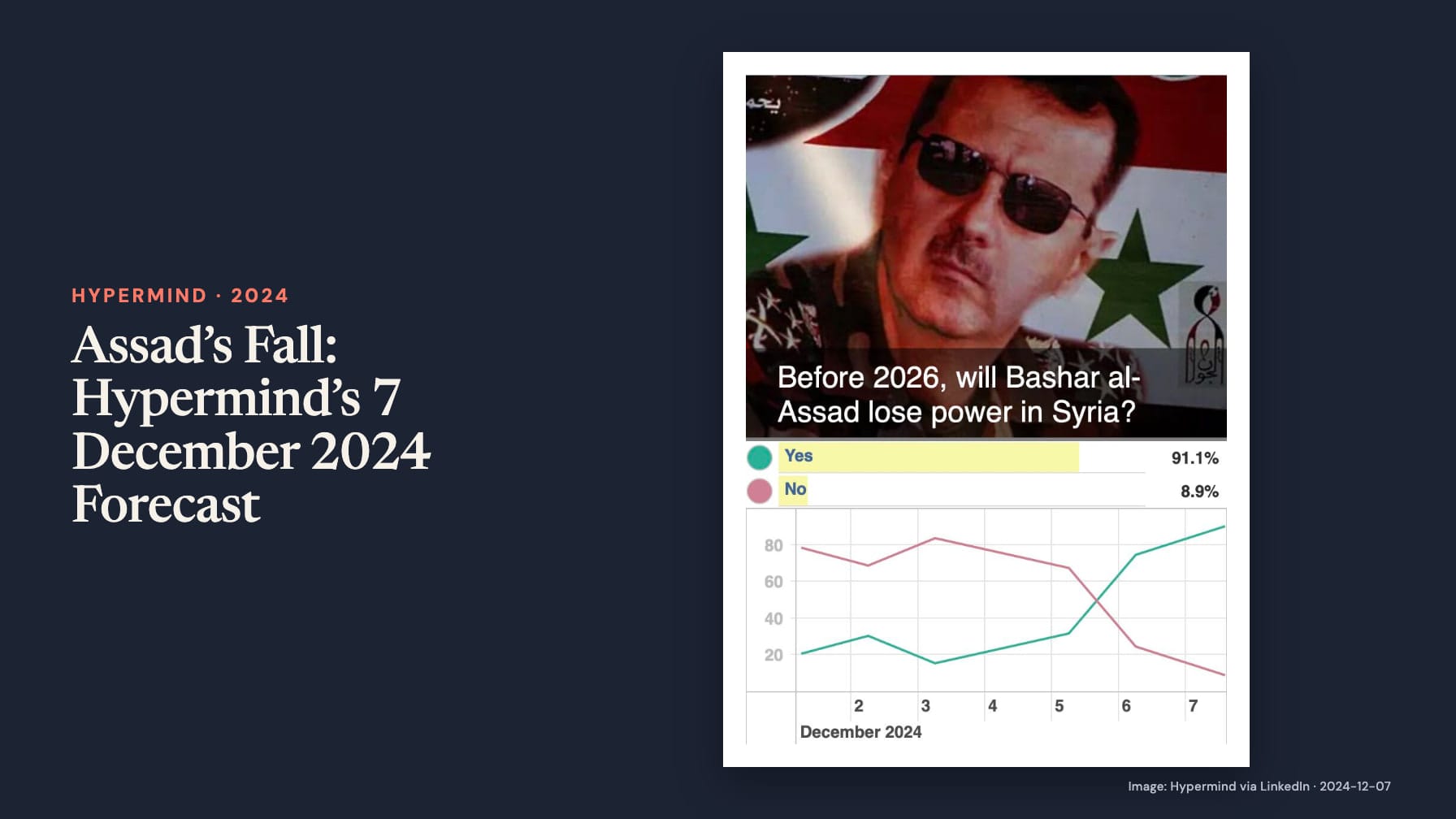
On 7 December 2024, Émile Servan-Schreiber shared a Hypermind forecast about Bashar al-Assad’s survival in office. The accompanying image asked whether Assad would lose power in Syria before 2026. It displayed 91.1% for “Yes” and 8.9% for “No”. The next day, Assad’s government fell, an event subsequently documented by the United Nations commission of inquiry on Syria.
The question and the evidence date
The forecast’s horizon matters. The contract asked about removal before 2026, not about the next day or even the next week. Hypermind’s accompanying comment suggested that the end was approaching, but the chart’s probability cannot be translated into a 91.1% chance of an immediate fall. It covered the whole remaining period to its deadline.
The chart also preserves a short history of changing assessments during December 2024. The “Yes” and “No” lines reverse their ordering between the labels for 5 and 6 December, before “Yes” reaches the displayed 91.1%. That is evidence of a substantial update in the week shown. The displayed 91.1% is the figure in the snapshot shared on 7 December, following that rapid reversal.
What happened afterwards
The UN commission’s report states that Assad’s government fell on 8 December 2024: the president fled and opposition forces entered and took over Damascus. This confirms the substantive event asked about in the screenshot. Hypermind’s detailed settlement record is unavailable.
Servan-Schreiber’s own comment expressed doubt that whatever followed would be much better. It was an opinion about Syria’s uncertain future, separate from the market’s probability about Assad. A forecast of a leader’s departure does not establish what follows, who governs effectively or whether conditions improve for citizens.