
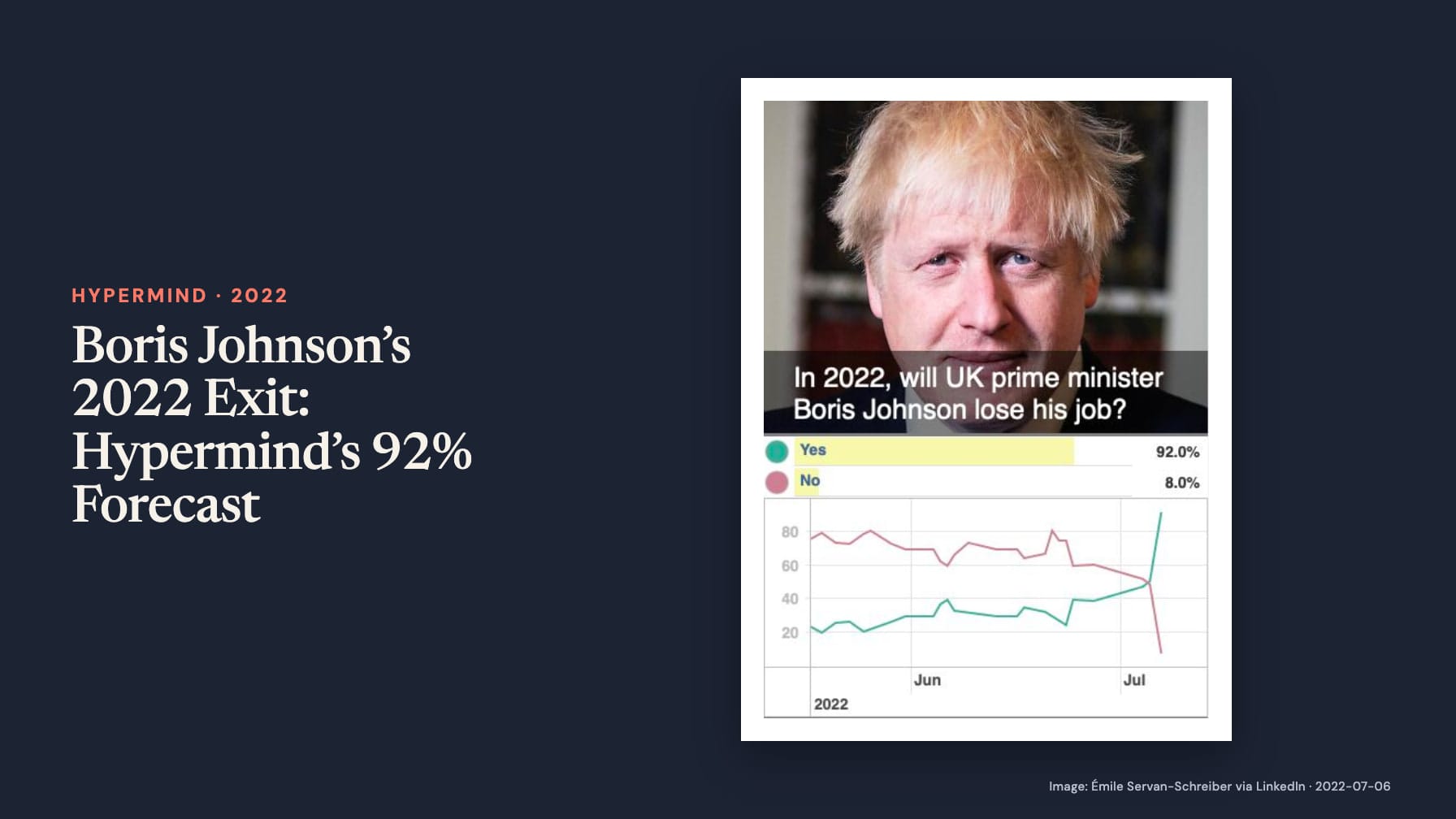
On 6 July 2022, at 19:14:52 UTC, Émile Servan-Schreiber posted that Hypermind’s prediction market thought Boris Johnson had a good chance of soon being out of a job. The accompanying image gives the statement a more precise meaning. It asks whether the UK prime minister would lose his job in 2022 and displays yes at 92.0%, no at 8.0%.
The date and the horizon matter
The market card sets a calendar-year horizon. It does not say that Johnson would leave Downing Street the next morning, or forecast the number of days until his departure. Servan-Schreiber’s informal description of the danger should therefore be read alongside the question on the image rather than substituted for it.
This was already a crisis in public view. The government’s published record dates Rishi Sunak’s resignation letter, and the prime minister’s response, to 5 July. The Hypermind snapshot came the following evening. It documents the crowd’s assessment during that crisis, not a months-ahead prediction made before the ministerial break became public.
The chart’s final movement is steep, with the displayed yes probability reaching 92.0%. That visual history places the estimate in a changing political situation. Its useful evidence is the figure shared on 6 July, rather than an inference that the market had anticipated the crisis far in advance.
Announcement on July 7, departure on September 6
In his official statement on 7 July, Johnson acknowledged that the parliamentary Conservative Party wanted a new leader and therefore a new prime minister. He also said he would serve until that leader was in place. The announcement and the end of his time as prime minister were separate events.
The government’s biographical record gives his term as 24 July 2019 to 6 September 2022. His final speech as prime minister is also dated 6 September. Those records establish that he left the job during the year covered by the chart. The platform’s full settlement rules are unavailable.
What the example can establish
The July 6 snapshot assigned a high probability to an event that subsequently happened. It is a clear, dated example of a market reacting to political-survival risk. It is also a narrow test: the forecast was observed during an advanced crisis, and a single high-probability outcome supplies little evidence about accuracy across many questions.
The journal’s guide to calibration and forecast accuracy explains how repeated probabilities can be judged. For this case, the useful record is simpler: who forecast, when the figure was published, which job the question concerned, and the distinction between a resignation announcement and actually leaving office.