
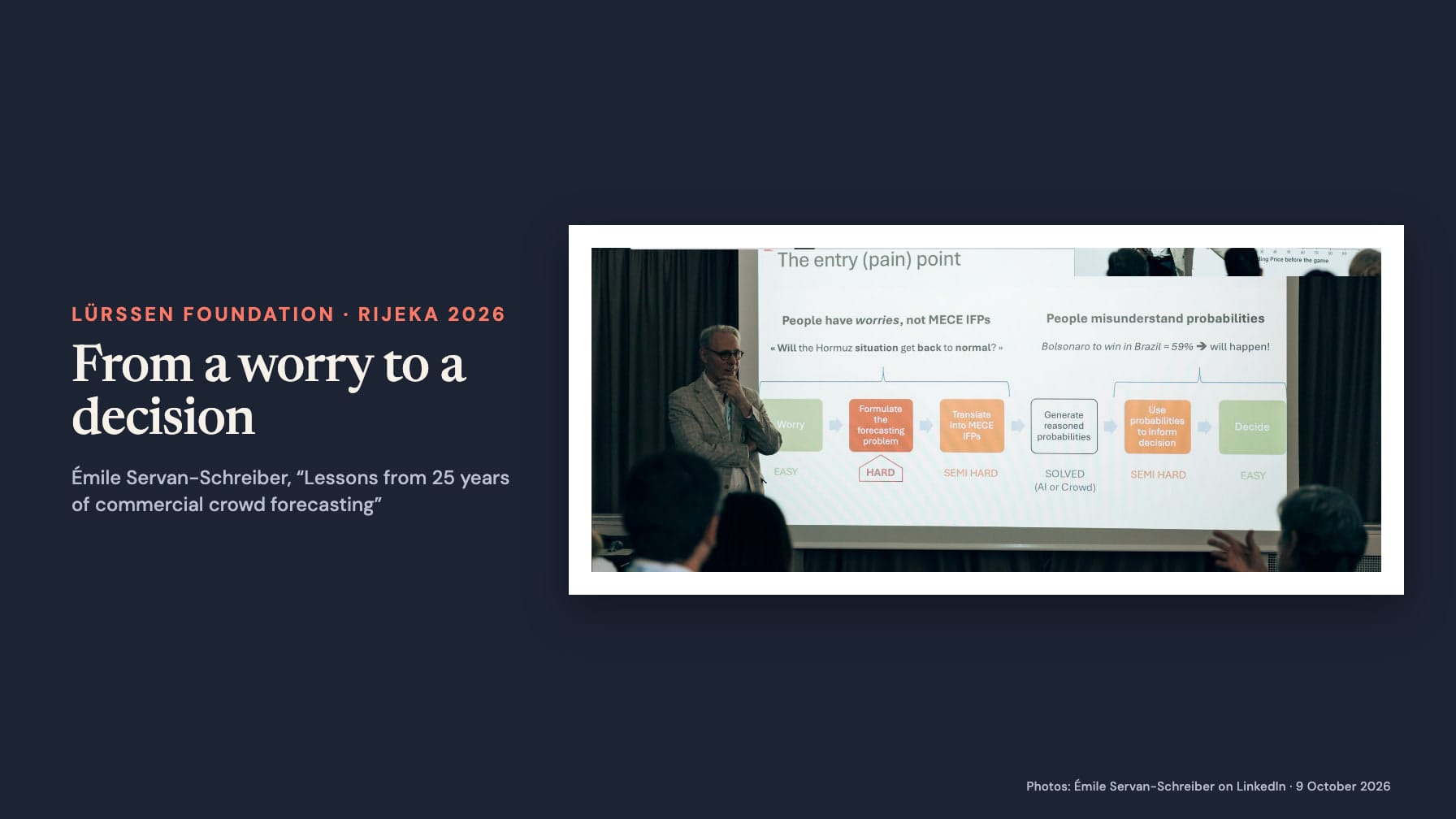
At the seminar on the future of forecasting in Rijeka, Émile Servan-Schreiber concluded his presentation with an argument about what happens before and after a probability is produced. Forecasting earns its place, he argued, when it connects a decision maker’s initial worry to a decision. In his LinkedIn recap on 9 October 2026, he identified problem formulation and the interpretation of probabilities as the critical difficulties on either side of the forecast.
The workshop, “Future of Forecasting: Collective and Artificial Intelligence”, took place on 1–2 October 2026 at Terminal, Rijeka, within the Lürssen Foundation Principal Fellowship Programme. The wider programme ran from 26 September to 3 October. Servan-Schreiber credited Drazen Prelec and Danica Mijovic-Prelec with organising the seminar. In his group photograph, he also named Julian Jamison, Snjezana Prijic Samarzija, Andrea Mesanovic, Rava da Silveira, Yonatan Loewenstein and John McCoy.
His contributions drew, he wrote, on 25 years of commercial crowd forecasting and prediction markets with Hypermind, alongside the opportunities offered by AI with The Forecasting Machine. Our earlier preview of his four lessons covered the planned talk. His post-event account and accompanying photographs show where he brought the argument: the full path from concern to action.
The six stages of the worry-to-decision pipeline
The concluding slide assigns a difficulty label to each stage. These are Servan-Schreiber’s assessments of the process:
- Worry — EASY.
- Formulate the forecasting problem — HARD.
- Translate into MECE IFPs — SEMI HARD.
- Generate reasoned probabilities — SOLVED (AI or Crowd).
- Use probabilities to inform decision — SEMI HARD.
- Decide — EASY.
The contrast locates the hardest work at the entry to the process. The slide’s first warning is “People have worries, not MECE IFPs”. IFPs are individual forecasting problems: questions for which a forecaster supplies a probability. MECE means mutually exclusive and collectively exhaustive; applied to possible answers, it requires outcomes that do not overlap and together cover all possibilities.
Defining the concern before generating probabilities
His slide illustrates the entry problem with a worry about whether the Hormuz situation will return to normal. As phrased, that concern leaves “normal” undefined. The distinction between a worry and a forecasting question is the point: someone must establish what the client actually needs to know before a crowd or AI can process it. Servan-Schreiber described that translation of an ill-defined concern as hard work.
At the other end, the slide warns that “People misunderstand probabilities”. His recap treats making the numbers relevant and understood as another critical pain point. The Hypermind calibration article explains the related distinction between a probability and a certainty: calibration tests whether predicted likelihoods match observed frequencies across many forecasts. That statistical meaning still has to reach the person making the decision.
Why the forecast does not complete the process
Servan-Schreiber’s “SOLVED” label applies to generating reasoned probabilities with AI or a crowd. His post describes forecasting itself as largely solved; that is his assessment. For the narrower evidence on crowd accuracy, our Hypermind benchmark against Polymarket and Kalshi examines the company’s report. Hypermind concludes that performance is broadly at parity, while acknowledging that differences in questions and samples prevent a conclusive head-to-head comparison.
His closing concern was that, unless both pain points are addressed, decision makers can bypass forecasting and move straight from worry to decision. He warned that choices uninformed by predictions can lead to serious mistakes. For the AI opportunities he discussed with The Forecasting Machine, the implication of his account is practical: producing probabilities is one stage of the work. Defining a useful question and helping the client act on the answer remain part of the job.