
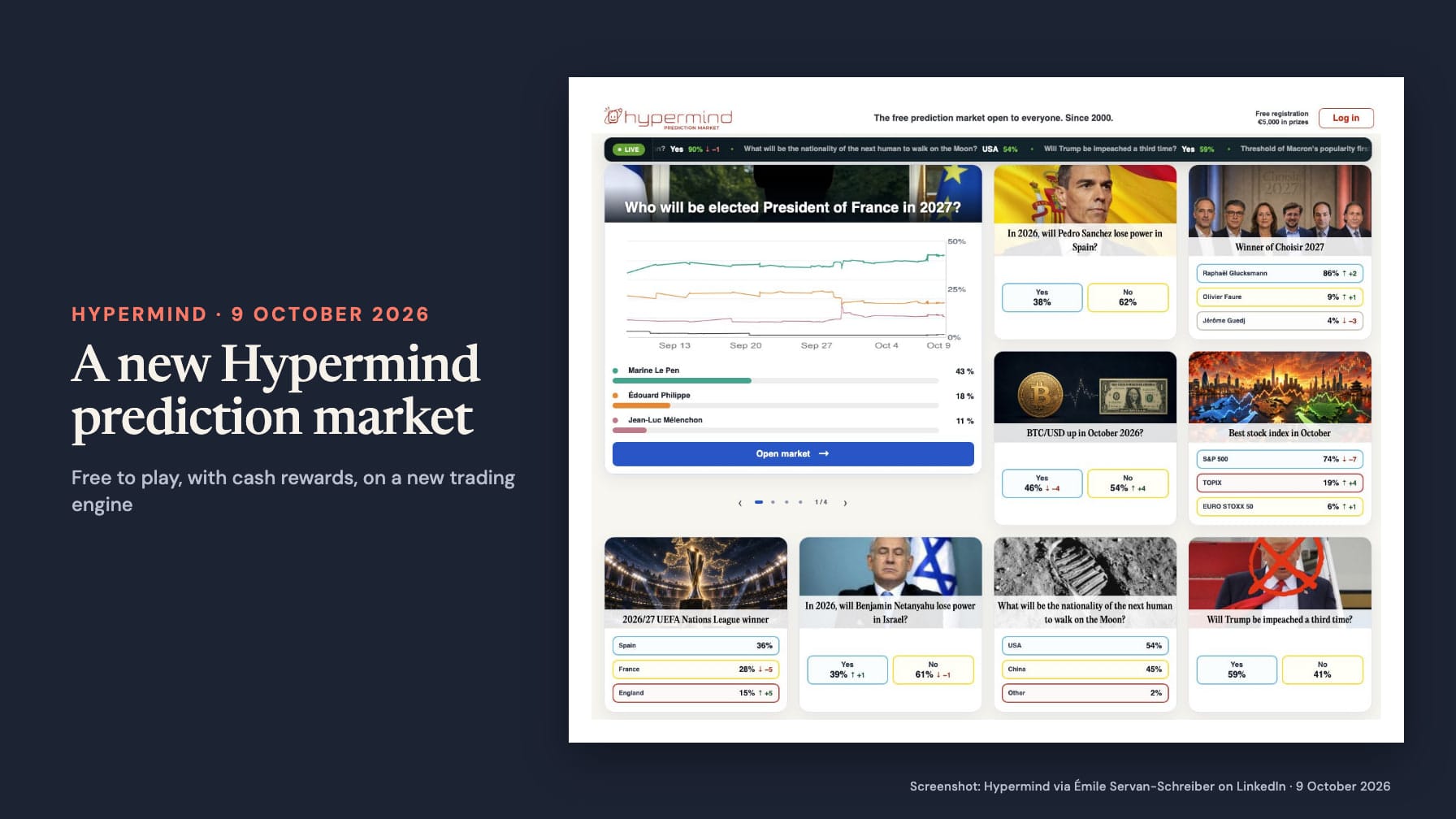
On 9 October 2026, Émile Servan-Schreiber announced the launch of a new version of Hypermind’s public prediction market. Participation remains free, with cash rewards. According to his announcement, the new trading engine combines zero fees, an automated adaptive market maker and a proprietary MECE order-matching algorithm. He presents those choices as serving Hypermind’s central purpose: producing accurate forecasts.
Free participation, cash prizes and a longer history
Hypermind’s official website directs visitors to the public market at predict.hypermind.com. The launch screenshot advertises free registration and €5,000 in prizes, wording also present in the publicly indexed dashboard. The announcement confirms cash rewards without specifying their distribution schedule. Hypermind’s July accuracy report describes the established model as trading with play money and sharing cash prizes among successful participants.
The screenshot’s “Since 2000” tagline refers to an earlier chapter in the company’s history. Hypermind’s official account dates the first NewsFutures prediction market, developed by Maurice Balick and Servan-Schreiber, to spring 2000. It dates the launch of the market called Hypermind to 2014; the accuracy report specifies May. The October announcement is a relaunch of that public market.
How liquidity and MECE pricing serve forecasting
Servan-Schreiber gives each engine feature a forecasting rationale. He associates zero fees with avoiding fee-related price distortions, the adaptive market maker with continuous liquidity, and MECE matching with coherence across outcomes. He also identifies lead developer Florian Jacques as a prediction trader with decades of championship experience. These are his descriptions of the launch and its team.
An automated market maker supplies a counterparty so a trader can express a view without waiting for another participant’s matching order. In research on liquidity-sensitive market makers, adaptation means changing how strongly prices respond to trades as market activity grows. This can help information reach prices in a thin market and moderate the effect of a given trade in a more active one. That explains the design rationale; the announcement does not disclose Hypermind’s adaptation rule.
MECE means mutually exclusive and collectively exhaustive: the options cannot happen together, and they cover every possible resolution. For such a complete set, coherent probability estimates total 100%; in a yes/no question, the two probabilities complement each other. Matching orders across related options can respect these relationships when traders express different views. Servan-Schreiber says Hypermind’s proprietary algorithm provides this coherence. Internal consistency makes a probability forecast easier to interpret, while accuracy still depends on how well traders assess the underlying events.
The accuracy record behind the announcement
Servan-Schreiber calls Hypermind’s record since May 2014 “unmatched” in duration and “unbeaten” in accuracy. Those are his claims. The published evidence is examined in our Hypermind accuracy benchmark against Polymarket and Kalshi. Hypermind’s own July 2026 report covers 1,141 resolved markets and 981,180 trades. Its cautious conclusion is broadly comparable accuracy with the real-money platforms, acknowledging that differences in questions, trading periods and sample sizes prevent a conclusive comparison.
Our long-term Hypermind calibration article explains a complementary test: whether outcomes assigned a given probability occur at approximately that frequency across many forecasts. Coherent prices and reliable access to trading support that forecasting process. Measuring any improvement from the new engine will require resolved forecasts produced after the relaunch; the historical report evaluates the preceding market record.