
On 24 October 2018, Émile Servan-Schreiber announced that his new book was available in bookshops and invited readers’ responses. The launch image names Supercollectif: La nouvelle puissance de nos intelligences and its publisher, Fayard. Fayard’s catalogue independently confirms the release date. The post also announced access to the first chapter through Fayard’s website or Amazon.fr.
In the following months, readers and commentators took up the book in newspaper reviews, arguments about democracy and digital technology, personal recommendations and a bookshop display. Servan-Schreiber was still posting under the Supercollectif hashtag on 2 May 2019, continuing to draw attention to its central subject: how people’s intelligence can be organised together.
A book about organised intelligence
Fayard’s description places the book at the intersection of group intelligence, diversity, companies and democracy. It asks how collective wisdom can be used while avoiding conformity, and how group intelligence relates to artificial intelligence. The publisher presents organisation as the problem connecting these themes: bringing people together creates possibilities, but using their differences requires attention to how they interact.
The original launch is distinct from the later English-edition story. Here the evidence concerns the first French edition and the ways readers and commentators brought it into public discussion during 2018 and 2019.
Reviews and recommendations
A clipping shared on 23 November 2018 identifies a Les Echos review by Benoît Georges, headed Intelligence: la puissance des foules. In our translation: Intelligence: the power of crowds. Servan-Schreiber’s accompanying post highlighted the review’s favourable assessment. Georges discussed collective intelligence as an approach to forecasting and drew attention to connections between organised human intelligence and AI. Georges’s account brought the forecasting argument to a business readership.
On 8 January 2019, Servan-Schreiber shared Sébastien Le Fol’s recommendation that democratic leaders draw more on collective expertise. The attached Le Point page dates the wider article to 7 January and places it in debate over the gilets jaunes and the proposed national consultation. The recommendation is Le Fol’s view, preserved in Servan-Schreiber’s post.
On 8 March, Servan-Schreiber thanked Robert Balick for a recommendation that explicitly named Supercollectif and its application to companies, governments and individuals. On 22 March, he highlighted Anne Méaux’s favourable assessment. The attached Stratégies clipping is dated 21 March. Her argument stresses that collective intelligence needs conditions that allow it to emerge, rather than arising automatically from connecting people.
A bookshop display at Orly
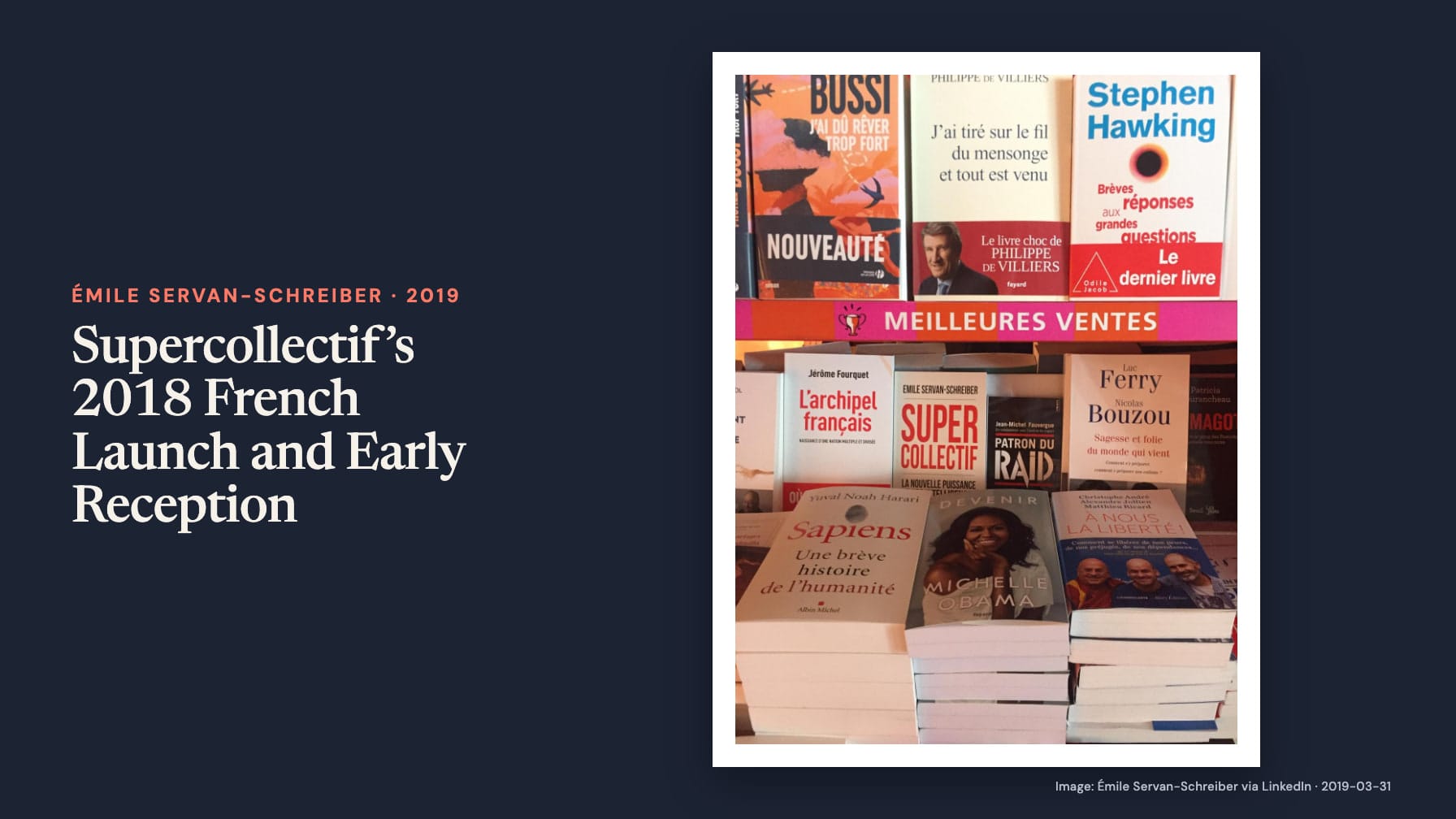
A 31 March photograph shows Supercollectif among books under a bestsellers display sign. Servan-Schreiber identified the location as Orly’s Terminal 4. The image documents the display; it supplies neither a sales total nor a national bestseller ranking.
These responses show readers engaging with different parts of the same argument. Le Fol emphasised democratic judgement, Méaux the conditions that make collective intelligence possible, and Balick its relevance across companies, governments and individuals. Their recommendations helped carry the book beyond a specialist forecasting discussion into broader questions about how institutions use what people know.