
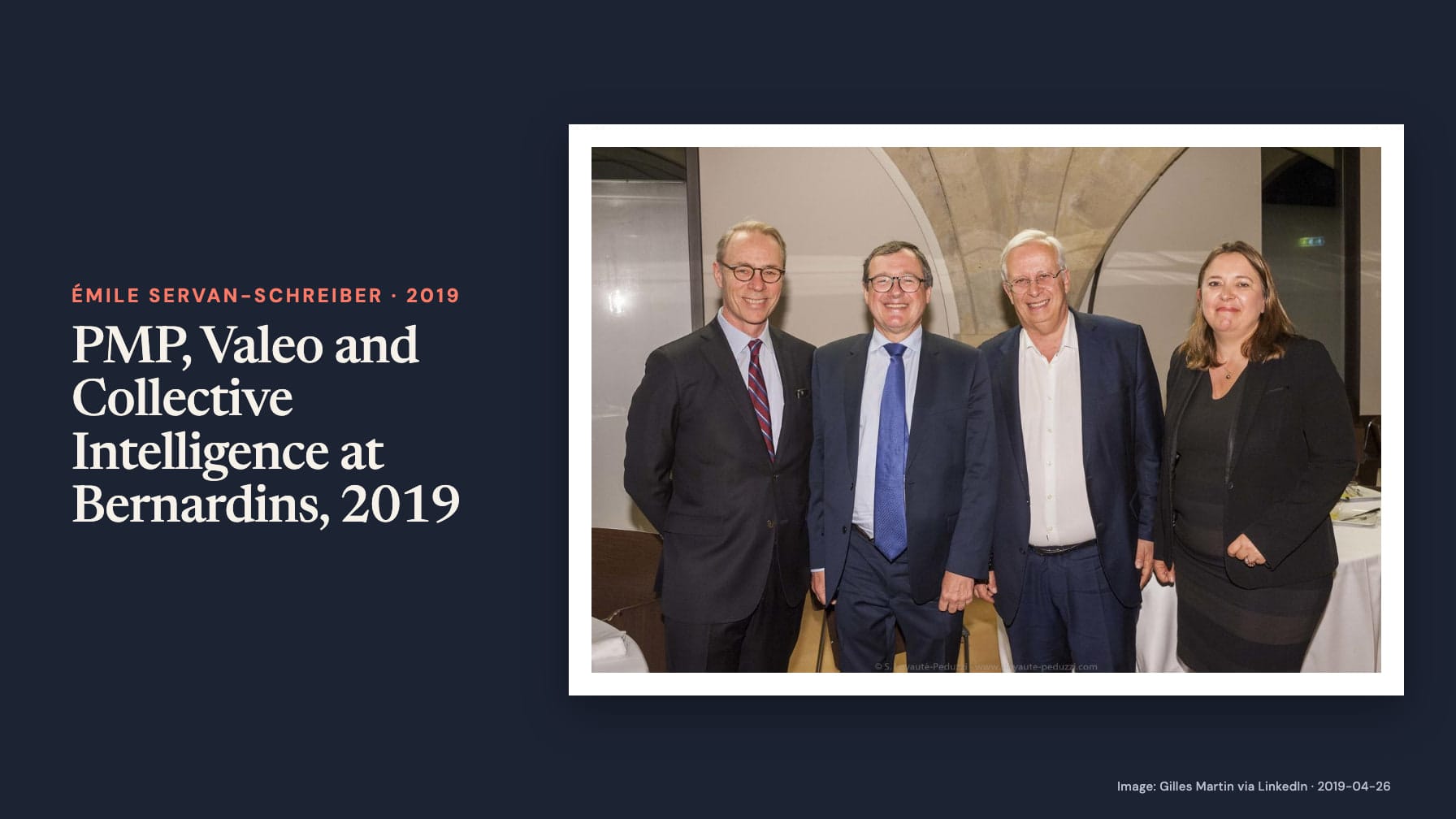
On 26 April 2019, PMP held a lunchtime roundtable at the Collège des Bernardins in Paris with Jacques Aschenbroich, then chairman and chief executive of Valeo, and Émile Servan-Schreiber. A same-day account by Gilles Martin described a good-humoured discussion of artificial and collective intelligence. Servan-Schreiber reshared that account, preserving a small but concrete part of the public conversation around Supercollectif.
Valeo as a technology company
The March invitation called the session “Valeo, entreprise technologique ?” In our translation: “Valeo, a technology company?” PMP’s own event page confirms that it belonged to its management-innovation conference series and ran from 12:15 to 14:00 on 26 April in Paris’s fifth arrondissement.
The organizer says Aschenbroich explained how Valeo had become a technology company and how he had transformed its management. It identifies Servan-Schreiber as a cognitive-psychology researcher, leader of Lumenogic and Hypermind, and author of Supercollectif, invited to contribute a collective-intelligence perspective. The debate was moderated by Gilles Martin, a senior partner at PMP, and Caroline Ponal, a partner.
A meeting of technology and collective judgement
Martin’s post supplies the Bernardins venue and explicitly places artificial intelligence alongside collective intelligence. It also credits the accompanying photograph to Serge Loyauté-Peduzzi. The organizer’s account presents complementary contributions: Aschenbroich on Valeo’s technological and managerial transformation, and Servan-Schreiber on collective intelligence. Martin’s recap puts both perspectives within the same discussion, rather than treating the event as a product announcement.
The pairing is relevant to forecasting because it brings two practical questions into the same room: how a company changes with technology, and how people organize judgement about change. Those questions put management choices beside the way an organisation draws on its people’s information.
Readers can follow the company’s historical names in the journal’s account of Lumenogic becoming Hypermind. At this event, the documented role was a contribution to a management discussion. The roundtable therefore connects technological transformation with how managers organise contributions, make choices and explain them to colleagues.