
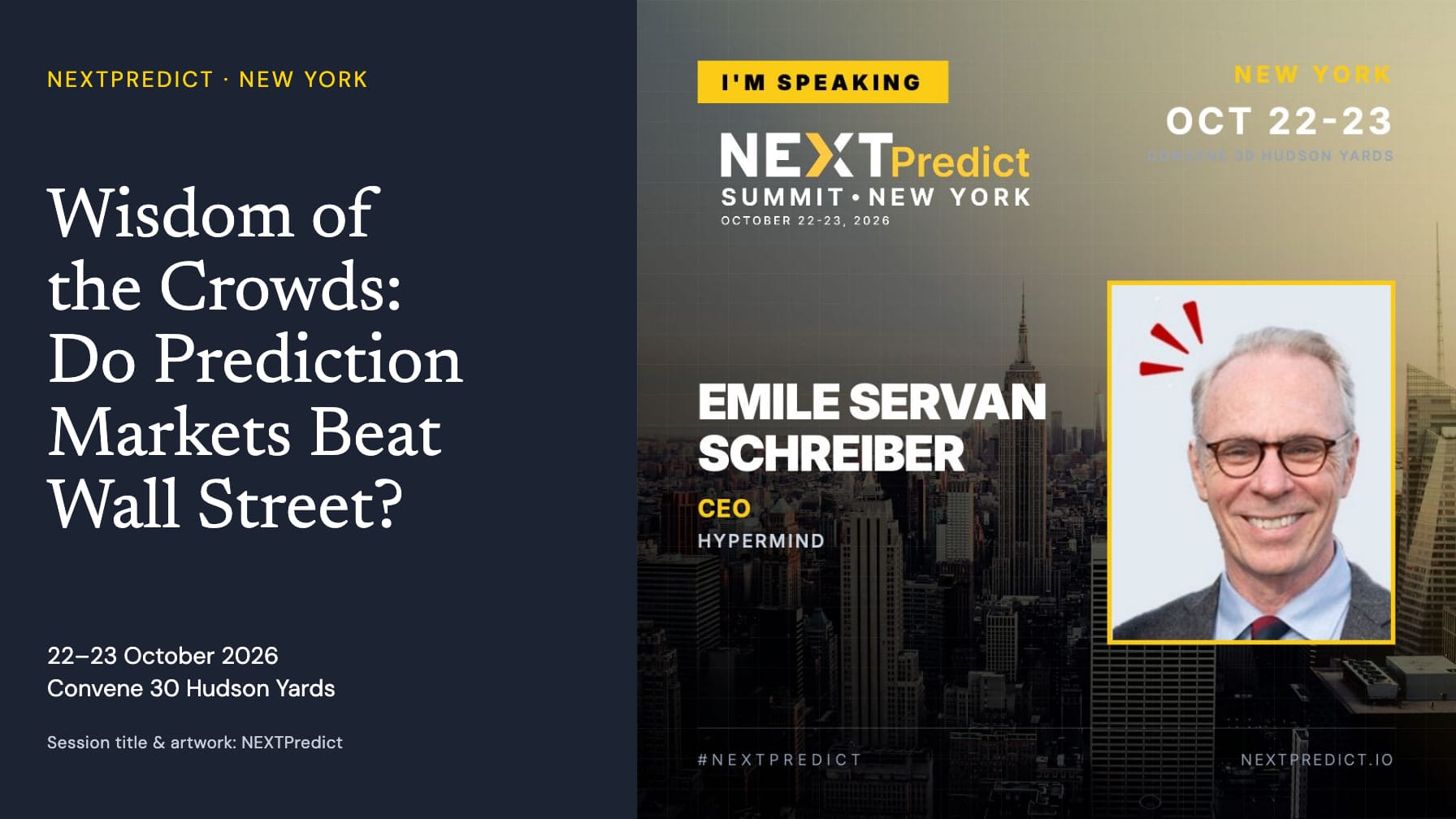
Émile Servan-Schreiber announced on 12 October 2026 that he would speak at NEXTPredict in New York and demonstrate Hypermind and The Forecasting Machine at a combined sponsor stand. The organiser scheduled the summit for 22–23 October at Convene 30 Hudson Yards, bringing prediction-market operators, researchers, investors and other industry participants together.
In a further announcement on 16 October, Gilles Haumont said he would join Servan-Schreiber at the booth for live demonstrations of The Forecasting Machine. Haumont framed the event as an opportunity to meet the entrepreneurs, investors and other participants shaping the field.
The NEXTPredict 2026 prediction-market panel
The official agenda lists Servan-Schreiber for Wisdom of the Crowds: Do Prediction Markets Beat Wall Street? on 22 October. The programme names Charles Payne of Wall Street Strategies and Fox Business, Microsoft Research economist David Rothschild, George Mason University economist Robin Hanson, and AQR’s Tobias Moskowitz alongside him. It identifies Servan-Schreiber as Hypermind’s CEO.
The session’s description connects forecast performance in finance with questions about who supplies information, how trading profits are concentrated and the role of insider information. Those are useful questions for anyone interpreting a market price as a probability: the information a market collects and the way participants trade both deserve examination.
Two approaches to forecasting at one stand
Servan-Schreiber described his two roles at the event as CEO of Hypermind and Chief Scientist of The Forecasting Machine. His announcement placed the prediction market and the AI forecasting platform together for demonstrations, allowing visitors to explore two ways of producing probabilities about future events.
Hypermind had announced a new version of its public prediction market earlier in October. It organises forecasts through participant trading. The Forecasting Machine produces AI forecasts with supporting analysis. A demonstration of either can show how a question is framed, what a displayed percentage refers to and how a reader can inspect the evidence or market behind it.
Comparing those approaches requires a common question and deadline, with the information available to each recorded at the time. Our guide to AI forecasting and prediction markets explains that comparison, while the Hypermind accuracy benchmark provides a separate historical record to examine. The summit announcements offer a practical setting for discussing those methods with the people building them.