
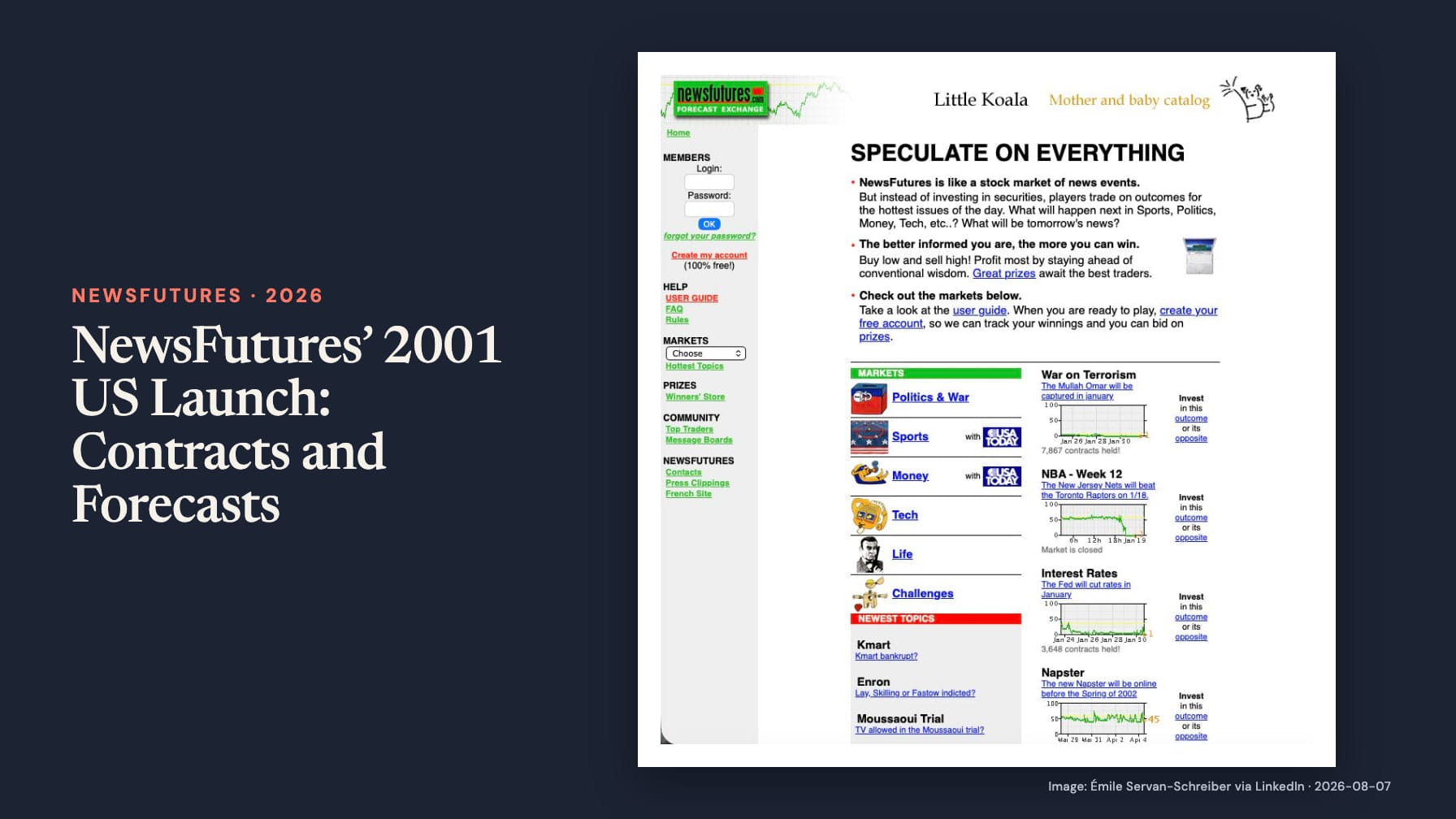
On 7 August 2026, Émile Servan-Schreiber shared a NewsFutures homepage he had found in the internet archives. He dated the image to January 2002, shortly after the US launch with USATODAY.com. Alongside it he reproduced a release dated 3 December 2001. Its detail helps explain what an early prediction market offered readers: a way to trade on the news, earn points and redeem them for prizes.
A newsroom supplied the news; readers supplied the prices
According to the reproduced release, USA TODAY was to be the sole content provider for NewsFutures’ US sports and money markets. Readers could trade expectations about the economy and sporting events, including during play. The homepage visibly places USA TODAY branding beside the Sports and Money sections. It also offers politics, technology and other categories.
The contracts represented outcomes of events rather than shares in companies. Players bought and sold those outcomes, and the eventual results determined their points. The release presented the prices as a second product of the game: estimates of what a population of motivated, informed traders expected to happen. It presented trading as a way to turn readers’ expectations into estimates of future outcomes.
That is the distinction behind the partnership. An ordinary reader contributes attention; a forecasting reader contributes a view that can be compared with other views and checked later. The prizes rewarded successful participation, while the changing prices gave the publisher material generated by its audience. This launch arrangement adds detail to the broader history of NewsFutures and newsroom forecasting.
The launch’s early accuracy claims
The release said NewsFutures traders had put George W. Bush’s chance of election above 85% before election day in November 2000. It also said Bush contracts remained worth more than twice Gore contracts during the subsequent uncertainty. These are retrospective claims in the reproduced 3 December 2001 release, with no dated trading snapshot supplied.
The National Archives records the outcome: Bush received 271 electoral votes and Gore 266. An election victory and a market’s probability describe different things. A probability expresses uncertainty before an outcome; the eventual winner provides one observation with which to assess it.
The release also claimed the French service had anticipated delays in Concorde’s return and China’s entry into the World Trade Organization. The WTO records China’s accession on 11 December 2001. The examples formed part of the launch’s pitch: participants could engage with an unfolding story through their expectations about its outcome.