
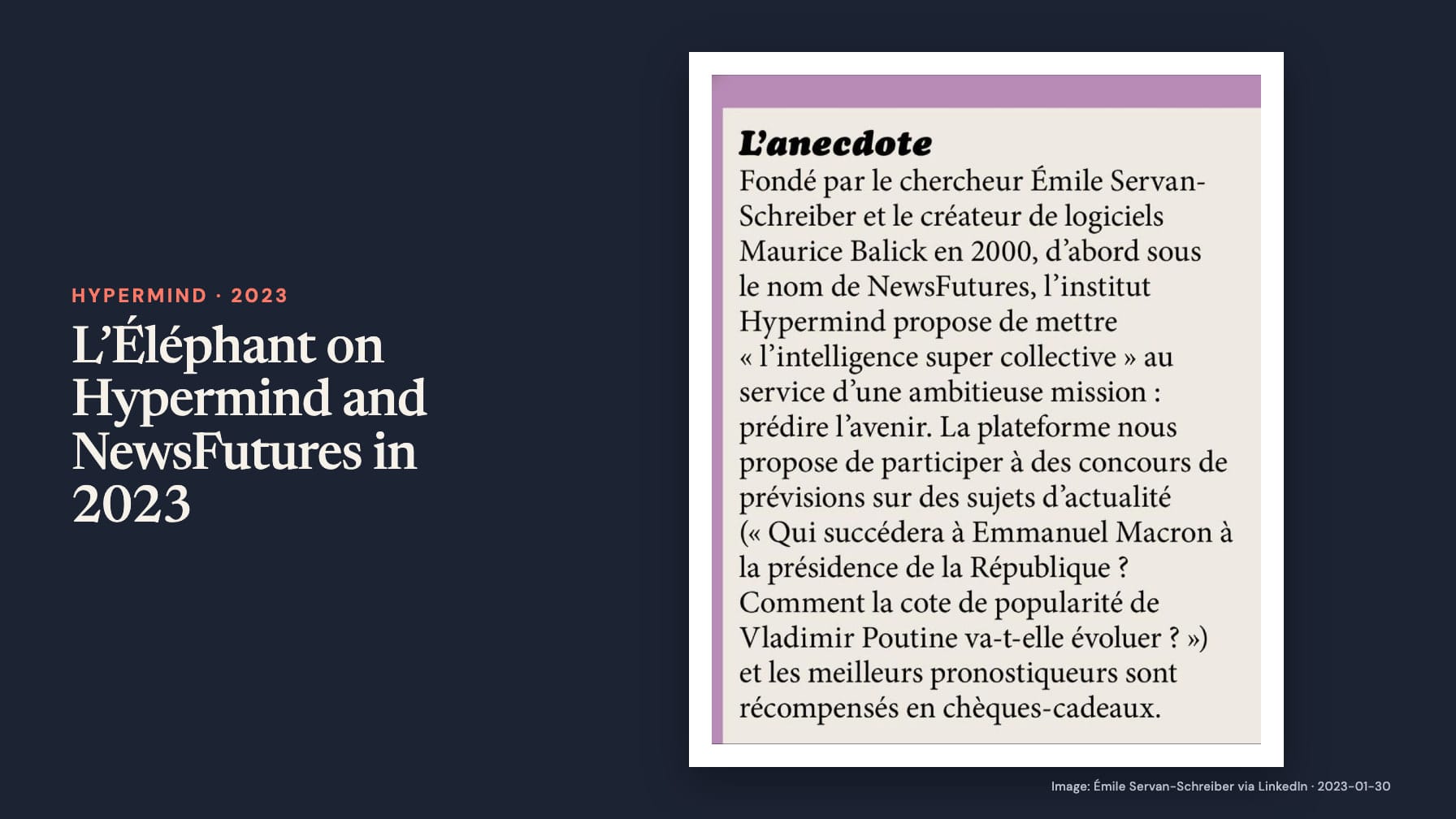
On 30 January 2023, Émile Servan-Schreiber thanked the magazine L’Éléphant for reminding him that a lifetime’s work might survive as little more than an anecdote. The attached clipping explains the remark. Its heading is L’anecdote. In our translation: The anecdote. Its subject is Hypermind: where it came from, what it asks people to forecast and how it rewards participants.
What the clipping documents
The short text names Servan-Schreiber and software creator Maurice Balick as the founders of the venture in 2000, originally under the name NewsFutures. It describes Hypermind’s ambition to put collective intelligence to work predicting future events. Its examples concern who would succeed Emmanuel Macron as French president and how Vladimir Putin’s popularity would change. The best forecasters, it says, receive gift vouchers.
Those examples show the kinds of questions the platform addresses. The clipping gives no probabilities, deadlines, outcomes or comparative accuracy results. It is an introduction to a forecasting activity, rather than evidence that a particular forecast succeeded.
The company history behind the anecdote
Hypermind’s official history corroborates the NewsFutures origin. It says Balick and Servan-Schreiber developed the first version in Annapolis, Maryland, in spring 2000, and initially deployed it in France. It dates the launch of the Hypermind prediction market to 2014, under Lumenogic. The magazine’s compressed history therefore connects the original venture with a later platform, rather than saying that the Hypermind market itself operated under that name in 2000.
The broader thread is documented in our account of NewsFutures and forecasting in newsrooms. A short magazine introduction has a different purpose from a research paper or a scored track record: it makes an unfamiliar method recognisable by describing participation and concrete questions.
Finding satisfaction in the work
Servan-Schreiber’s response was personal. He valued the happiness and privilege of working each day on a subject that fascinated him, more than the recognition it might receive. The magazine introduced that work through concrete questions and participation; his comment supplied the personal reason for continuing it.