
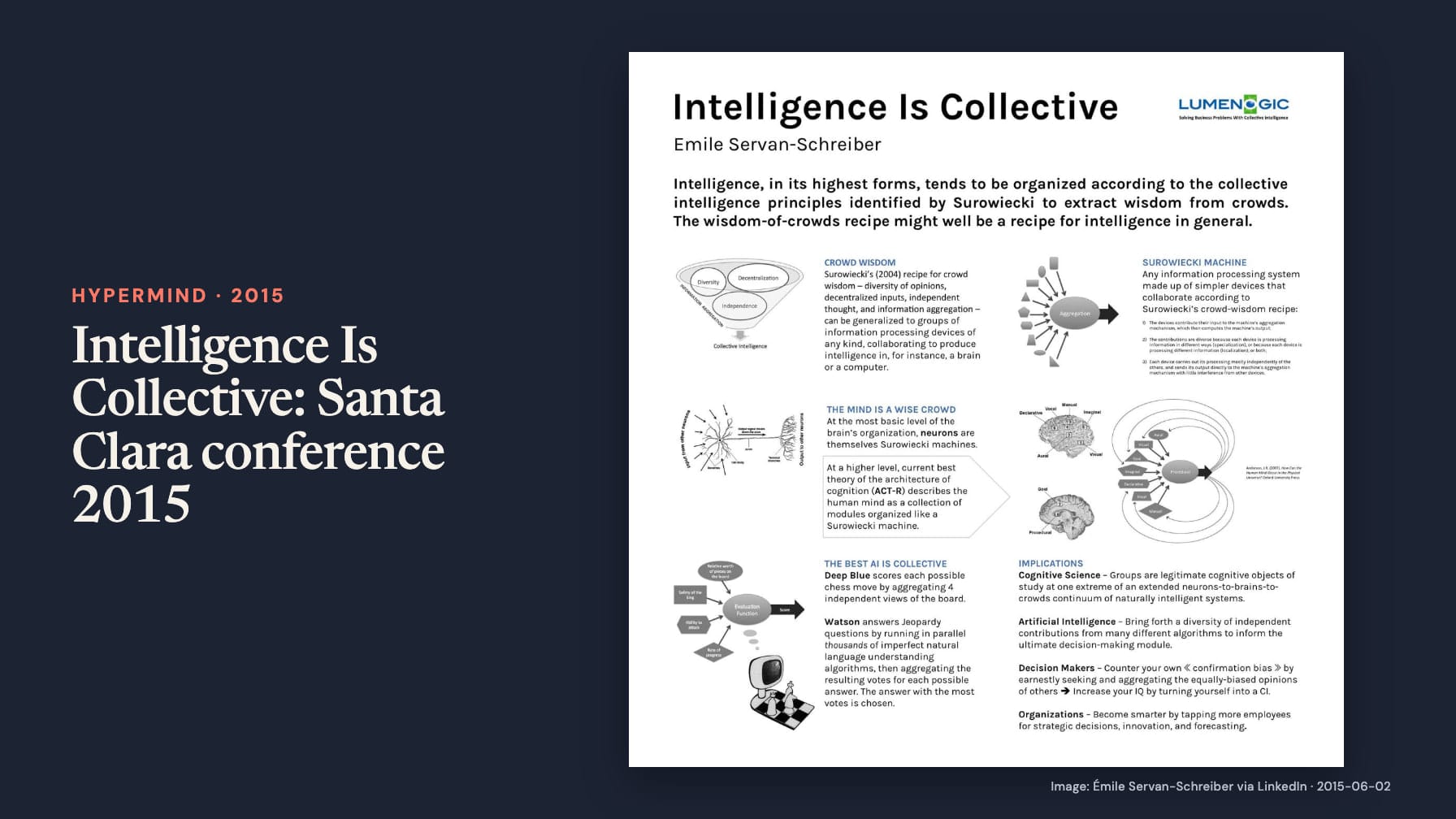
On 2 June 2015, Émile Servan-Schreiber shared the poster he said he had presented at the annual Collective Intelligence conference in Santa Clara. Its title, Intelligence Is Collective, proposed a connection between human crowds, individual minds and artificial intelligence. The poster carried the Lumenogic name, the company behind Hypermind at the time.
The official programme places Collective Intelligence 2015 at the Marriott Santa Clara from 31 May to 2 June. It also lists a separate presentation with Pavel Atanasov on Hypermind and electoral forecasting in the 1 June plenary on applications of collective intelligence. Servan-Schreiber had announced in March that he would speak about the prediction market. The June poster widened that practical topic into a general argument about intelligence.
Four conditions for collective intelligence
The poster drew on the conditions James Surowiecki described for wise crowds and asked whether they could apply to information-processing systems more generally:
- Diversity: contributions differ, bringing multiple perspectives on a problem.
- Decentralisation: components draw on specialised or locally available information.
- Independence: components can contribute without merely repeating one another.
- Aggregation: a mechanism combines those contributions into an output.
Servan-Schreiber called a system organised this way a Surowiecki machine. The poster’s diagrams show different inputs flowing into a shared aggregation mechanism. The important element in his account is the relationship between distinct contributions and their combination, rather than the simple presence of many parts.
A comparison across minds and machines
Servan-Schreiber illustrated his argument with neurons, the ACT-R cognitive architecture and the AI systems Deep Blue and Watson. He offered these as examples of a proposed organising principle, without a formal proof that all intelligence follows it.
The practical question for an organisation is how to preserve distinct information while producing a shared answer. A group can contain many specialists yet give their differences little room to affect its decisions. Applied to forecasting, the poster’s organising principle asks both what participants contribute and how their contributions are combined.
A research setting for Hypermind’s early work
The programme and the two papers make it possible to distinguish the general poster from the election-comparison presentation. The latter concerned Hypermind’s 2014 US midterm forecasts and comparisons with statistical models. Its performance claims belong to that specific study, rather than proving the poster’s broader thesis.
The journal’s account of Lumenogic’s later change of name follows the company history. This earlier conference contribution captures an intellectual continuity: preserving different judgements and finding a useful way to combine them, whether the contributors are people or computational components.