
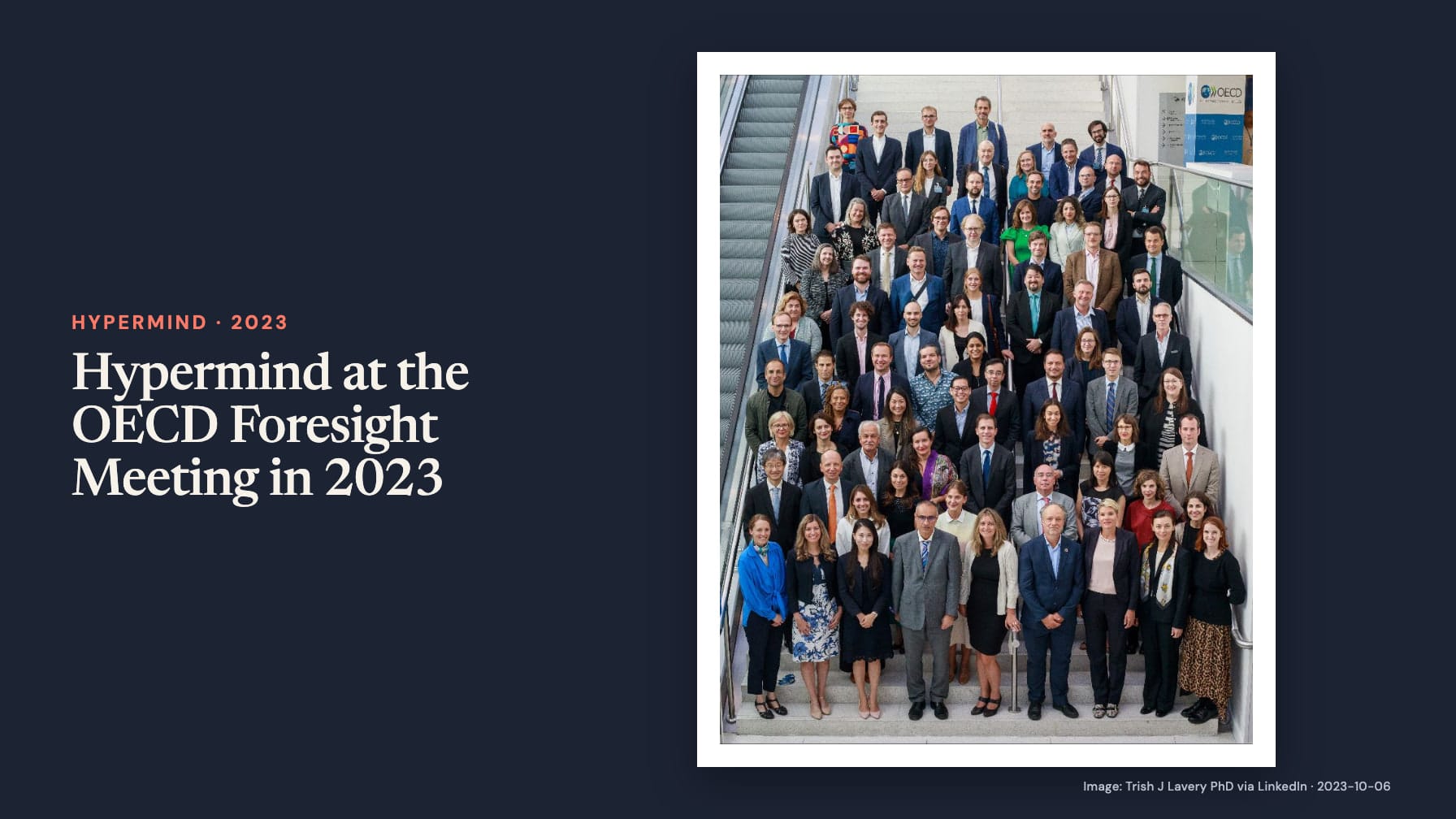
The OECD Government Foresight Community met in Paris on 3–4 October 2023 to discuss how governments could anticipate change. Émile Servan-Schreiber was among its presenters. In a LinkedIn recap on 6 October, he said he had discussed Hypermind’s crowd-forecasting use cases in geopolitics, public health and artificial intelligence with experts and fellow practitioners.
A place for probability within foresight
The official OECD programme places the meeting at its Paris headquarters under the theme of the transformative impacts of geoengineering and artificial intelligence. Its detailed summary lists Servan-Schreiber as Hypermind’s CEO and an affiliate professor at UM6P’s School of Collective Intelligence, among contributors to the first day’s breakout sessions.
The OECD summary describes an exchange of methods and experience. It also distinguishes scenario work, which helps uncover assumptions, from predictions. That gives useful context to Hypermind’s contribution: a probability forecast can put a number on a defined uncertainty, while a scenario can explore the wider consequences and assumptions around it.
Three domains for crowd judgement
Servan-Schreiber’s recap names three application areas. Geopolitics concerns contingent events shaped by decisions and conflict. Public health brings questions about the timing and extent of disease. AI forecasting asks how quickly technical capabilities might develop. His account establishes that these domains were discussed; it does not identify every example presented.
The journal’s separate account of crowd forecasting for infectious disease gives readers a fuller research case. Hypermind’s AI-progress forecasting contests provide another example of questions that can eventually be assessed against observed events.
Bringing these methods together gives policy teams different ways to examine uncertainty. A scenario can reveal consequences that a narrowly framed question leaves out. A forecast can make an expectation explicit enough to revisit when evidence changes. Used together, they invite two questions: what futures should a government prepare for, and how much confidence should it place in an expectation about a specific event? The 2023 meeting gave practitioners a setting in which to compare those approaches.