
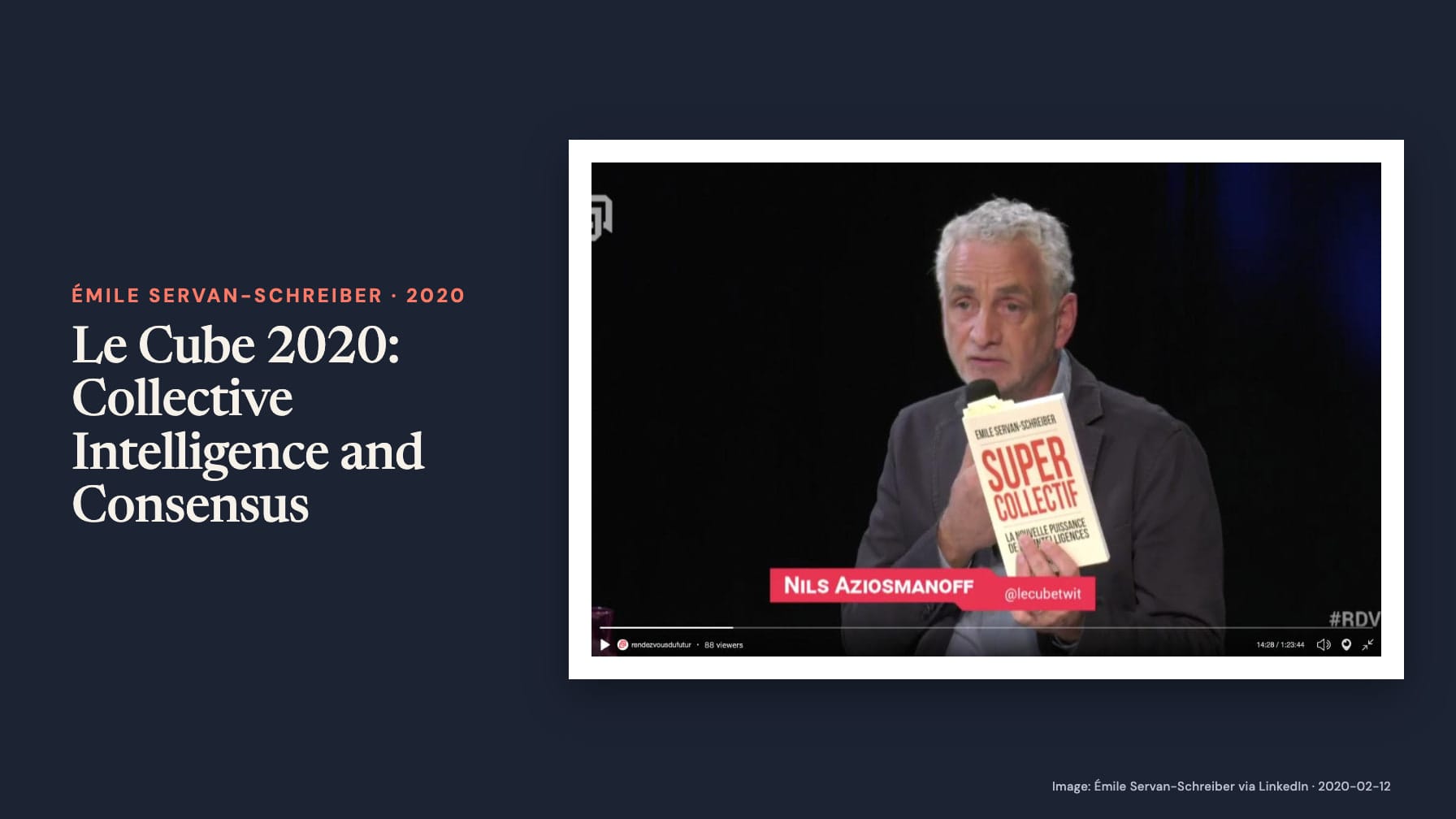
On 11 February 2020, Émile Servan-Schreiber appeared on Le Cube’s web-TV programme Rendez-vous des Futurs to discuss collective intelligence. His invitation specified a live start at 19:30. The programme’s official episode page confirms the date and framed the conversation around how organisations and societies can make better use of people’s complementary contributions.
The evening had two separate guests: Servan-Schreiber at 19:30, followed by CoopCycle co-founder Alexandre Segura at 20:30. Segura’s segment concerned cooperative bicycle delivery. The programme placed collective intelligence alongside another organisational response to digital platforms, without treating the two projects as one.
What an attendee took away
The next day, Servan-Schreiber thanked Nils Aziosmanoff, then shared Guillaume Peter’s account of the discussion. Peter described the interview as a clear explanation of ideas from Supercollectif. Among the lines he singled out was:
Le consensus est l’ennemi !
Guillaume Peter’s recap of the Le Cube discussion, reshared on 12 February 2020
In our translation: Consensus is the enemy! The quotation is Peter’s record of the discussion. His notes also stressed cooperation, the contribution of each person to the group and respect for employees’ intelligence. He distinguished hierarchy from the imposition of ideas from above.
Diversity has a specific forecasting meaning
Peter also referred to Scott Page’s diversity theorem. For numerical predictions combined by averaging, Page’s published account gives a precise relationship: collective squared error equals average individual squared error minus the diversity of predictions. The mathematical point concerns the spread of estimates, rather than a guarantee that every group will be wise.
A separate 2011 experiment by Jan Lorenz and colleagues found that exposure to others’ estimates could reduce diversity without improving collective accuracy in simple estimation tasks. That supplies a research reason to take premature agreement seriously. It was not a finding produced by the Le Cube interview, and it does not show that every form of discussion is harmful.
The journal’s account of expertise and diversity develops the same practical tension. People need to cooperate, but a forecast can lose useful information if everyone converges on the same answer too quickly. Peter’s recap connects that tension to workplace practice: cooperate, respect employees’ intelligence and preserve room for different answers before reaching a decision.