
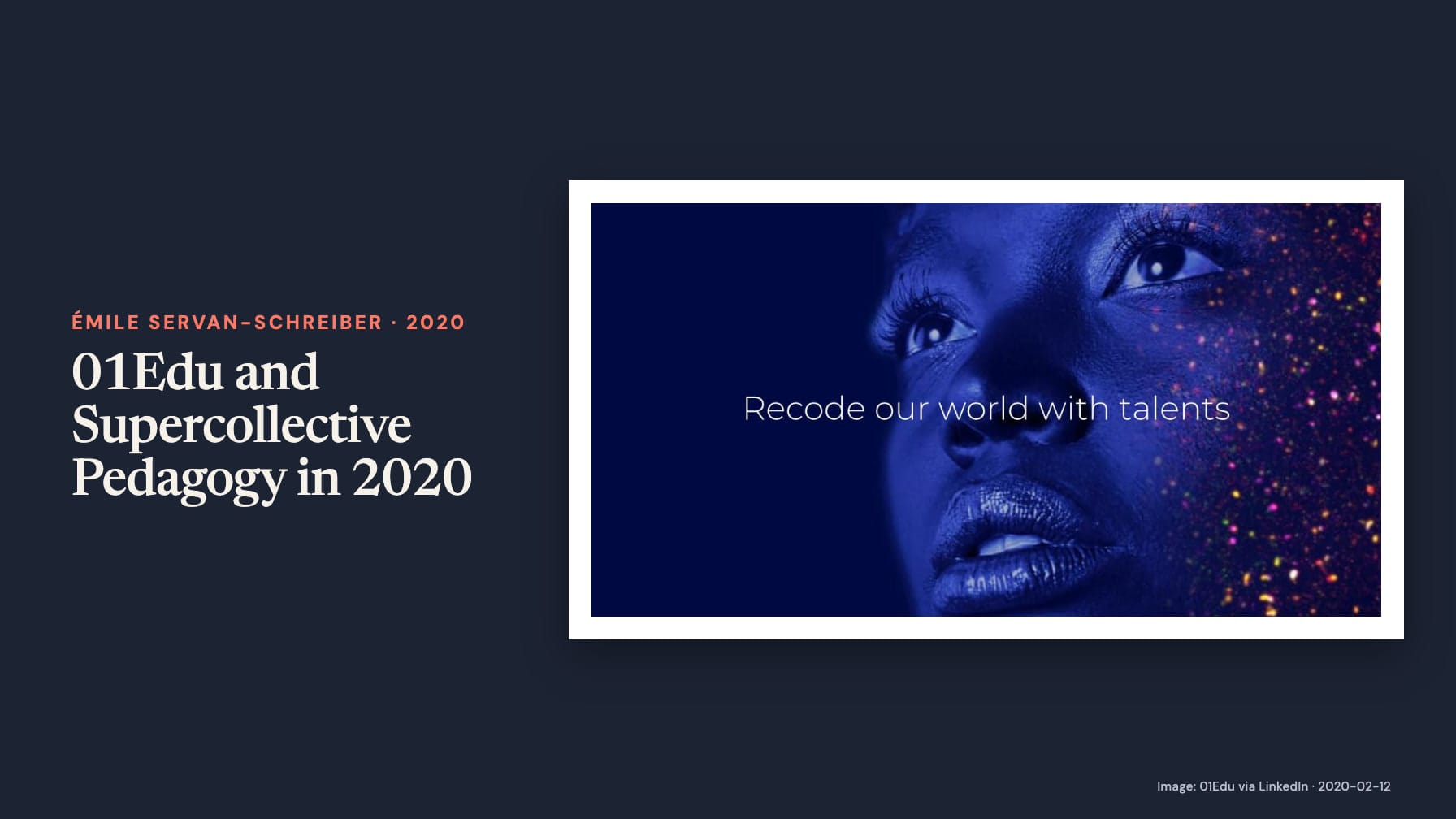
On 12 February 2020, Émile Servan-Schreiber reshared an announcement from 01Edu and praised it as an example of putting supercollective intelligence into practice. The subject was Nicolas Sadirac’s educational platform for opening schools and training people in coding and innovation. The emphasis was on organising a community of learners so that students could learn from one another.
Learning organised around peers
01Edu’s announcement placed the platform in the lineage of Sadirac’s work at Epitech, Web Academy and 42. The company describes the approach as a combination of peer learning, gamification and collective-intelligence methods. These elements describe how the company intends learning to work.
The central educational idea is to make the learner community part of the teaching process. In its current official presentation, 01Edu describes project-based, peer-to-peer programmes rather than conventional classes led by teachers.
A public repository adds a concrete view of the learning material. It publishes course subjects and projects and explains that some tasks are deliberately ambiguous or underspecified. The content team also invites contributions. The tasks give students opportunities to practise interpreting a problem as well as writing code.
Sadirac’s own Learning 3.0, available through Zone 01 Oujda, develops these ideas. It describes peer evaluation, project-based learning and mutual help as parts of the pedagogy developed through his schools.
Organising contributions and feedback
Servan-Schreiber’s connection was to the organisation of many minds. Peer learning asks students to work through problems with others and draw on contributions beyond a single instructor. Our discussion of Supercollectif places that idea in a broader argument about how groups are arranged.
The forecasting relevance is methodological: assembling people is different from designing a process in which their contributions become useful. In education, the contribution might be a project, an explanation or a peer’s evaluation. In forecasting, it is an estimate that can later be checked. Both raise questions about whose contributions are heard and how feedback helps participants improve. Servan-Schreiber’s endorsement identifies a promising educational approach, without supplying a controlled comparison of learning outcomes.