
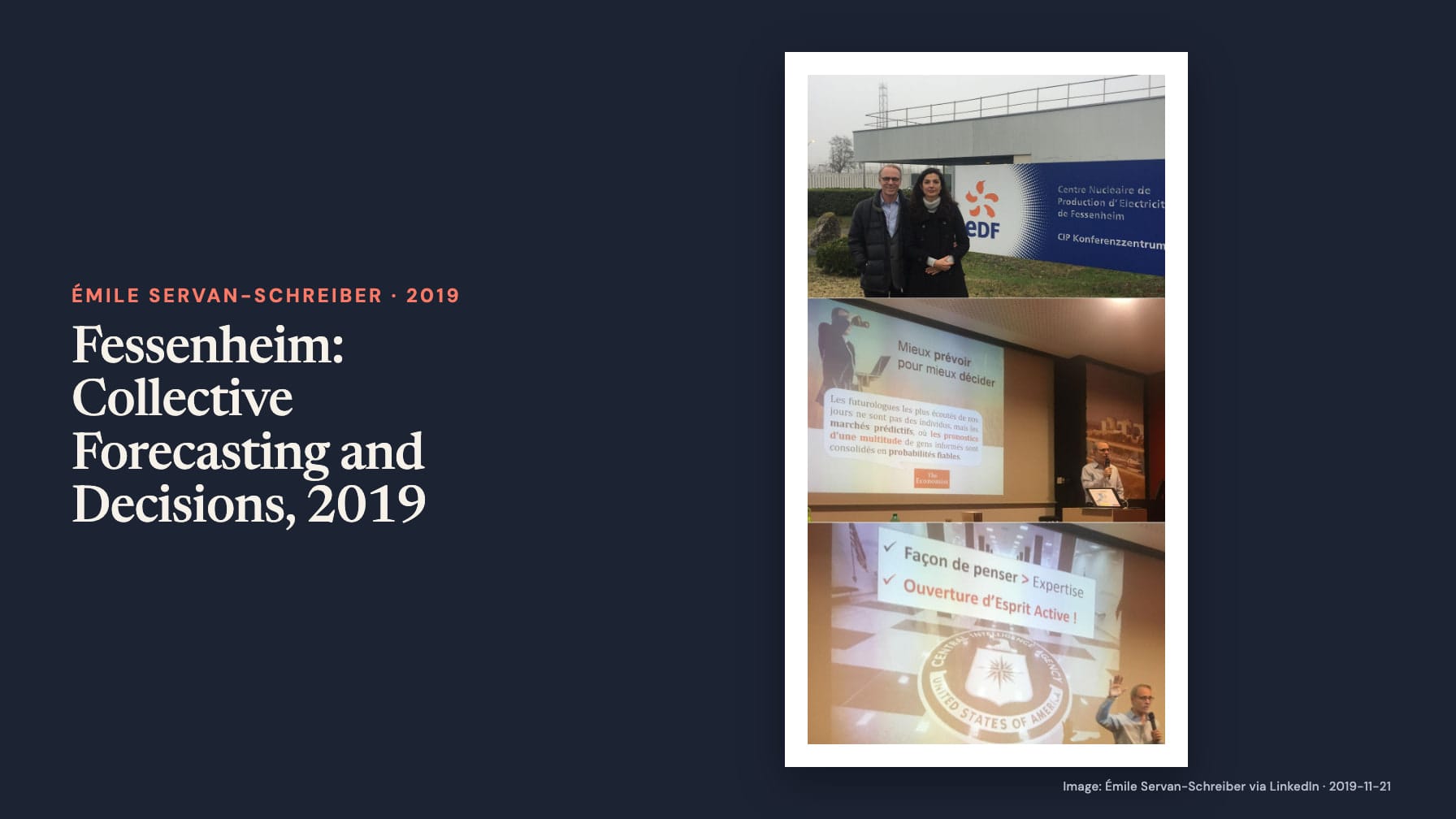
On 21 November 2019, Émile Servan-Schreiber reported giving a conference the previous day at the Fessenheim nuclear plant. He credited Caroline de la Mardière and Christophe Lach with organising the visit. His subject was supercollective intelligence, with particular emphasis on collective forecasting and open-minded thinking as inputs to decisions.
The attached photographic collage gives the account additional substance. It shows the site sign and lecture slides, including one headed “Mieux prévoir pour mieux décider”. In our translation: forecast better to decide better. Another slide places ways of thinking above expertise and calls for actively open-minded thinking. The two slides connect a forecasting practice with a habit of considering alternative explanations.
The closure was already scheduled
Fessenheim’s future was not an abstract question at the time. EDF’s official statement of 30 September 2019 announced that it had submitted requests to end operation and permanently shut down both reactors, with planned dates in February and June 2020. The lecture therefore took place after the closure timetable had been announced.
Servan-Schreiber’s recap criticised that decision as prematurely sacrificing a technological asset for electoral reasons. That is his political interpretation. His criticism contrasts the decision process he advocated with the one he believed had led to closure.
A judgement about how institutions decide
EDF’s plant history records the permanent shutdown of the two reactors in February and June 2020. The French government’s June 2020 announcement also set out support for workers and the surrounding territory. The closure is a documented outcome; the merits of the decision remain the subject of Servan-Schreiber’s political argument.
The forecasting relevance is the distinction between informing a decision and choosing it. A crowd can estimate uncertain consequences, but someone must still specify the alternatives and weigh the objectives. The journal’s discussion of governing through prediction explores that institutional question. Fessenheim supplied a concrete setting for the speaker’s argument, with the eventual closure documented and his criticism clearly attributed.