
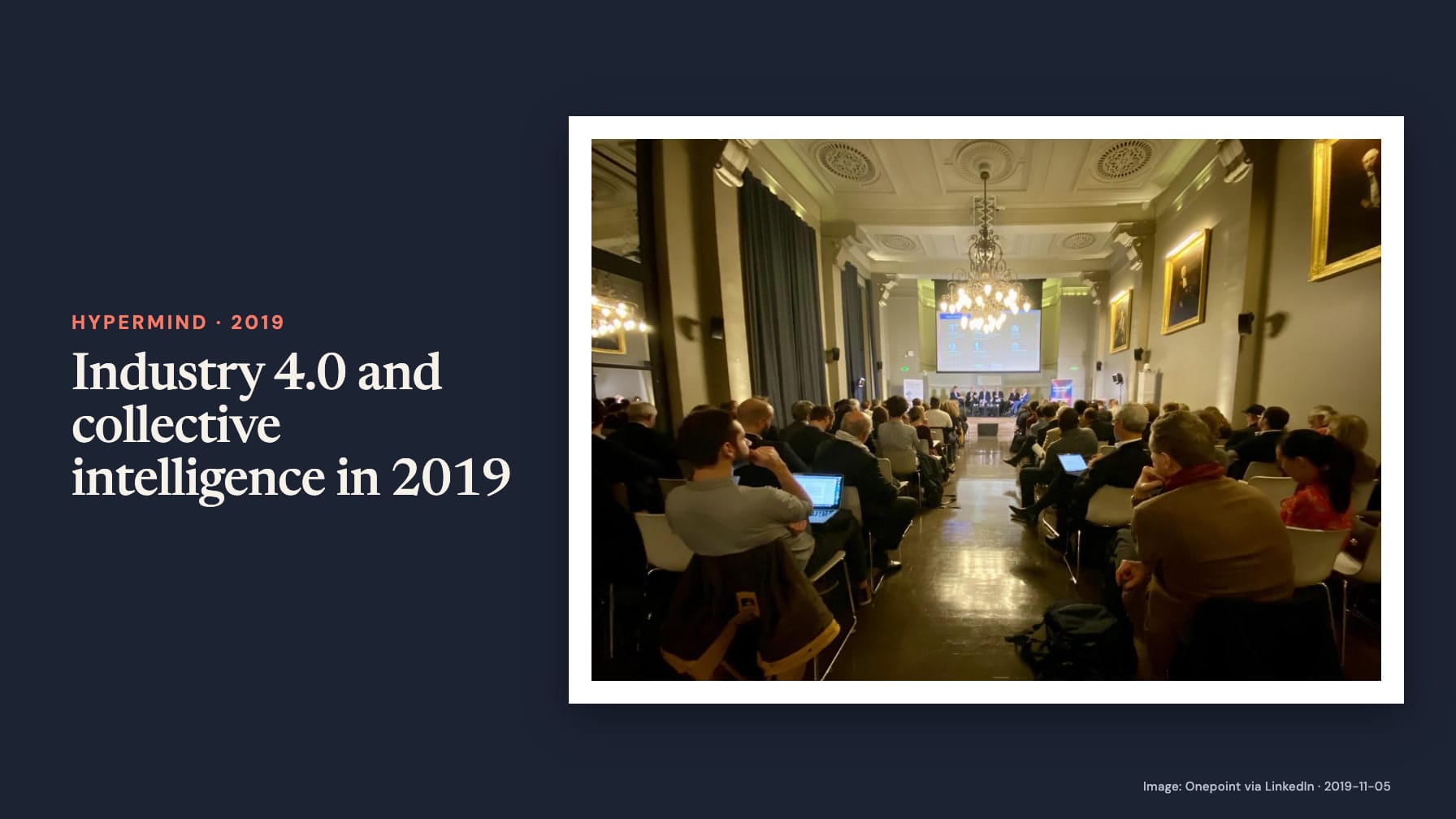
On 4 November 2019, Onepoint brought a discussion of industrial reinvention to the Hôtel de l’Industrie in Paris. The announced agenda combined data, artificial intelligence, digital transformation and new forms of organisation. Émile Servan-Schreiber’s contribution placed the last of those subjects at the centre: how digital tools might organise the intelligence of many people.
The invitation he shared on 14 October presented a colloquium hosted by David Layani, Onepoint’s president, and Olivier Mousson, president of the Société d’Encouragement pour l’Industrie Nationale, with Jean Rognetta moderating. It announced the 4 November date and Hôtel de l’Industrie venue. Servan-Schreiber’s next-day response then described the message he had delivered there.
From the invitation to the delivered message
In his next-day post, published on 5 November, Servan-Schreiber thanked the hosts and described the message he had delivered the previous evening. He argued that the coming century would belong to intelligence, and that the opportunity was to organise human contributions through digital technology. This was a statement of direction for industrial transformation, rather than a dated probability about an industrial outcome.
Onepoint’s recap reported more than 100 participants and named Eric Campos, Paul de Billy, Ronan Le Moal, Stéphane Roussel and Servan-Schreiber among the speakers. That attendance figure is the organiser’s account. The earlier invitation named Catherine Cousinard instead of Campos; the announced programme and the recap therefore provide different lists, without establishing why the line-up changed.
An organisational question inside a technology agenda
The forecasting relevance lies in the choice of what to organise. A digital platform can distribute information, but collective forecasting also requires a way to elicit and combine judgments. Servan-Schreiber’s argument directs attention to those human contributions alongside computing infrastructure. His later Institut Diderot discussion of collective intelligence develops the organisational theme in another setting.
At this Industry 4.0 forum, Servan-Schreiber made organising collective intelligence part of the conversation about industrial reinvention. His argument asks decision makers to consider how people contribute alongside what technology can compute. In forecasting, that means attending to the question, the information participants bring and the way their judgements are combined. These choices determine what a digital platform is being asked to produce.