
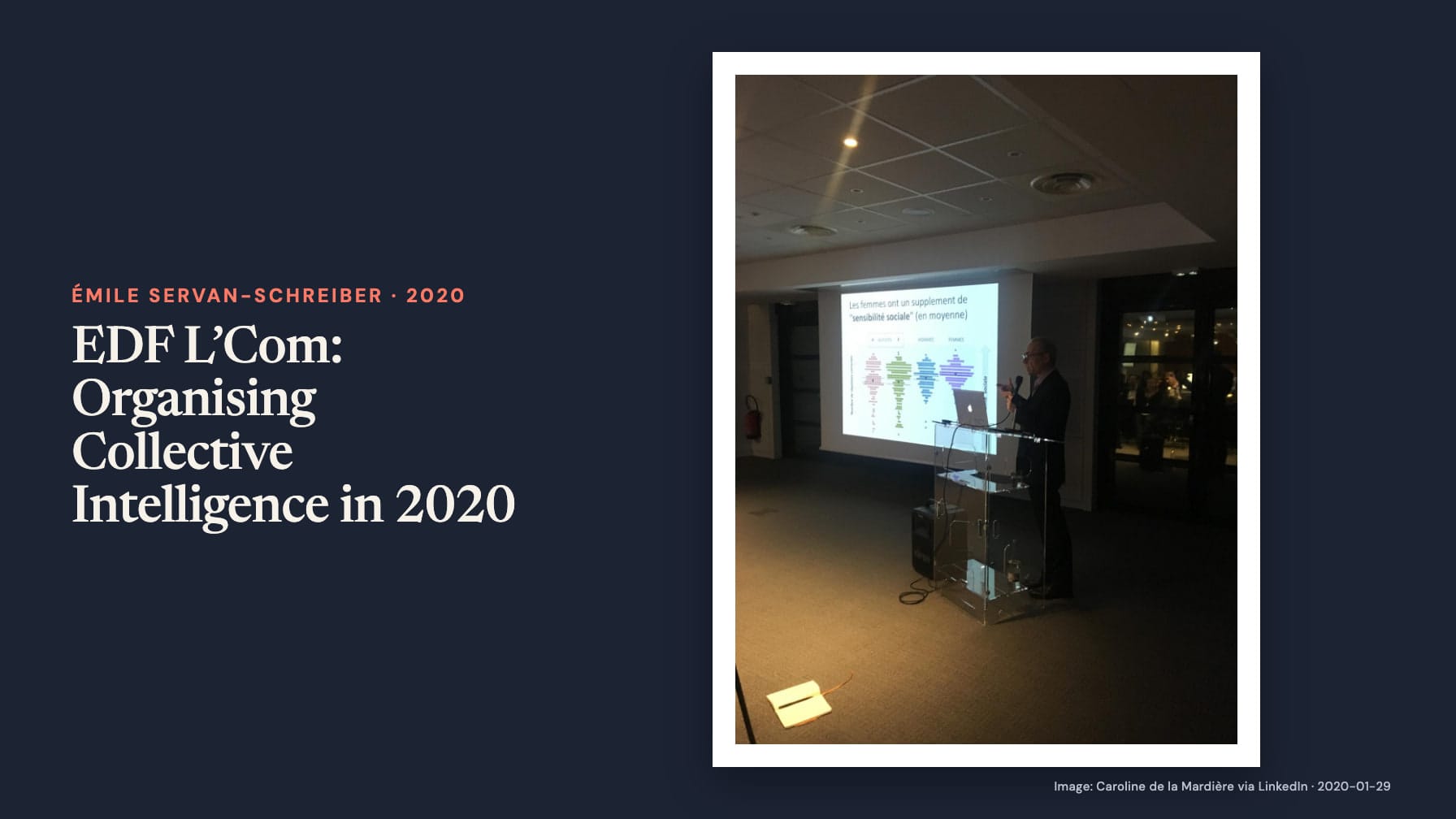
On 29 January 2020, Émile Servan-Schreiber reshared Caroline de la Mardière’s account of his lecture for EDF’s nuclear teams the previous evening. She placed the event within L’Com and credited Sylvie Richard and Charlotte Maes with its organisation. One audience question gave the account its methodological focus: do television street interviews, gathering different opinions about a subject, count as collective intelligence?
Diversity needs a common task
According to de la Mardière, Servan-Schreiber answered that the interviews were entertaining information. Collective intelligence, in his explanation, involved a precise method for organising different perspectives towards a shared result. The exchange is reported in her account.
The distinction is useful because diversity can serve several purposes. A selection of opinions may show how differently people feel about an issue. A group tasked with estimating a quantity, finding a solution or forecasting an event must also decide how those contributions become an answer. The purpose and the combination method change what can reasonably be assessed.
From an audience question to forecast design
Hypermind’s official master-class material gives a concise version of its approach: diversity, independence and aggregation. Diverse judgements supply different information. Independence helps preserve that information before people simply repeat one another. Aggregation produces a shared estimate that can be compared with what is eventually observed.
A prediction market is one way to organise that last step, as our prediction-market explainer describes. Its probabilities address an outcome question. A montage of reactions has no equivalent common estimate merely because several people appear in it. This is the practical forecasting implication of the distinction reported at EDF.
An EDF speaking relationship
Servan-Schreiber’s accompanying message expressed admiration for the nuclear teams and thanked de la Mardière for the opportunities to interact with them. Servan-Schreiber’s speaker-agency profile separately carries an EDF LCOM network testimonial praising an intervention on cognitive biases and conformity. That corroborates an EDF speaking relationship, although the testimonial itself is undated.
The audience question links the lecture to a practical design choice. Before consulting a group, an organisation needs to specify what it wants to learn and how the answers will be used. Gathering reactions, selecting ideas and producing a forecast call for different methods. A shared objective gives contributors a task and gives decision-makers a result they can interpret.