
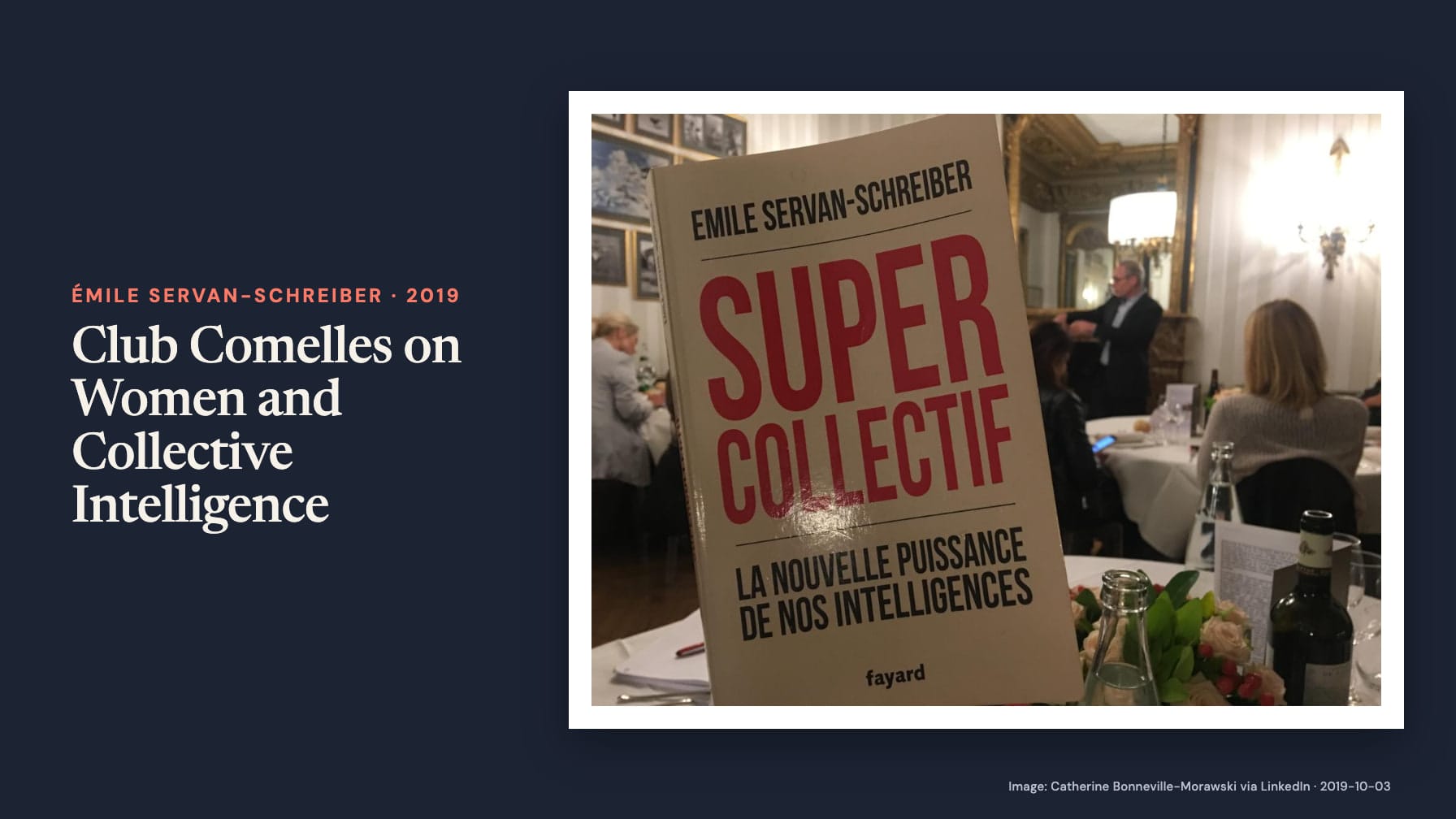
On 3 October 2019, Émile Servan-Schreiber reshared Catherine Bonneville-Morawski’s account of a Club Comelles evening at which he had been the guest. Her recap identified two themes: making an organisation more intelligent and understanding the role of women’s participation in collective intelligence. She recommended his book Supercollectif to readers interested in the subject.
The attached photograph foregrounds the French book at a dinner gathering. Bonneville-Morawski thanked Nadia Leroy of NEVA.associés for the photograph. The image places the book within a shared discussion, while the recap connects its ideas to a practical organisational concern: whose contributions are heard and used when a group works together.
The research behind the organisational question
A relevant scientific reference predates the meeting. In their 2010 Science paper, Anita Williams Woolley and colleagues studied whether groups had a general ability to perform across different tasks. They identified a collective-intelligence factor and reported that it was associated with members’ average social sensitivity, more equal conversational turn-taking and the proportion of women in a group.
The paper also explains a qualification: the relationship with the proportion of women appeared largely mediated by social sensitivity. In the sample, women scored better on that measure. This is evidence about group composition and interaction in the studied tasks; it does not establish that gender alone determines a team’s effectiveness, or that every organisation will show the same pattern.
The findings provide research context for the topic named in Bonneville-Morawski’s recap. In a collaborative task, social sensitivity concerns how members recognise others’ perspectives, while turn-taking concerns whether those perspectives can enter the discussion. Both put attention on interaction as well as the knowledge that individuals bring.
From participation to a better collective answer
For forecasting, the organisational question is how a group hears and combines its members’ information. A team discussing a shared task and a market aggregating probabilities organise participation in different ways. The Club Comelles evening addressed participation and group intelligence; its findings cannot be treated as a prediction-market performance result.
The journal’s Institut Diderot conference account explores related questions about organising group intelligence. The Club Comelles evening adds a specific setting in which those questions were discussed, with women’s participation explicitly foregrounded. It invited an organisational reading of collective intelligence: evaluate how a group works together, alongside the expertise of the people in it.