
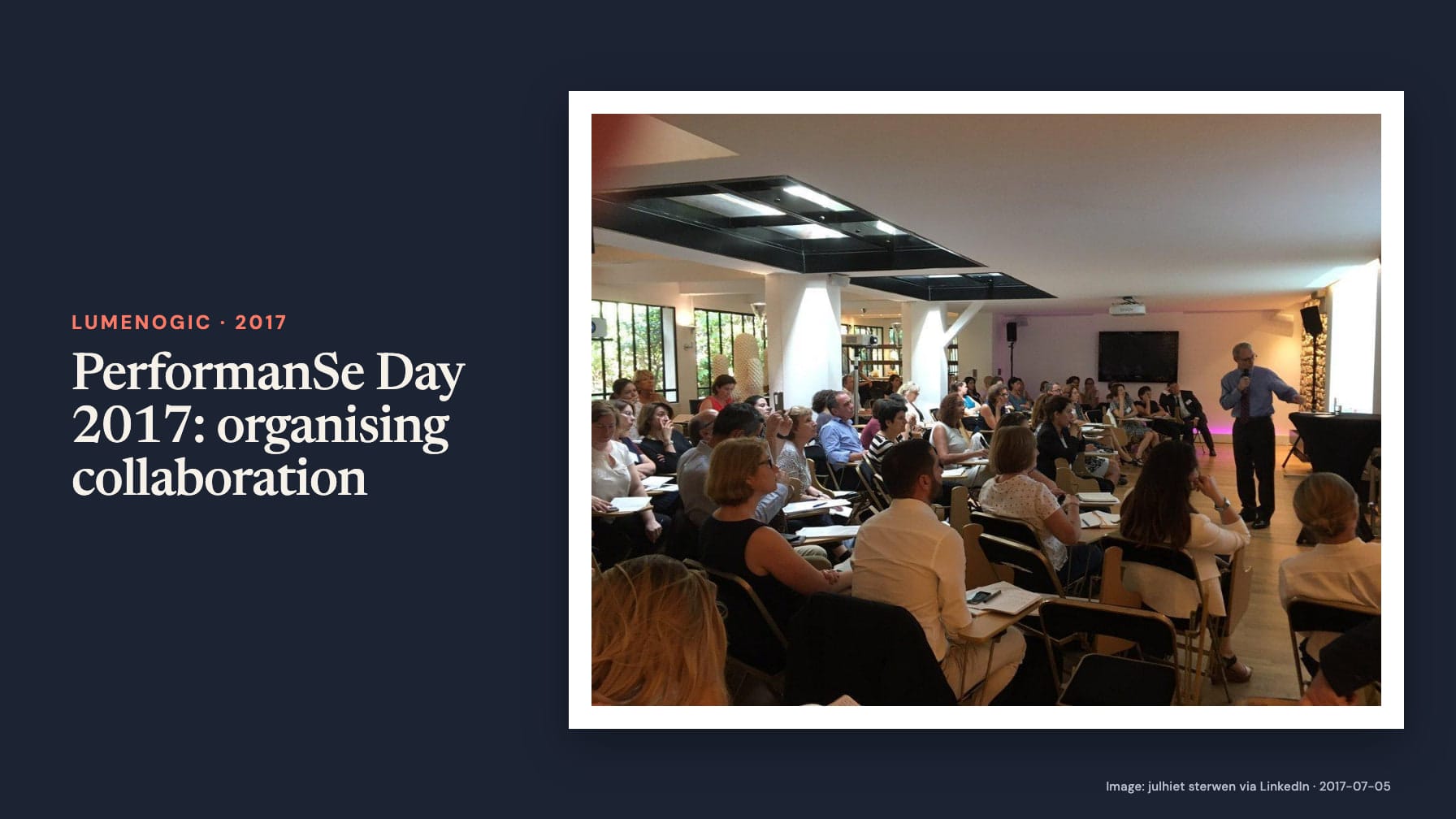
On 5 July 2017, Émile Servan-Schreiber reshared Julhiet Sterwen’s thanks to the speakers and participants of PerformanSe Day. The post described a day devoted to employees and collaboration. Contemporary sponsored coverage in RH Matin, published on 11 July, dates the event to 4 July and reports an audience of more than 90 HR professionals.
The thank-you post named Servan-Schreiber alongside François Geuze, Anne Boinnot, Riadh Lebib, Alexandra Didry and Nadia Nardonnet. It provides a participation record. The later event coverage supplies the substance missing from that short acknowledgement, including a closing conference by Servan-Schreiber on collective intelligence.
A group needs an organising method
According to the sponsored account, he described collective intelligence as a group’s capacity to be more intelligent than its members considered individually. His practical recipe brought together varied perspectives, original thinking, specialised information from the field and an objective way of combining contributions. The account presented these as things an organisation could actively cultivate.
That recipe makes the subject more concrete than an invitation to collaborate. Collecting views is one step; allowing them to remain different and deciding how to combine them are additional choices. For a forecasting exercise, the practical implication is to ask how useful information reaches the shared estimate.
Prediction markets as a tool
The coverage reports that Servan-Schreiber offered prediction markets as one way to organise those contributions. It described an online market in forecasts, where the traded positions concerned future outcomes. His argument was that the approach could help companies make more reliable probability estimates.
The coverage presents a method for bringing judgement together, without a scored corporate forecast from the event. In practice, using that method would require a defined outcome, a deadline and information that participants could assess. It would also require a comparison with what happened, so that the organisation could learn whether its probability estimates were useful.
Collaboration was being discussed as something that could be structured and supported by tools. The journal’s account of the 2017 Futuribles forecasting toolbox examines prediction markets in a different professional setting. PerformanSe Day records that methodological discussion reaching an HR audience, with the organiser’s acknowledgements and contemporary coverage supporting the event history.