
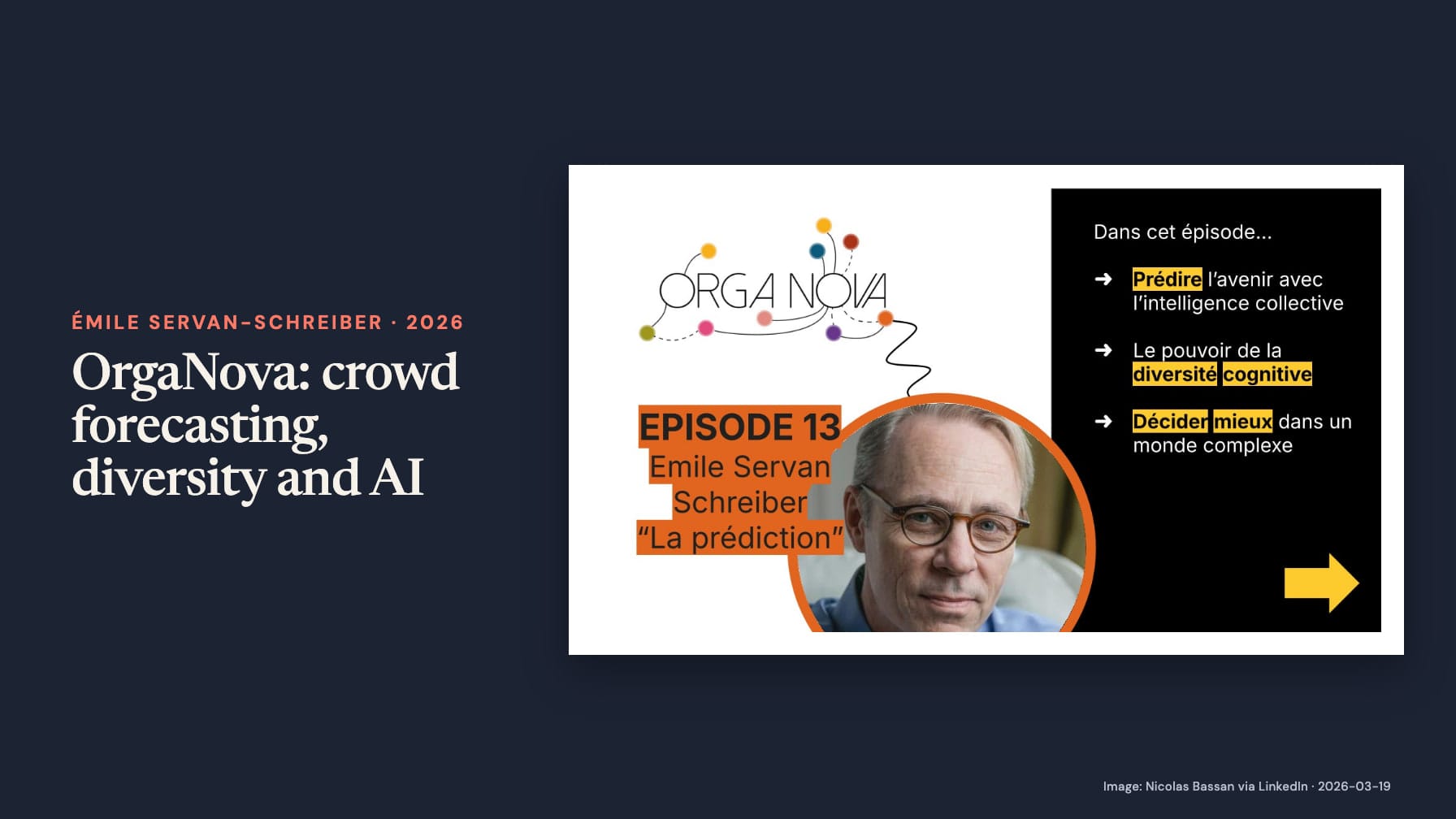
On 19 March 2026, Émile Servan-Schreiber shared Nicolas Bassan’s OrgaNova interview with a comment connecting collective intelligence, artificial intelligence and prediction markets. Bassan’s episode description places forecasting inside everyday organisational choices: anticipating a market, assessing a risk and deciding which innovation deserves investment.
The episode, released on 18 March, is a conversation about how to organise knowledge that no single person possesses. Bassan’s accompanying LinkedIn summary makes the practical argument more specific: the value of a crowd depends on the different information its members contribute.
More people, with diminishing returns
Bassan described the move from one participant to five as a large gain, and from five to ten as still useful. Beyond that, he said, additional gains become marginal. These are the host’s illustrative comparisons, not a published accuracy curve or a universal recommendation to recruit ten forecasters.
The distinction is useful for organisations. Adding another judgement may help when it brings a new source or perspective. Recruiting more people who repeat the same account gives a different kind of input. Group size alone does not tell a decision-maker how much independent information has been collected.
Three conditions for a useful collective
Bassan’s summary names diversity, independence and aggregation. Participants should bring different viewpoints, avoid copying each other and have a process for combining their answers. He contrasts that design with a group that amplifies biases and imitation. His account also lists distributed intelligence, idea prioritisation and AI among the topics discussed.
For an organisation, these conditions turn forecasting into a design problem. What knowledge should participants contribute? Can they form an initial judgement before seeing colleagues’ answers? How will competing estimates be combined? Bassan’s summary offers a framework for asking those questions before deciding that a larger group will necessarily produce a better answer.
A later If This Then Dev interview develops related themes in a separate conversation. OrgaNova’s emphasis, as presented by Bassan, is the organisational choice behind a useful crowd: how to gather complementary perspectives rather than simply increase the headcount.