
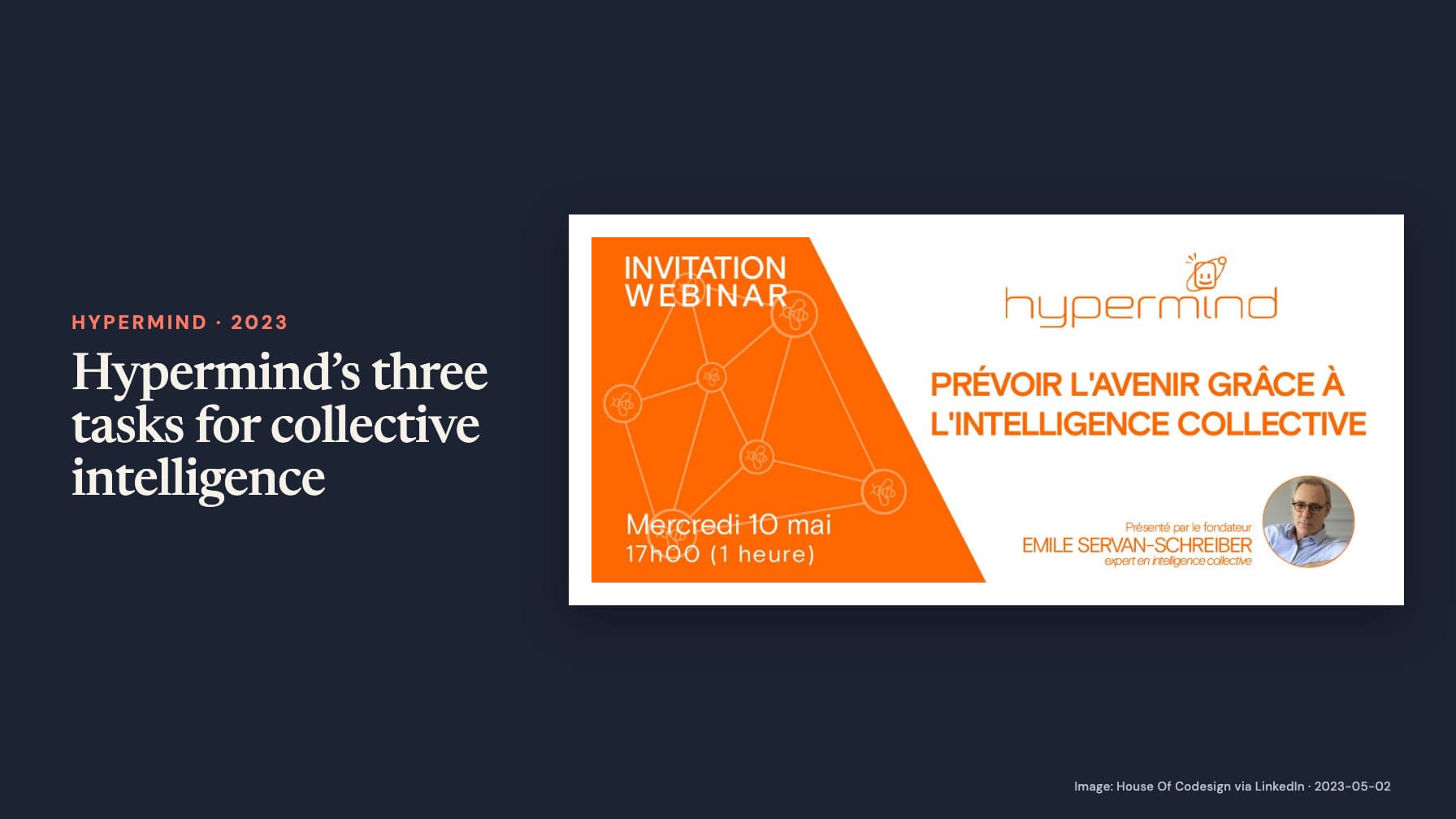
On 2 May 2023, Émile Servan-Schreiber reshared House Of Codesign’s invitation to a webinar scheduled for Wednesday 10 May at 17:00. It advertised an introduction to Hypermind with its founder, covering the principles of collective intelligence and applications for businesses. The attached invitation specified a one-hour session.
The announcement promised demonstrations and concrete examples across three areas: collective forecasting, intelligent brainstorming and collective decision-making. Those are different tasks, even when the same community supplies the knowledge for each. The invitation establishes the planned programme; it does not show which demonstrations were delivered.
Anticipating events and comparing ideas
Forecasting asks what will happen. A useful answer describes uncertainty about a defined outcome, with a date and a way to check the result. Hypermind’s current Prescience documentation describes a platform that gathers individual forecasts, combines them and provides scoring and feedback. It also distinguishes probabilities about discrete outcomes from distributions over numerical quantities.
Brainstorming asks what could be done. Prioritisation then asks which proposed ideas deserve attention. Hypermind’s current Storm documentation describes a process in which participants propose solutions, allocate a limited number of tokens to ideas judged likely or unlikely to succeed, and explain their choices. Decision makers evaluate the ideas that emerge. The company explicitly distinguishes forecasting an idea’s prospects from expressing personal preference.
The product descriptions were checked on 9 October 2026 and clarify the three tasks without establishing the webinar’s exact 2023 feature set. Forecasting, brainstorming and decision-making need different outputs. A forecast expresses uncertainty; a proposed response creates an option; prioritisation directs attention to the options the group considers promising.
The question behind the tools
For a business, the link between the tasks is the movement from uncertainty to action: anticipate possible developments, generate responses and compare them. Our article on prediction markets in the foresight toolbox explains where quantified forecasts fit into that process. The House Of Codesign invitation presented those uses together. Treating them as separate tasks helps an organiser specify what participants should contribute and how decision makers will use the resulting information.