
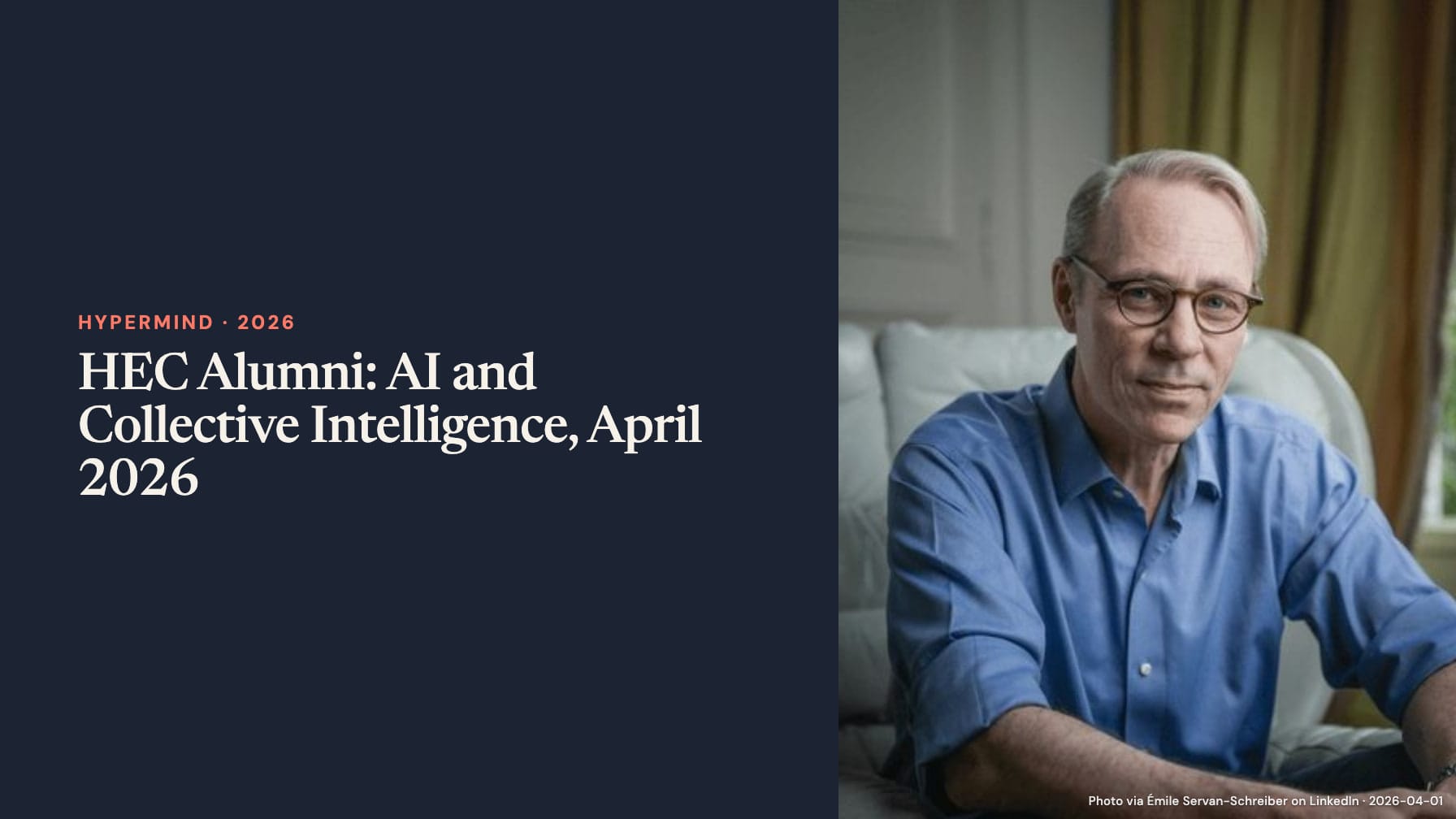
On 18 April 2026, Émile Servan-Schreiber shared a final invitation to a HEC Alumni conference scheduled for 21 April in Paris. Its question was larger than whether AI makes an individual more productive: can it help an entire organisation think and act together? The invitation came from Serge Dautrif and followed two earlier announcements.
The official HEC Alumni programme confirms the third session of its Intelligence Collective Augmentée cycle, organised by the Consulting & Coaching Club. It was scheduled at the Maison des HEC, 9 avenue Franklin Delano Roosevelt, from 18:30. The LinkedIn invitations specified a two-hour event, a livestream and a cocktail afterwards, and said attendance was open beyond HEC graduates.
The risk of making individuals smarter in isolation
Dautrif’s 18 April invitation offered a warning: when everyone consults a personal language model or agent, organisations could end up institutionalising solitude. He also argued that AI could help people strengthen relationships with colleagues, customers and suppliers. That was the proposed debate, rather than a finding that AI necessarily improves or damages cooperation.
The 1 April announcement described Servan-Schreiber’s argument in Supercollectif: group performance depends on how people interact, alongside what individuals know. Listening, sharing speaking time and considering others’ views matter. For collective forecasting, the announcement emphasised three demanding conditions: diverse participants, independent thinking and appropriate aggregation. Without them, a group can slide into conformity.
Cooperation across an organisation
The programme named Servan-Schreiber for a keynote on collective maturity and organisational learning. Other announced contributors included John Hazan of Bain & Company, Marine Laufer-Tourte of BearingPoint, Philippe Armandon of Sopra Steria Next and Father Sébastien Thomas, discussing the Church’s synodal process. Their advertised perspectives ranged from talent and organisational change to supply chains and governance.
For forecasting, the practical issue is how information travels before it becomes a shared judgement. A larger group is useful only if its different observations survive the process of combination. The journal’s discussion of correlation in human and AI forecasts examines a related problem: repeated answers need not represent independent information.